

The US Navy Is Going Next-Gen With Its Autonomous Warfare Program
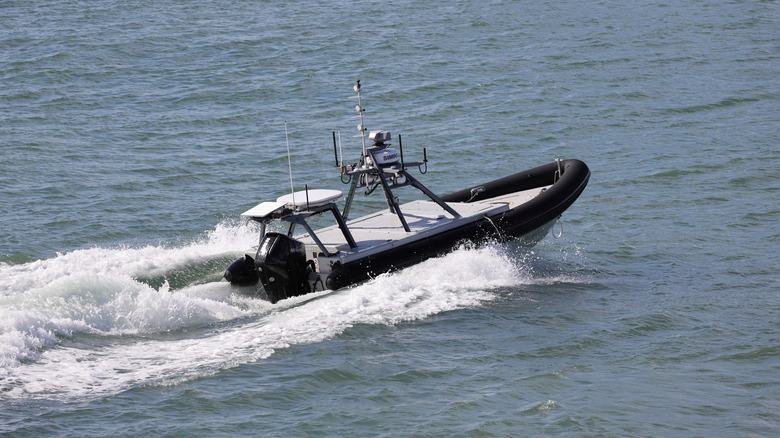
As wartime technology becomes more advanced, the U.S. Navy is launching the Next Generation Undersea Security Initiative (NG-USI), focused on autonomous high-tech systems designed to defend the United States' seas against enemy AI and robotics. The key focus is detecting, tracking, and then defeating systems across land, sea, and sky, including swarms of autonomous drones and AI-driven cyberattacks on security networks.
One focus area of the NG-USI is autonomous surveillance. Leveraging commercial robotics, the Navy hopes to achieve autonomous patrolling, inspection, and response. The prototype technology is looking for solutions around the shore as well as open ocean environments. These technologies will scatter signals, jam electronic warfare, and shield infrastructure.
The Navy hasn't specified which exact systems will be tested and implemented, but these could include sensors on land and underwater, smart cameras that can detect threats, patrolling drones, and unmanned ground vehicles. It has already implemented a solar-powered drone that can patrol the ocean for days, as an example. Companies are encouraged to submit technologies that meet these criteria and can perform autonomous tasks.
Autonomous technology is a huge focus for the U.S. Navy

The NG-USI's autonomous technology focus is nothing new for the U.S. Navy. Autonomous vessels are the next big step in maritime warfare, according to Chief of Naval Operations Adm. Daryl Caudle. While speaking with Bloomberg, Caudle admitted the Navy is not advanced enough in the autonomous and drone fields, but is currently investing heavily in unmanned systems for air, sea, and underwater operations.
The biggest development is the deployment of a fully autonomous vessel that would locate and neutralize mines without putting sailors' lives at risk. This is just the beginning of the Navy's vision of having unmanned ships, unmanned underwater vehicles, and unmanned drones all working together. "We're not just in our respective domains," Caudle said. "We package this like we do in the joint force to solve a real mission problem." The Navy is also looking into an autonomous submarine that can travel long distances underwater and then release autonomous drones. Other countries have been revealing autonomous military technology for a while, including China's landing vehicle and underwater drone.