

This HDMI Cable Allows For The Fastest Speeds, But Do You Really Need It?
We may receive a commission on purchases made from links.
If you're shopping for the right HDMI cable for your TV or monitor, you may have come across the Ultra96 cable. Unless you're a technophile, you may not know that the Ultra96 supports up to 96 Gbps of bandwidth under the HDMI 2.2 specification. This means that this cable can handle extremely demanding video formats and superior resolutions. But is it just too much cable for what you need?
If you're buying HDMI 2.2 hardware capable of using its full 96 Gbps bandwidth, the answer is no. In that case, an Ultra96 HDMI cable is the right choice as it delivers everything you need for some modern PCs, TVs, and other advanced devices. This is especially true if you're using a device capable of 4K at 240Hz, uncompressed 8K at 60Hz, and resolutions up to 16K at 60Hz. The Ultra96 is designed to support these specifications, making it the fastest and highest-bandwidth HDMI cable you can buy.
But if your devices are designed around HDMI 2.1 with 48 Gbps, a cable rated for those specifications is really all you need. The Ultra96 will not give your older devices the best resolution and the fastest speeds because the capability of your equipment is limited to the HDMI standard it was designed to support. However, if you're planning on upgrading your devices in the future, you could swap your current cables for the Ultra96, because they are backward-compatible. That way, you'll be ready when you decide to update your equipment.
What makes the Ultra96 cable different
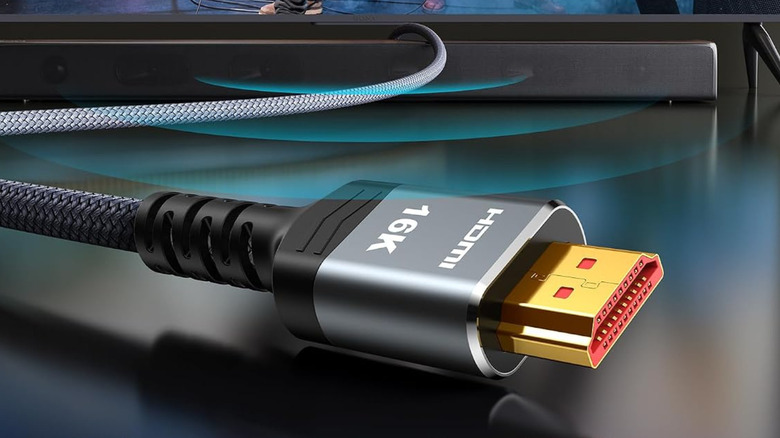
Ultra96 is the latest advancement in the evolution of HDMI technology. Its 96 Gbps bandwidth is a major improvement over the once-standard HDMI 2.0 specification. HDMI 2.0 supported up to 18 Gbps of bandwidth before HDMI 2.1 increased that capability to 48 Gbps. But Ultra96 is designed to support the continued push toward higher resolutions, faster refresh rates, and more demanding video applications.
However, the Ultra96 certification goes beyond just bandwidth. Ultra96 cables are classified as Category 4 HDMI and must go through a testing phase to verify they can meet the full 96 Gbps specification. They are also tested for low electromagnetic interference, which helps reduce the possibility of interference with wireless networks and other electronic devices. But while the Ultra96 cable itself is designed to support the full 96 Gbps bandwidth, HDMI 2.2 devices can often be a bit more complicated.
That's because unlike HDMI 2.1, HDMI 2.2 includes a few different bandwidth tiers, including 64 Gbps, 80 Gbps, and 96 Gbps. This means that a device bearing an HDMI 2.2 designation may not necessarily support the full performance available from an Ultra96 cable. As a result, consumers will need to pay attention to the specific bandwidth, as well as features, supported by their devices. Otherwise, they could end up with an HDMI cable that goes beyond the capabilities of their equipment.