

Is A 30 Amp RV Plug The Same As A Dryer Plug? Here's What You Need To Know

While there are a variety of different RVs and campers, most of them in the U.S. run on a hybrid 12V DC/120V AC electrical system, and they require a 30 amp or 50 amp service when plugging into grid power (or shore power, as some call it). Smaller RVs are usually 30A models, while bigger RVs with multiple AC units require a 50A service. Most modern RV parks will accommodate both, but it's relatively common to use adapters –- such as a 50A to 30A 125V adapter, or vice versa –- if a receptacle is damaged or the appropriate one isn't available, and provided you exercise safety and caution.
A common question regarding 30A RVs is whether they can be plugged into a dryer outlet – the answer is always no. The confusion stems from older homes that may still use a 3-wire dryer plug. The NEC began requiring a 4-wire dryer receptacle in 1996, but that only applies to new construction. For the uninitiated, a 30A RV receptacle and a 30A dryer receptacle may seem the same, but you wouldn't have to spend long looking through forums to find out what would happen should you make that assumption. But I'll save you some time: the voltage overload would kill the converter/charger, and likely a number of 120V appliances, like microwaves and ACs.
Attempting to power your RV from a 30A/240V plug would at best ruin the RV, and at worst start a fire. This is because a dryer always runs at 240V, and a 3-wire plug doesn't change that, but means the ground and neutral paths are combined. Here's what you need to know.
Understanding the difference between 30A/125V and 30A/240V
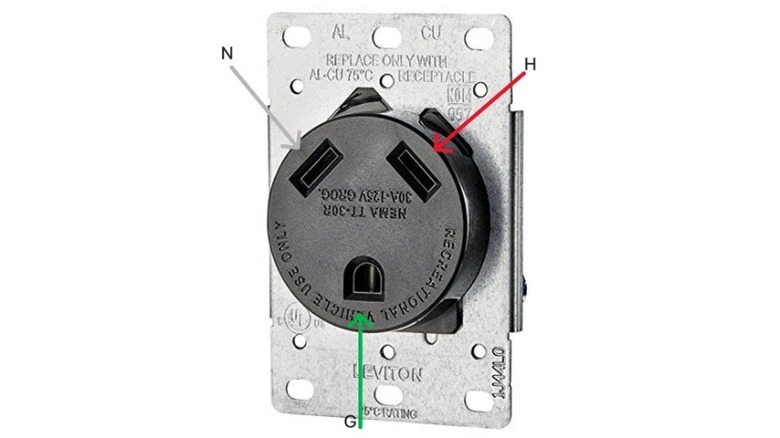
As mentioned earlier, homes existing before 1996 – and there's a lot of those – are going to be using a 3-wire cable to supply the dryer, which means there will be a 3-wire dryer receptacle in the form of a 30A/240V, also known as a NEMA 10-30R. The exception to this would be if the home has been updated to include a 4-wire cable and the appropriate 4-wire receptacle (NEMA 14-30R). A 30A/240V receptacle will usually have an L-shaped ground pin, while the 125V variants have a U-shaped ground pin.
For a 30A RV or trailer, the receptacle you want will always be a NEMA TT-30R. This configuration provides a hot, neutral, and ground. While 30A/240V to 30A/125V cord adapters do exist, I would not recommend them –- they are of dubious quality and function. I even hesitate to recommend the more common adapters that I mentioned previously, even though I have seen them widely used. I have also seen them melt if they are not used carefully.
An adapter should never be used in place of a permanently installed 30A/125V circuit, but should you have to use one, it needs to be temporary. You also need to be conscientious about the loads you are running while using an adapter and limit high wattage loads as much as possible. There's no shortage of electrical mistakes you don't want to make in your home, and this too, is one of them.