

Only One Man Got To Fly NASA's X-15 Rocket-Powered Plane & The Space Shuttle
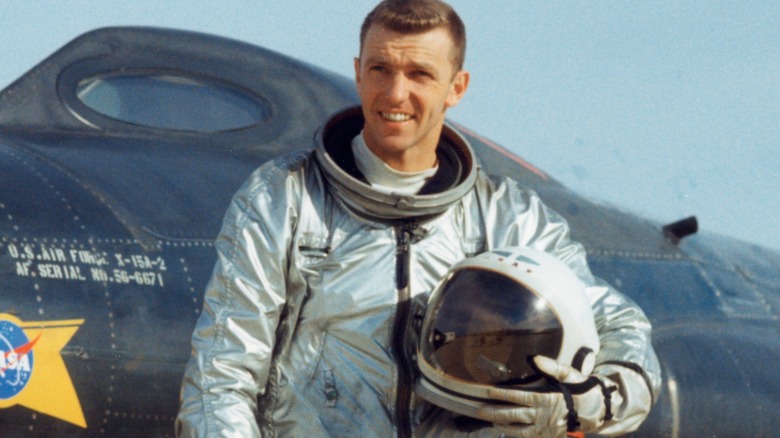
With planes like the now-famous Lockheed-designed SR-71 Blackbird and the U-2 Dragon Lady capable of flying at extremely high altitudes, touching the edge of space is something that a handful of aviators have actually managed to do. Crossing that barrier in a winged vehicle is an incredibly rare feat, though, and only one pilot managed to do so in two of the U.S.' most iconic vehicles.
In 1965, then-Capt. Joe Engle flew the rocket-powered X-15 plane at altitudes of over 50 miles on three flights, crossing the Kármán line – the height that NASA, the U.S. military, and the National Oceanic and Atmospheric Administration designate as the boundary between the atmosphere and space — and earning his astronaut wings in the process. This was just the start of Engle's impressive achievements, though, because he went on to join NASA's astronaut program in 1966. He joined during the legendary Apollo program and could have landed on the Moon, but he never got the chance.
Engle remained with NASA, though, and he eventually got to do something few people ever achieve: fly the Space Shuttle. This makes Joe Engle the only person to fly the X-15 and the Space Shuttle, placing him among the nation's aviation greats like Scott Crossfield and Neil Armstrong, both of whom also flew the incredibly fast X-15. Still, only Engle flew two winged vehicles into space, setting him apart even from such esteemed company.
Capt. Joe Engle's X-15 flights
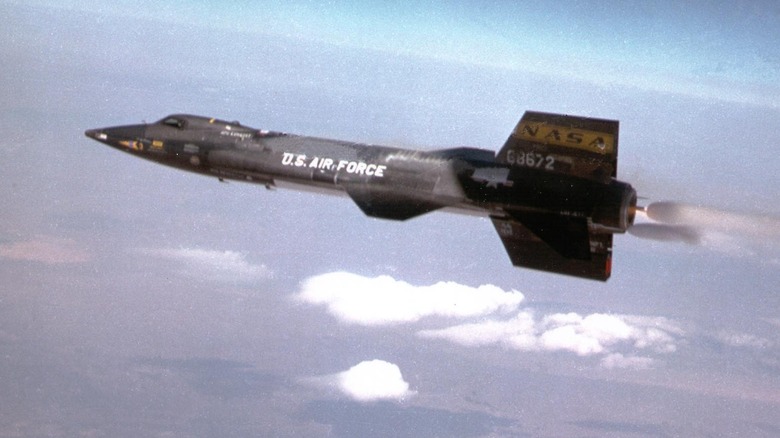
The X-15 Hypersonic Research Program was a joint effort between the National Advisory Committee for Aeronautics (later, NASA), the U.S. Navy, the U.S. Air Force, and North American Aviation Inc., which built the plane. The goal was to study piloted hypersonic flight, and the information learned from the program helped to directly influence the design of the Mercury, Gemini, and Apollo programs' vehicles. It also influenced the Space Shuttle's design and operation.
Capt. Joe Engle joined the X-15 program in June 1963, though he initially hoped to be selected for NASA's astronaut program. The Air Force pulled that request, sending him to Edwards Air Force Base in California to test the X-15 instead. While Engle is probably best known for flying above the Kármán line three times, those flights were only a small part of his total time in the X-15. Engle flew the X-15 16 times before finishing with the program in October 1965.
On February 2, 1965, Engle took the aircraft to Mach 5.7 (3,866 mph), while his highest-altitude achievement in the X-15 came on June 29, 1965, when he soared up to 280,600 feet, or 53.1 miles. His flights were also exciting in other ways, too; on his first flight, which was also his shortest, Engle lost radio contact with a B-52 and performed an unauthorized 360-degree roll on his flight back to Edwards AFB.
Astronaut Joe Engle's Space Shuttle missions
In 1966, Joe Engle was one of only 19 "Spacemen" selected by NASA for its astronaut program. He began with the agency as support for Apollo 10, and later became the backup Lunar Module Pilot for Apollo 14. He didn't get the opportunity to fly, however, as Edgar D. Mitchell performed the mission without the need for a backup. After that mission, Engle became the primary Lunar Module Pilot for Apollo 17, but NASA bumped him for Harrison H. Schmitt.
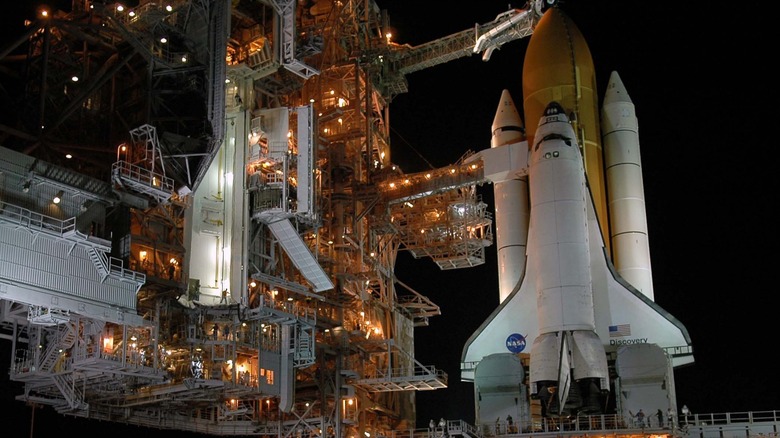
That was the closest Engle got, as NASA abandoned the Apollo 18 mission. As of writing, nobody has returned to the Moon's surface, though NASA plans to return via the massive Artemis Moon Rocket by 2028. After losing out on the Apollo program, Engle commanded STS-2, the second test flight of the Space Shuttle, which took place in 1981. That was only a test flight, though it gave Engle vital experience with the newly developed reusable shuttle while setting him up for his eventual command of STS-511, the 20th Space Shuttle mission and sixth flight of Space Shuttle Discovery.
Engle remained a member of the Air Force until he retired in 1986 at the rank of colonel. He retired the same year from NASA, but later accepted the rank of brigadier general in the Kansas Air National Guard. In 1991, Engle retired from the Air National Guard as a major general and was honored as an inductee of the Aerospace Walk of Honor, the Astronaut Hall of Fame, the Kansas Aviation Hall of Fame, and the National Aviation Hall of Fame.