

This Is The Fastest Speed Ever Recorded For A Man-Made Object
In 1986, Maverick and Goose uttered the now iconic line, "I feel the need... the need... for speed!" In the original "Top Gun" film, the pair of naval aviators flew a Grumman F-14 Tomcat, which had an advertised top speed of 1,544 mph. In other words, it could hit Mach 2.34, but that was at 40,000 feet. Its speed dropped precipitously at sea level, where it only reached 912 mph, or Mach 1.2. That's cute, at least when it comes to fastest speed ever recorded for a man-made object, but that's not the Tomcat's fault since the physics of Earth's atmosphere keeps it in check.
At sea level, the speed of sound sits at around 761 mph (or 1,100 feet per second), and the current Outright Land Speed Record stands at 763.035 mph, so just a skoosh above Mach 1. Meanwhile, a bullet can travel at up to 2,727 mph. All of these are fast, but still, nothing goes faster than things in outer space. Our baker's dozen of fastest human-made objects in space includes one such object that trumps all the rest.
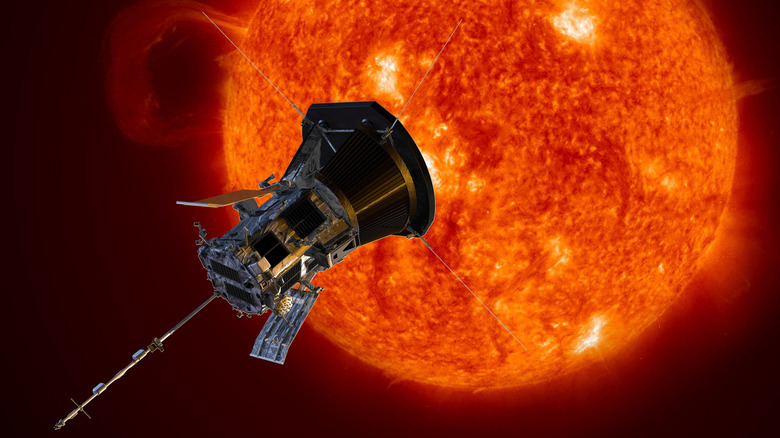
NASA's Parker Solar Probe launched on August 12, 2018. Its primary mission, which is still in progress, is to circle the Sun and collect data not only about its corona, but help determine the origin and evolution of solar wind. At the time of this writing, it was traveling at 37,755 mph (Mach 49.2). That's nothing compared to the mark it set on Christmas Eve 2024, when it shot by the Sun at the record-setting speed of 430,000 mph (Mach 560.43).
The need for speed continues
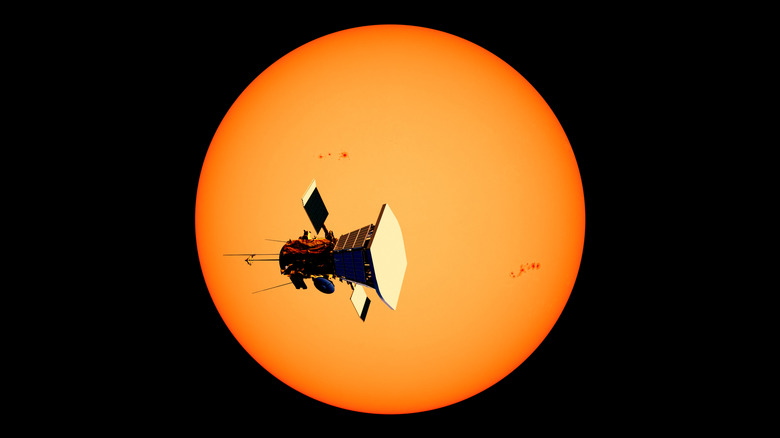
Since then, it's hit that same record-shattering mark of 430,000 mph not once, not twice, but five times, with the most recent occurring on March 11, 2026. For a frame of reference, at that speed you can get from Philadelphia to Washington, D.C., in one second flat. What's more, Parker will — if everything goes according to plan — match that speed every time it flies by the Sun, until the mission is deemed complete in 2029. On June 8, 2026, Parker made its 28th close approach to the Sun, which holds many secrets, including that it "woke up" in 2008 and has been more active since.
While Parker used a Delta IV-Heavy rocket to launch, it's not what powers the speed records; instead, it relies on a process called gravity assist, along with the Sun's immense gravity. The probe uses seven carefully calculated flybys of Venus to first shed orbital energy, which acts as a brake, causing it to drop closer to the Sun. As Parker falls deeper into the Sun's massive gravitational well, it picks up speed just like a roller coaster dropping down that first big hill. By the time it reaches perihelion — its closest approach — it's breaking records.
But that's not the space probe's only great achievement. On December 14, 2021, Parker flew through the Sun's upper atmosphere (the corona), coming closer to the surface than any other spacecraft, where it touched the Sun, so to speak. At its closest point, NASA says the heat shield reaches temperatures of about 1,700 degrees Fahrenheit. How? Parker is protected by cutting-edge thermal engineering, in this case, a 4.5-inch-thick carbon-composite heat shield, designed to handle temperatures upwards of 2,500 degrees Fahrenheit.