

Why Do Speed Limit Signs In Oklahoma Say 'No Tolerance'?
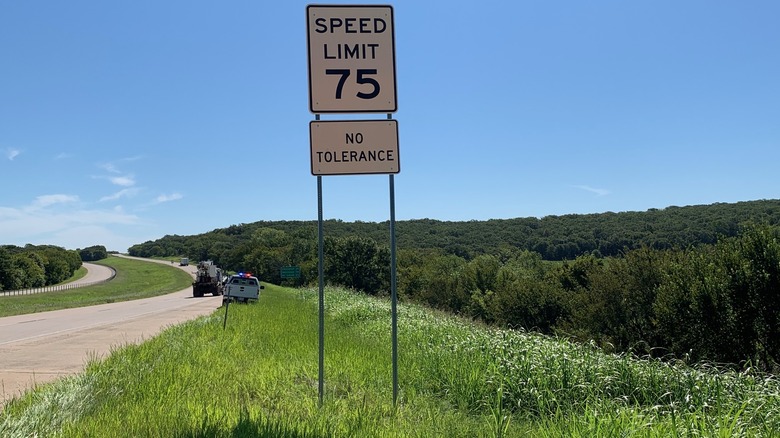
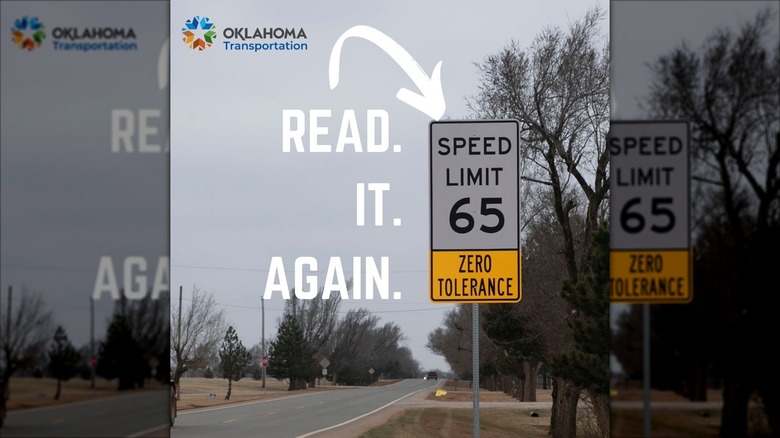
For many, the terms "zero tolerance" or "no tolerance" might bring to mind any number of laws aimed at drugs or alcohol, immigration policies, guns on school grounds, or unacceptable behavior in the workplace. It's become the catch-all for prohibiting something under any circumstance. However, if you're driving on the highways in Oklahoma — where a huge stretch of the famous Route 66 can still be driven – you might see these words plastered on speed limit signs and wonder what they mean.
Oklahoma has two types of speeding laws. The Absolute Speed Limit Law states that if you're going any faster than the posted limit, you're violating that law. Any speed — even 1 mph — above that is considered illegal, hence the zero/no tolerance verbiage on signs. The Basic Speeding Law requires motorists to drive carefully at all times, taking into account factors like traffic volume, highway width, and weather conditions. For example, driving down a stretch of road during the day in clear weather with little traffic at the posted 55 mph limit is not the same as driving that exact stretch at night in poor weather with traffic where cruising at 55 mph could be perceived as breaking the law.
In 1998, the Oklahoma Turnpike Authority began a public safety campaign featuring the zero/no tolerance signs along Oklahoma's turnpikes. In 2012, the state initiated the Highway Safety Corridor Project on three roads in Pottawatomie County with the highest accident rates. At the time, the Oklahoma Highway Patrol was instructed to ticket anyone going even the slightest bit over the posted speed in a given stretch.
It's best to stick to the speed limit
Absolute speed limits in Oklahoma typically occur in most school zones (25 mph), state parks and wildlife refuges (35 mph), and most county roads (55 mph). According to Title 47 of the Oklahoma Statutes, a fine for speeding between 1 and 10 mph over the limit is $10.00. From there, speeds go in increments of 5 mph up to 36 or more over the limit, which carries a much heftier fine of $205. Plus, going 36-plus mph over could land you in jail for up to 10 days. A second conviction within one year ratchets jail time up to 20 days, while a third or more convictions (within one year after that first conviction) can go up to as much as six months.
But what about inaccurate speedometers that aren't set or calibrated correctly? You do have the legal right to contest a speeding ticket in Oklahoma, even one where you're barely going over the limit. However, because of the state's Absolute Speed Limit Law, it's a good idea to contact an attorney before going to court.
According to the Oklahoma Department of Transportation, it's the driver's responsibility to obey traffic laws, and you'll probably need to prove your speedometer was set wrong or that the officer's equipment was faulty. If it's your first ticket, or it's been a while since you had one, you might be able to request a deferred sentence, a reduction in the fine, or take a defensive driving course. Policies vary by county or municipal court, so you'll need to check with the court listed on your ticket. Oklahoma also happens to be one of the few non-car title-holding states.