

What Is A 'Jellyfish' Drone Swarm, And Why Are They Considered So Dangerous?
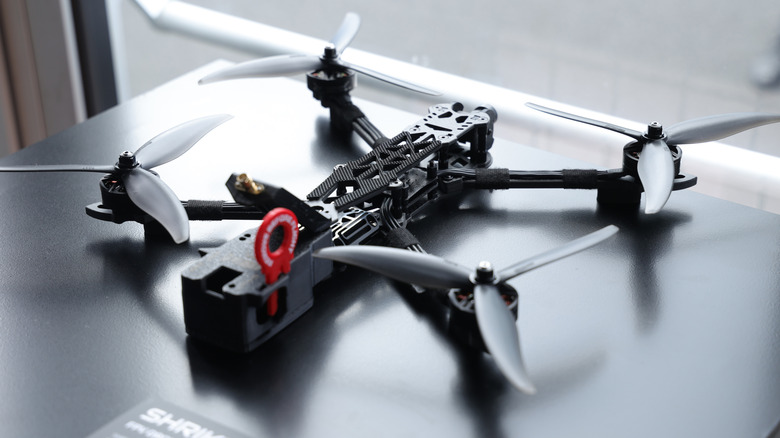
When a U.S. Air Force F-15E Strike Eagle was shot down over Iran during Operation Epic Fury, one detail from the pilot's subsequent debrief quickly captured the attention of military analysts. According to multiple sources familiar with the report, the pilot described witnessing what appeared to be a vast number of drones moving together in a formation resembling a "jellyfish". Larger unmanned aircraft reportedly occupied the center of the formation, while smaller drones hung beneath them like tentacles, all maneuvering as though they were a single organism rather than a collection of independent aircraft.
Intelligence officials remain divided over exactly what the pilot saw, particularly as he had suffered a concussion during the ejection, meaning the account should be treated as an intriguing report rather than confirmed evidence of a revolutionary capability. However, whether or not the jellyfish swarm proves real, the underlying concept certainly is. Drone swarms, large groups of unmanned aircraft autonomously completing tasks without relying on persistent command guidance, already exist.
In civilian life, this technology has become synonymous with spectacular drone light shows, where thousands of aircraft create moving images across the sky with remarkable precision. In military circles, however, the same principles enable autonomous reconnaissance, electronic warfare employment, and target identification on a scale that would overwhelm a human operator.
The distinction here is important. Whereas entertainment displays generally follow pre-planned flight paths, military swarms require deeper on-board decision-making functions to address the complexity and decision-making tempo of combat. It is through this demand for real-time battlefield perception and adaptation that a scalable, autonomous, and weaponized swarm is making substantial progress towards becoming science fact.
Swarming isn't new, but it is evolving

The idea of swarming drones has been under serious military development for almost a decade. One of the first major demonstrations came in 2016 when the U.S. Department of Defense unveiled the PERDIX program. During the trial, 103 micro-drones were released from a pair of F/A-18 Super Hornets before autonomously organizing themselves into a distributed swarm. Rather than acting as individually programmed aircraft, the drones collectively made decisions, adapted their formation, and even demonstrated self-healing behavior by reorganizing as members of the swarm were lost. Significantly, there was no single node acting as the brain, instead, cognition was distributed across the entire network.
Today, drone displays involving hundreds, or thousands, of units have become commonplace. In May 2026, Chinese company Yufengzhe Technology set a new Guinness World Record by flying an astonishing 33,615 drones simultaneously over Dujiangyan City. While intended purely as entertainment, this demonstrated just how mature large-scale swarm management has become. Thousands of individual aircraft can now be coordinated reliably, safely, and with centimeter-level precision.
In the military domain, the significance of these developments lie in their network resilience. Modern swarms use mesh networking, allowing every drone to relay information through neighboring aircraft. Unlike conventional military formations, there may be no obvious command node whose destruction causes the entire system to collapse. Instead, the swarm continually reconfigures itself, making traditional targeting strategies far less effective and dramatically increasing the survivability of the swarm as a whole.
How a 'Jellyfish' swarm could change the battlefield
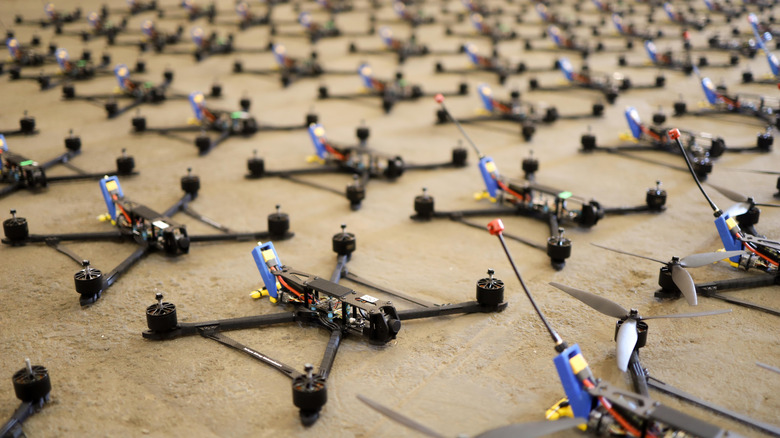
The military value of drone swarms extends far beyond simply employing a large number of airframes. Defensive swarms could function as airborne minefields, creating persistent barriers that threaten enemy aircraft while simultaneously carrying electronic warfare payloads capable of jamming radars, spoofing sensors, or generating false targets. Rather than defending a fixed point with missiles, future militaries may deploy constantly shifting clouds of autonomous drones that reshape themselves in response to incoming threats. If employed offensively, a mass of inexpensive, mesh-networked drones could simultaneously conduct reconnaissance, perform electronic attacks, and deliver precision strikes, saturating and crippling adversary defenses. Through sheer mass, a swarm of cheap, simple, commercially available drones can become a highly coordinated combat system capable of defeating state-of-the-art military defenses.
This is where the reported jellyfish formation becomes particularly interesting. If the pilot's observations were accurate, it would suggest something beyond a simple distributed swarm. Instead of every drone being broadly equal within the network, this report hints at a tiered command architecture, with larger aircraft acting as intermediate command nodes directing groups of subordinate worker drones.
If such a capability were fielded outside of testing, it would represent a significant evolution in autonomous warfare, moving artificial intelligence beyond basic task execution toward more advanced forms of battlefield decision authority and autonomous coordination. While there is currently no public evidence that any military has deployed such a capability, the possibility of this kind of advancement is precisely what has generated significant interest following the pilot's remarkable account.