

What Fuel Type Do Most Nuclear Reactors Primarily Use?
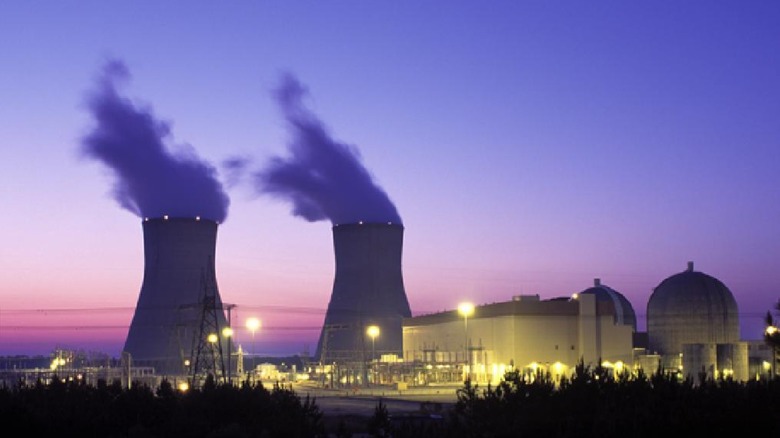
Nuclear power has been around since the 1950s, transforming radioactive material into energy through a complex process. In some cases, nuclear power has proven incredibly beneficial, while in others, like the Chernobyl and Fukushima nuclear disasters, it was much the opposite. Regardless, nuclear power is one of the cleanest, most efficient, and safest energy production means in the world, but unless you're a nuclear engineer, odds are you don't know how it all works.
It's clear that nuclear power plants use some kind of fuel, but what exactly is being used to produce energy? The answer is uranium, but it's not as simple as pointing to that one element on the Periodic Table and ending the discussion. The most common fuel used in the world's nuclear reactors is U-235, a specific type of naturally occurring uranium that's capable of sustaining nuclear fission easily, which makes it useful for energy production and nuclear weapons. When an element is fissile, that means that it can sustain a nuclear chain reaction after capturing slow-moving neutrons.
U-235 is the most common fuel used in nuclear reactors, primarily because it fissions easily. This means that when U-235 atoms split via fission, they release a great deal of energy, much of which is in the form of heat. This is used to convert liquid water into steam, driving a steam turbine, which is how a radioactive material produces energy. Granted, it's more complex than that, but generally, that's how nuclear reactors work: they utilize fissionable fuel — U-235 — and convert its heat into electricity via a turbine.
U-235 and its use in producing electricity
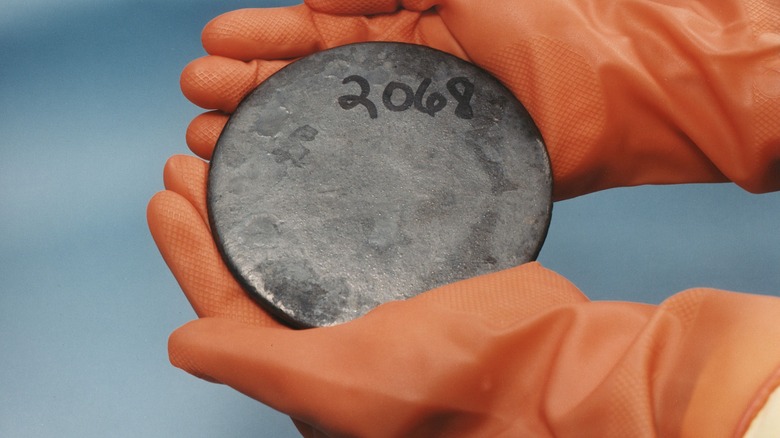
U-235 is ideal for nuclear reactors, but it's not the most abundant form of uranium. That distinction belongs to U-238, which isn't great for nuclear power. This is due to the even number of protons and neutrons in the atom's nucleus, making it less fissionable than U-235, though it is fissile only through high-energy neutrons. For this reason, U-238 isn't a suitable fuel for a reactor. While U-235 is the best option, it's difficult to mine and refine.
U-235 is so named for the total number of protons and neutrons in its nucleus, which come to 92 and 143, respectively. The element has a half-life, meaning the time required to reduce its radioactivity by half, of 704 million years. To use U-235 as a fuel source, it must first be mined and enriched. The concentration of U-235 is so low that enrichment is necessary to produce usable, fissile fuel, which is manufactured into fuel rods. These are metal tubes filled with pellets of uranium oxide. This is then used in nuclear reactors to generate heat, producing energy.
Nuclear fuel lasts a while, but it degrades over time, and the United States' nuclear power plants don't reprocess and reuse their fuel. It's less expensive to mine and refine newly acquired U-235, and there are other ways to utilize spent fuel. Instead, the spent fuel is stored through a complex disposal process that sees it through multiple steps, depending on its level of radioactivity, requiring years of management and maintenance to ensure safety, as spent fuel contains around 90% of its original energy.