

What Was The Top Speed Of The Original 1938 Volkswagen Beetle?
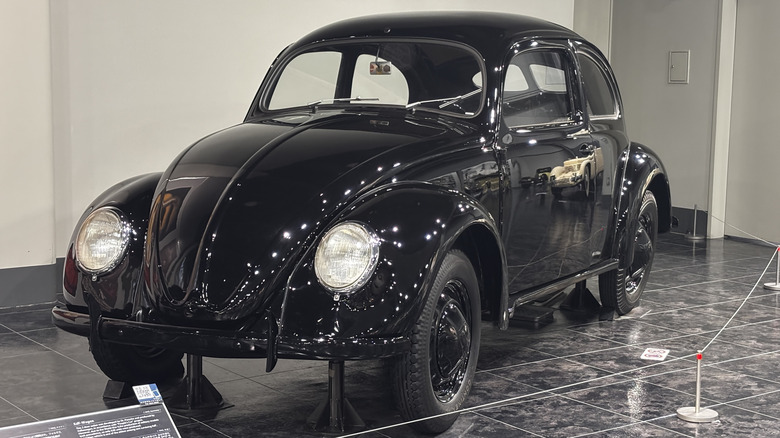
In February of 1939, the first production Kdf-Wagen debuted at the Berlin Motor Show. This bug-shaped oddity was equipped with a 22.5 hp 0.9-liter engine, and it had a top speed of 62 mph (100 kph). A 1938 brochure for the vehicle claims it could carry 661 pounds of cargo (at sea level) in first gear at 12 mph and climb a 32-degree hill.
Second gear allowed it to clamber up an 18-degree incline at 25 mph, while third pushed it to 40 mph on a 9-degree slope. Finally, fourth gear reached the top speed of 62 mph on flat ground. Acceleration from zero to 37 mph (60 kph) was done in 14 seconds. A different brochure states the air-cooled engine produced 23.5 hp and used just 1.5 to 1.8 gallons per 62 miles (based on driving style and terrain).
Later that year in September, Nazi Germany invaded Poland, which is important to know, because manufacturing never really got off the ground until after World War II. In 1946, Volkswagenwerk GmbH was placed under British control and production resumed on what was named the Type 1. This is, of course, what would become the world-famous VW Beetle.
From the outset, Hitler wanted it to seat two adults and three children, have room for some suitcases, and reach 62 mph (100km/h). The little car — developed by Dr. Ferdinand Porsche – was quite adept given its joyfully odd-for-its-time appearance, and it eventually sell nearly 22 million units before the last one rolled off the assembly line at Volkswagen's plant in Puebla, Mexico, on July 30, 2003. Many of those classic VW Beetles are still worth buying today.
Hitler and the Beetle
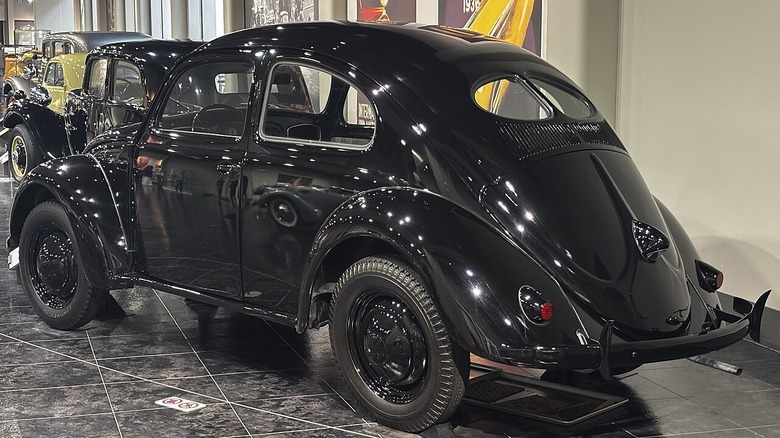
The number of Kdf-Wagen's built before WWII is somewhat of a mystery. Some sources claim only 210 were built. Still, others say as many as 630 rolled off the production floor before Volkswagen had to cease civilian production and shift gears to build military vehicles for Hitler and the Nazis. Whatever the number, Hitler was said to have received the very first convertible, while many of the others were given to his military officers as personal cars.
In May of 1938, Adolf Hitler ordered the German Labour Front (DAF) to hold a showy ceremony to lay the foundation for Volkswagen's new plant in what is known today as Wolfsburg. They rolled out three versions of what was known internally, at the time, as the Porsche Type 60, so the 50,000 attendees could get a look at a sedan, a roll-top sedan, and a convertible. Although Hitler didn't design the car, he did play a significant role in its creation. He labeled it the "Kdf-Wagen," the abbreviation standing for Kraft durch Freude, or strength through joy in English, a DAF organization created to control workers' leisure time while spreading propaganda (and hopefully more support) for the regime.
Interestingly, Hitler's staged press event was so big that the New York Times reported on what transpired, and, by all accounts, it was the first time the word beetle was attached to the car. The article inferred that Germany's Autobahn would soon be packed with "thousands of thousands of shiny little beetles." In other countries it was called Vocho, Coccinelle, Fusca, or Maggiolino, and Käfer in Germany.