

Toyota Corolla Cross Vs Cross Hybrid: Is The Drivetrain The Only Difference?
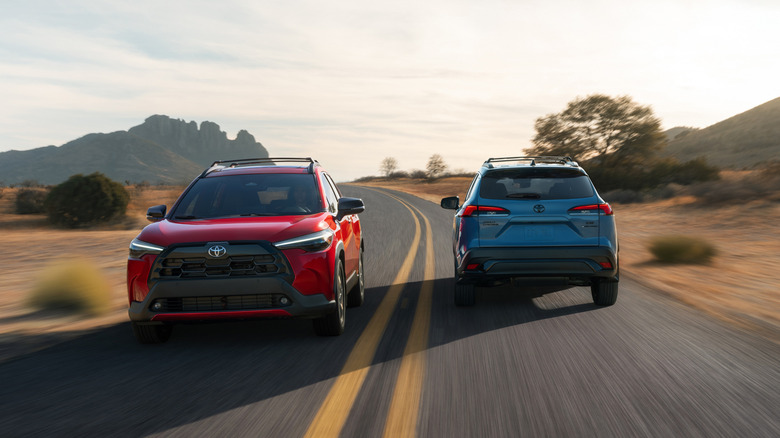
To hybrid or not to hybrid. That's a question that many potential Toyota buyers have to answer, with the majority of the brand's vehicles offering at least some form of electrification. On some of its popular models, like the redesigned 2026 RAV4, Toyota has made the choice for you by switching to a hybrid powertrain across the board, but some models still let buyers choose between hybrid and non-hybrid drivetrains.
The Corolla Cross subcompact crossover, the cheapest SUV that Toyota currently offers in North America, is one of those models. As you'd expect, the non-hybrid Corolla Cross is the cheaper version, with a 2.0-liter, naturally aspirated four-cylinder engine that makes 169 horsepower, mated to a continuously variable automatic transmission.
The more expensive Corolla Cross Hybrid also has a 2.0-liter four-cylinder engine, but has better fuel efficiency and more horsepower — 196 hp combined — thanks to its electric assistance. The Corolla Cross Hybrid also has all-wheel drive as standard, along with an improved rear suspension design. Toyota also styles the hybrid and non-hybrid models differently, which gives each version its own personality.
It's about more than just fuel efficiency
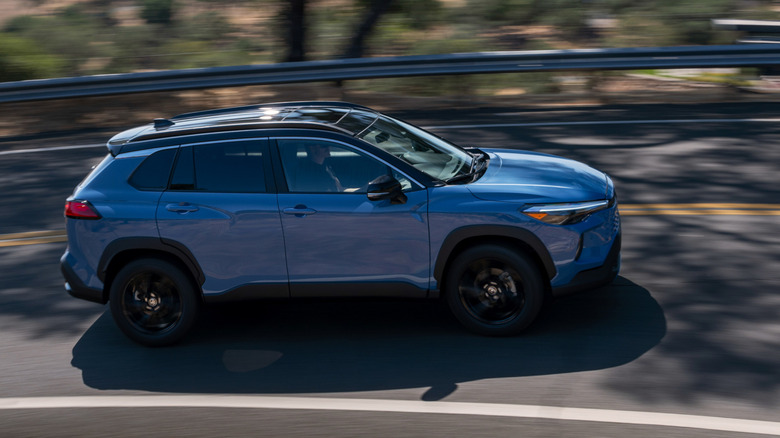
The least expensive Corolla Cross in the lineup is the gasoline-only Corolla Cross L, which, for 2026, has an MSRP of $26,830 after destination. In its standard form, the non-hybrid Corolla Cross comes with front-wheel drive, though all-wheel drive is an option. This raises the price to $28,130, also after destination. Notably, opting for all-wheel drive (which is standard on the hybrid) also gets buyers a more sophisticated multi-link rear suspension, compared to the twist-beam setup on the FWD version.
The least expensive 2026 Corolla Cross Hybrid is the S trim, which comes in at $31,190 after destination and includes a standard electronic all-wheel-drive system. This makes the entry-level Corolla Cross Hybrid about $3,000 more than the comparable gasoline Corolla Cross L AWD – which uses a more traditional mechanical system. The price differential remains as you climb the trims, although our review of the 2026 Corolla Cross Hybrid XSE found it to be one of the best new car choices for budget-minded buyers even then.
The updated 2026 Corolla Cross Lineup has a distinct styling difference between the non-hybrid L, LE, and XLE trims and the hybrid S, SE, and XSE trims. Equipment more or less remains the same as you go up in trim, but the non-hybrid models have a more traditional, rugged SUV look, while the hybrids get a sportier look, with a color-coded front grille and unique wheel designs.
The hybrid just makes more sense
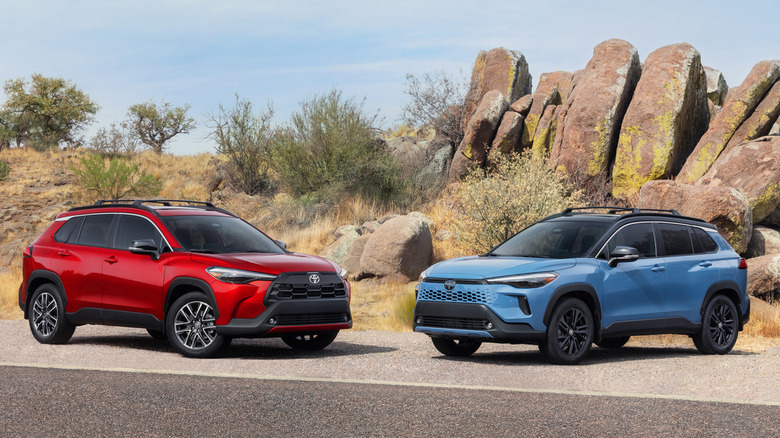
While the Corolla Cross Hybrid's added electric torque and horsepower bump over the non-hybrid model is noticeable, it's, of course, fuel economy where the Hybrid really establishes itself. With an EPA-estimated 42 mpg combined compared to 30 mpg for the non-hybrid AWD model, the former should offer noticeable savings in the long term.
While some might be drawn to the gasoline version's lower price, those potential fuel savings could be enough to entice many buyers to spend the extra few grand on the Corolla Cross Hybrid. There's also the depreciation factor to consider. The Corolla Cross is known for having excellent resale value, and opting for the more powerful, more fuel-efficient hybrid model should only help in that regard.
The next generation of the Corolla Cross could follow models like the Camry and RAV4 by going hybrid-only, but for now, Toyota still gives buyers a choice. We think most buyers will find that the Corolla Cross Hybrid's much-improved fuel economy, added horsepower, and superior resale value make the hybrid's modest price premium well worth it.