

What's The Difference Between A UV Light Flashlight And Black Light Flashlight?
We may receive a commission on purchases made from links.
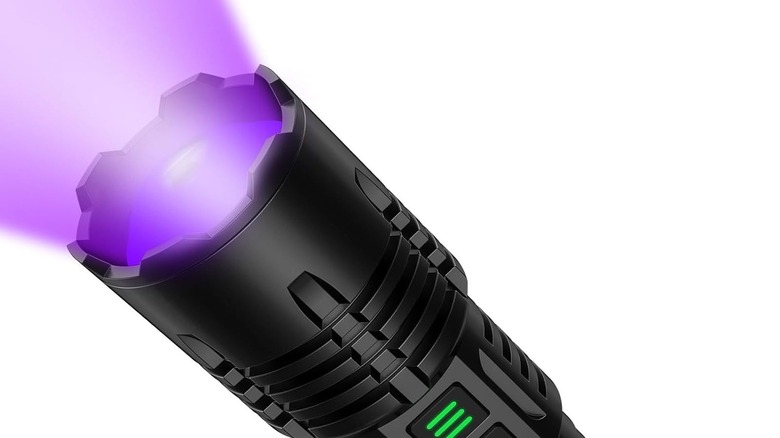
Anyone who has ever watched a movie or a TV show knows UV flashlights are a great crime-solving tool. However, they can be pretty useful at home as well, like for pet owners to find any hidden stains from their little furry friends or when you want to do some deep cleaning. That said, when shopping for a UV flashlight, you probably encountered terminology like "UV light" or "UV black light". So, what's the difference? In short, for consumers, there isn't one. Both emit long-wave UVA radiation, and a black light flashlight is basically a UV light flashlight.
You see, all black light flashlights emit UV light, but not all UV lights are black lights. This is because UV light is a broad term, and there are several types of wavelengths (which we'll cover shortly), all invisible to the human eye. Interestingly, those wavelengths are the primary differentiator when it comes to buying a UV flashlight.
The most common wavelengths you'll see when buying a UV flashlight is 395nm (nanometers) and 365nm. Both of those are black lights that emit UVA radiation and do the same job. The difference is that the 365nm one is a more specialized (and costlier) UV flashlight because it's more accurate at detecting things such as counterfeit money. Additionally, unlike 395nm, 365nm flashlights produce almost no visible violet light, so they're easier on the eyes due to the lack of a flashlight beam. This is a stark contrast to regular flashlights, as some of them can be really bright.
Different types of UV light
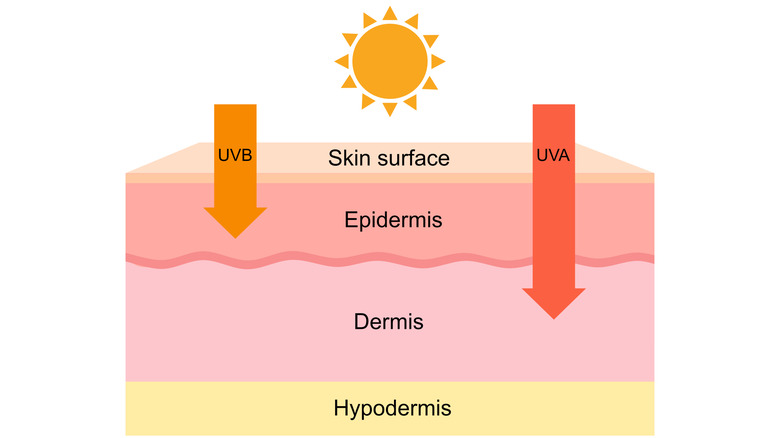
As mentioned, there are several types of UV light, or UV radiation. The type of UV light produced by UV flashlights is UVA, with a wavelength of 315nm to 400nm. It's the most common UV light, accounting for roughly 95% of the UV radiation reaching the Earth. This type is the most responsible for tanning, wrinkles, and premature aging, since it penetrates deep into the skin. A lot of things also stop it from doing more harm, as UVA rays can be blocked by car windshields, for example.
UVB is next in line and has a wavelength of 280nm to 315nm. Most of the UVB rays are absorbed by the ozone layer, and only a small part of them reaches us. UVB is the primary cause of sunburn, but it is also a source of vitamin D. There are no UVB flashlights available like there are UVA, but there are specialized UVB light sources that are used in medicine or for reptile care.
Finally, we have UVC, which has the shortest wavelength at 100nm and 280nm. UVC is the most harmful UV radiation, which can easily damage the skin and the eyes, but fortunately, none of it passes through the ozone layer or atmosphere. Still, it can be found in certain tools, primarily used for the sterilization of surfaces, water, and air. For instance, UVC lamps are used to destroy bacteria or viruses.