

How Do Windmills Pump Water From Underground?
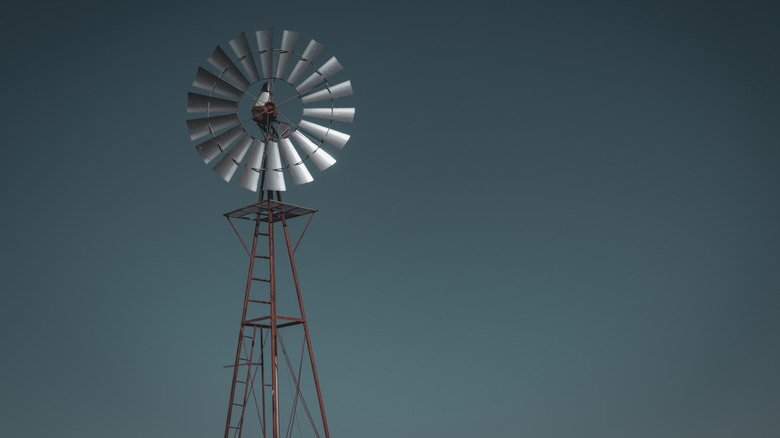
When it comes to machines, a lot of them have simply been replaced by something with a motor at this point. The problem with those is that they also consume energy and have a lot more parts to break. Perhaps that's why it's almost refreshing to see classic water-pumping windmills, which do their work using nothing but a breeze, still in operation.
Water-pumping windmills remain a staple on old ranches that look like they belong in a history book. They work by using the wind to draw water from deep underground. This water is then used for livestock and agricultural irrigation, among other things. The curved blades at the top of the windmill help make this happen by catching the wind and turning a shaft. That turning shaft runs into a gearbox, where a crank arm converts that rotation into an up-and-down stroke. Bolted to the crank arm is also a long pump rod, sometimes called a sucker rod, and it runs the full height of the tower straight down into the well.
Below the water line in the bottom of the well lies a cylinder with a piston tucked inside. With every rotation up top, the piston is hauled by the rod up and then back down. Inside the cylinder, two check valves function as one-way doors to prevent water from going back down. With each upstroke, the water gets sucked into the cylinder and then up the pipe. As the process repeats, the water rises until it eventually pours out at the surface, typically into a storage tank.
What's behind the longevity of the water-pumping mill
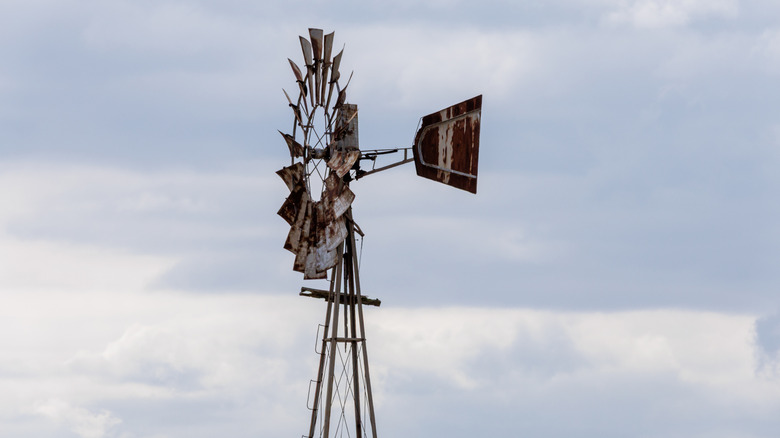
Usually, you'll spot way more blades on a water-pumping mill than what you get on even the largest wind turbines in the world, with the former carrying around 18 and the latter made with just three. These extra blades basically increase the surface area from which the wheel catches wind. This design has been in use ever since the 1890s, making this an old piece of tech that still remains in use. Today, very few companies build these kinds of water-pumping mills, however, with Aermotor claiming that it's the last American windmill maker still in business.
The reason why this design is still around today is because they require little oversight or upkeep. For one, they are able to turn themselves to face whichever way the wind is coming from, thanks to a tail vane that swings the wheel around. The mechanism is also ingeniously designed to rein the wheel in when the gust is too strong, so that the whole thing doesn't shake itself apart.
As for maintenance, they use self-oiling gearboxes that only need a look once or twice a year. This was a huge upgrade over the earlier models that had open gears, which farmers had to grease every few days. It's worth mentioning that these windmills are also built to last, often running for decades on that once-a-year attention alone.