

Amazon's New Data Center Tech Could Rewrite The Rules Of Cloud Storage

We may receive a commission on purchases made from links.
Amazon Web Services has been powering a significant swath of the internet for years. As of first-quarter 2026, the cloud and AI company controls 28% of the global cloud infrastructure market, according to CRN. That's why whenever AWS suffers an outage, it feels like it takes most of the internet with it. This makes network resilience a top priority in any data center, and given the scale at which AWS operates at and how much of the internet depends on it, it's especially important for AWS data centers.
A longstanding hurdle in data centers is moving beyond the so-called "fat tree" network topology. While they might be reliable and predictable at scale, but it's well known that they come with tradeoffs in efficiency and bandwidth. Amazon reports that its new network design is the first of its kind, and is able to supplant fat tree networks in AWS data centers. Amazon is calling this new network design RNG, short for resilient network graphs.
According to an Amazon press release, its new RNG network hierarchy is a "breakthrough that will deliver greater reliability and performance for AWS customers, save billions of dollars in hardware, and lower CO2 emissions across a growing number of grids where the company operates."
Amazon is going flat instead of fat for its new data centers

Although Amazon and its team produced a novel approach for its RNG network design, its underpinnings aren't new. It's based on an existing body of work and research into flat networks (like the Jellyfish network interconnect design), the idea of connecting routers and switches directly to each other, rather than in layers used in a tree hierarchy. A fat tree topology has been a common network design in data centers, where nodes are connected in layers, and the branches at the top of the tree have higher bandwidth ("fatter") than those at the bottom. Data packets then move up and back down the tree, being routed in a prescribed path.
While this topology has been critical for data center hyper scaling –- despite Americans pushing back on them –- it is also prone to choke points and congestion. The routers at the top of the tree can be critical points of failure, taking out entire parts beneath it if they go down. Amazon's RNG, based on flat networking theory, improves bandwidth through random connections, which reduces data bottlenecks in the network but also reduces single points of failure, with no router being more important than another.
In an article published at Amazon Science, Giacomo Bernardi, Ratul Mahajan, and Seshadhri Comandur, the team who led Amazon's foray into alternatives to the fat tree topology, pointed out that a loss of 1% of routers equates to roughly 1% of capacity loss in a random network, highlighting the increased resilience over a tree topology. But implementing a random network has always posed certain impracticalities, namely in how to cable such a network, as criss-crossing millions of fiber optic cables in a data center is simply unfeasible. There's also the challenge of how to efficiently route data without a strict protocol that established topologies offer.
Amazon created Spraypoint and ShuffleBoxes to achieve a quasi-random network
To solve the challenges of a random network, Amazon uses a blend of fixed network elements mixed with select parts of a random network architecture to create a "quasi-random" network. To do this, Amazon created a data routing algorithm called Spraypoint, and a passive optical device called a ShuffleBox. According to a white paper published at arXiv, Spraypoint works by "spraying" all packets at the source to its neighbors, which are all eligible next hops, and one is selected based on Equal-cost multi-path routing (ECMP).
The idea is that each packet sprayed from the source goes to a random neighbor, then the shortest path is taken to a waypoint, and waypoints send traffic to a destination. Amazon uses waypoints to help fan out traffic and prevent packets from piling up at one destination. The Spraypoint algorithm allows some level of random networking on commodity routers, so routers don't require specialized CPUs or memory to store and process all possible routing paths.
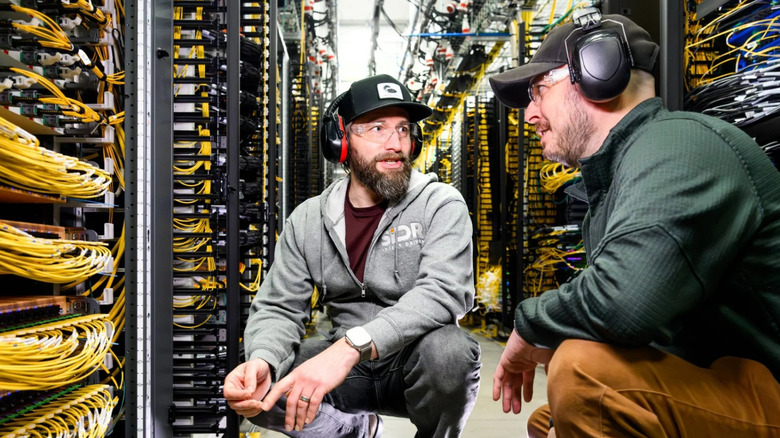
The ShuffleBox addresses the physical connectivity of RNG. ShuffleBoxes are optical devices with a sealed enclosure and no power supply, so they add no latency and reduce the risk of failure. ShuffleBoxes work by having router-facing ports to connect server racks, and then another set of ports to connect them to other ShuffleBoxes. The fiber wires are shuffled internally according to a special pattern detailed in the white paper, then ShuffleBoxes are interconnected randomly. This gives the network its quasi-random connections, but also keeps cabling complexity low and allows them to be scaled to the footprint at which AWS operates. Amazon also states their cost is similar to regular patch panels, making them a cost effective solution.
Amazon is at the bleeding edge, and what it does matters
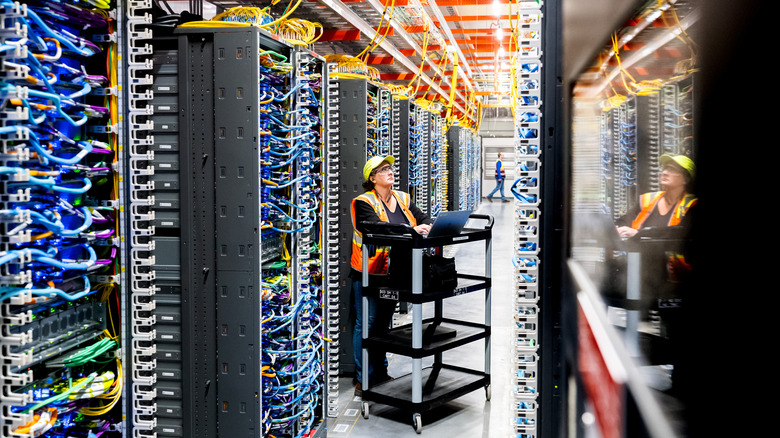
In Amazon's white paper, it's stated that RNG matches or exceeds fat tree networks in a variety of network traffic patterns and workloads, and is also capable of moving data up to a third faster while being up to 45 percent cheaper to implement. That's likely due to Amazon's claim its new quasi-random network equals a staggering 69 percent reduction in routers. That not only translates into reduced hardware costs, but also less electricity use –- Amazon expects AWS data centers using RNG to consume 40 percent less power compared to hierarchical networks.
Less power and hardware also means a reduction in the amount of cooling AWS data centers need, both of which will help Amazon reduce its CO2 emissions across its data center sites. The carbon and water footprints of data centers have become a major point of contention for both the public and lawmakers, turning the screws on these locations to be more environmentally sustainable. Amazon is already using reclaimed water to cool certain data centers, but that's only part of the equation.
However, by reducing the baseline cooling and power requirements for its data centers with RNG, Amazon may actually meet its goal of being water positive by 2030 and reaching net-zero carbon emissions by 2040. As a market leader, Amazon is at the bleeding edge of data center technology; what it does matters, as it has ripple effects on the industry. Now that the company has proven the viability of a hybrid networking approach, others — like Google and Microsoft –- may follow its lead.
According to Amazon, its first quasi-random RNG network went live in Dublin, Ireland, in 2024. It expanded to Spain and Germany throughout 2025, and as of April 2026, is now the standard for new AWS data centers.