

How Much Does It Cost To Charge An Electric Car & What Factors Affect The Price?
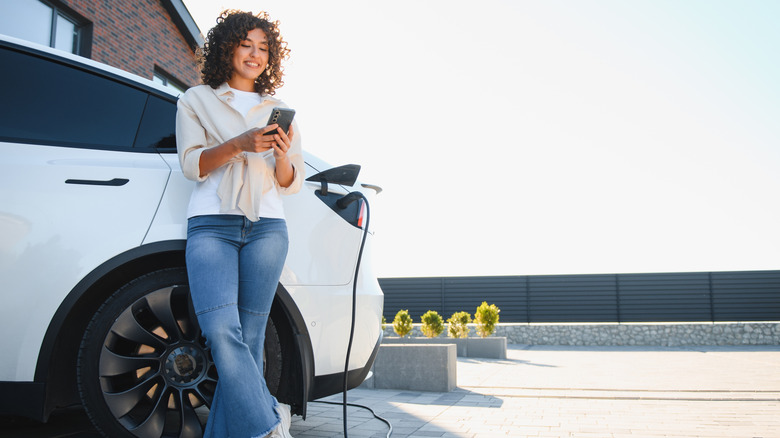
Working out how much it would cost to fuel your vehicle used to be fairly simple. All you need is a price per gallon, a reasonable idea of the fuel tank capacity, and how much fuel is needed to fill it. Armed with this information, you just apply a little mental dexterity, and you'll know how much it costs.
While the same basic principles can be applied to EVs, there are other factors to consider. Starting with the most obvious, the size of the battery plays a major role in how much it's going to cost you. Just like filling up a larger fuel tank will cost more, charging a bigger battery be more expensive. Similarly, the charge state also matters. In the same way that filling up an empty fuel tank costs more, so too will charging a depleted battery.
Now things begin to get a bit more complicated. The cost of electricity can vary dramatically across the United States. However, for a baseline figure, we can use the average price per kilowatt-hour (kWh) as supplied by the US Energy Information Administration – 18.83 cents per kWh. The average battery capacity for EVs is about 73 kWh. "Plugging" these figures in, we find the average cost of an 80% charge (at home) is about $11. We use 80% as opposed to 100% because proper EV battery maintenance should avoid a 100% charge.
Home charging is generally accepted as being the cheapest, and is often done overnight when special rates can be available.
Why real-world charging costs vary
While it's a useful starting point, the above calculation is very much an oversimplification.
For instance, two similar households in the same town can pay different rates depending on their plan. However, geography is one of the biggest influences on the cost. We mentioned the US average rate of 18.83 cents per kWh earlier. However, it's worth noting that this isn't a case of most states having prices close to that range; the swings are bigger than you may imagine. A couple of extreme examples include Hawaii with a cost of 46.62 and California at 35.25 per kWh.
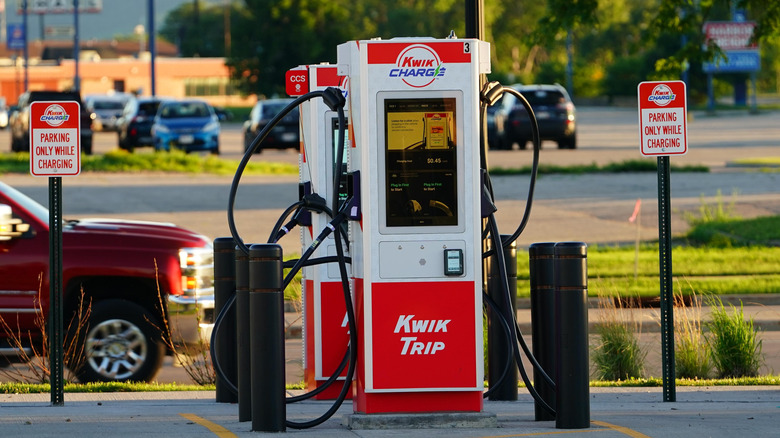
The other factor that has a bearing on cost is where you charge. The above only applies to home charging; the prices change again when we look at commercial options. Public charging stations are normally more expensive than home charging, though as ever there are some provisos. For instance, charging networks may offer subscription plans that offer discounts. Additionally, some new EVs may offer free charging as part of the purchasing agreement. It's maybe worth noting here that public charger issues are also the most commonly cited EV charging problem.
But, again, we can take an average figure for this. At the time of writing, and according to the American Automobile Association, the average US cost at public charging stations is 41.8 cents per kWh. Using this figure, an 80% charge of a 73 kWh battery at a public station comes out to about $24 — more than double the cost of the domestic charging scenario.
How to keep your EV charging costs down
The good news for EV owners is that even at the higher end of the cost spectrum, charging an EV vehicle is generally cheaper than filling up with the fossil-fuel equivalent. And it gets better, whereas the cost of filling up your gasoline car is dictated by gas station prices, EV owners have far more flexibility over what they ultimately pay.
As we've shown in this article, one way to greatly reduce the cost of charging an EV is to do it at home. This makes even more sense if you can charge at off-peak times when electricity rates are often much cheaper. For instance, some utility companies offer plans that are tailored for overnight EV charging. Such plans offer incentives like time-of-use scenarios, where the rate you pay is discounted during specific times. Installing a Level 2 home charger can also help you take advantage of these arrangements, although there is the upfront cost to consider. However, despite their expense, Level 2 chargers are still considered one of the best accessories for EV owners. Of course, if you use solar panels or other renewable energy systems, then these also offset the cost.
If you have to charge your EV at a public station, then it's also worth remembering that some networks offer membership benefits that include charging discounts. Additionally, the cost can vary from network to network. In some cases, you may also have to factor in factors like idle fees. Each network usually has an accompanying app that shows the current pricing and what additional fees may apply. Finally, resources like PlugShare can point you in the direction of any free EV charging stations available in your area.