

A '60s-Era SR-71 Flew So Fast It Broke The Radar Screen Of A Jet Trying To Track It
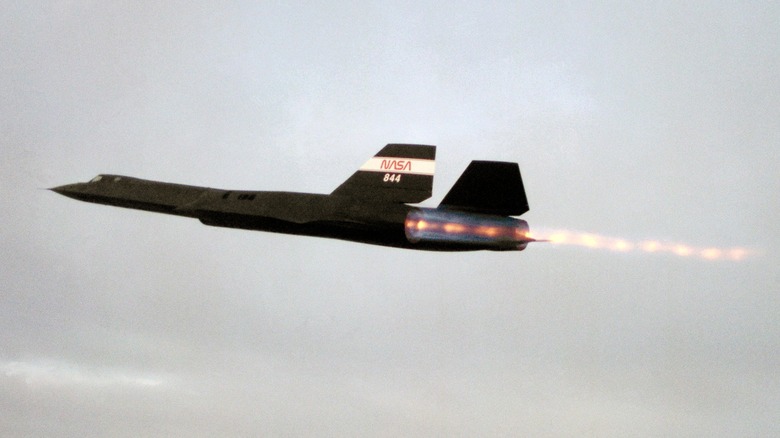
Of all the jets produced by the United States, few are as well known and beloved as the SR-71 Blackbird, first developed by Lockheed Corporation's Skunk Works in the 1960s. The SR-71 is best known for being incredibly fast, having set numerous as yet unbroken speed records under various conditions throughout its time in operation, which ended with NASA in 1999. The SR-71's speed is difficult to imagine, as it was capable of reaching Mach 3.3 (2,193.2 mph).
That's around four times the average speed of a passenger airline, so it's pretty fast. In fact, the SR-71 was so fast that one of the aircraft managed to break the radar screen of a jet trying to track it in the 1960s. This came during the Vietnam War, when an SR-71 exited Chinese airspace at a time when the Navy required at least two fighters to be airborne over the Gulf of Tonkin. The mission type was designated as BARCAP, or Barrier Combat Air Patrol, and when the SR-71 left Chinese airspace, one pilot operating their F-4B Phantom II fighter jet attempted to track it.
This wasn't for nefarious reasons, but knowing that the top-secret SR-71 was about to fly into their airspace was tantalizing enough to extend the antenna as far as it would go to see the aircraft zip by. Unfortunately, the SR-71 moved so quickly that it actually broke the fighter jet's radar screen — it simply couldn't handle monitoring an object moving that quickly through the air.
How an F-4B Phantom II's radar screen failed upon seeing an SR-71
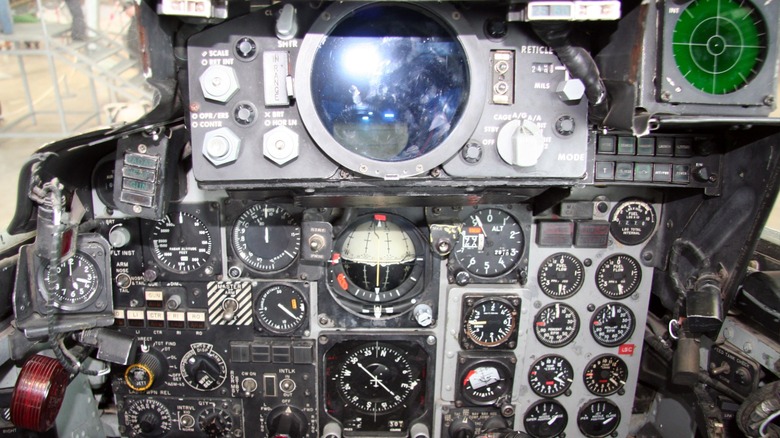
Jerry Hart, a former F-4B Phantom pilot explained what happened in an interview with The Aviation Geek Club. He described flying (Barrier Combat Air Patrol (BARCAP) missions as being typically dull, so it makes sense that an SR-71 sighting would entice him to try and track it. After turning north to face where the SR-71 would be, Hart explained how his attempt to track it went down:
"I watched in amazement as the Vc circle, which told us the relative closing velocity of the target, started rapidly winding up far higher than I had ever seen it before. Then the B trace, which indicated the target's position relative to the nose of our aircraft, began to dither back and forth rapidly before slamming to the side of the scope, and the screen went completely black. We never could get it to work again." Once instrumentation completely failed, Hart opted to use his Mark I eyeballs to see the elusive Blackbird.
Unfortunately, the SR-71 flew too high to be seen with the naked eye. This story comes from a former pilot who once positively identified an aircraft at 56 nautical miles (64.4 miles), so his inability to see the SR-71 suggests it was way too high and moving far too fast to see. That's what the SR-71 was designed for — it had to fly high and fast to elude Soviet anti-aircraft systems. It's not surprising to learn that it was difficult to find and see, even with prior notice that it was coming.