

Steam Deck Vs Steam Machine: What Are The Pros And Cons Of Each Console?

Valve has a surprisingly good reputation considering it has what is essentially a monopoly in the PC gaming space. You're likely most familiar with Steam, the company's digital storefront. Valve has earned plenty of goodwill over the years by not succumbing to anti-consumer practices and simply offering a game launcher that doesn't suck the life out of your gaming PC. Yet, even Valve isn't immune to criticism — there were plenty of disappointed gamers after the company finally unveiled the Steam Machine at $1,050, and that price doesn't include the Steam Controller.
The soaring prices of components are likely to blame here — even Apple and Xbox have recently hiked the prices of their products. So, if you're looking for a cheaper entry into PC gaming, you will likely stumble upon the Steam Deck OLED that we reviewed, which is now priced at $790. It's important to note, however, that these are two very different products, aimed at two different audiences. If you value raw power and the ability to play your favorite games at a high resolution and high frame rates, the Steam Machine is the one you should be eyeing.
But all that extra power over the Steam Deck doesn't matter much if portability is what you're looking for. While the Steam Machine is smaller than your average gaming PC, you still need to lug around a few cables, connect it to a display, and find a power outlet to start enjoying your games.
The Steam Deck is a handheld powerhouse
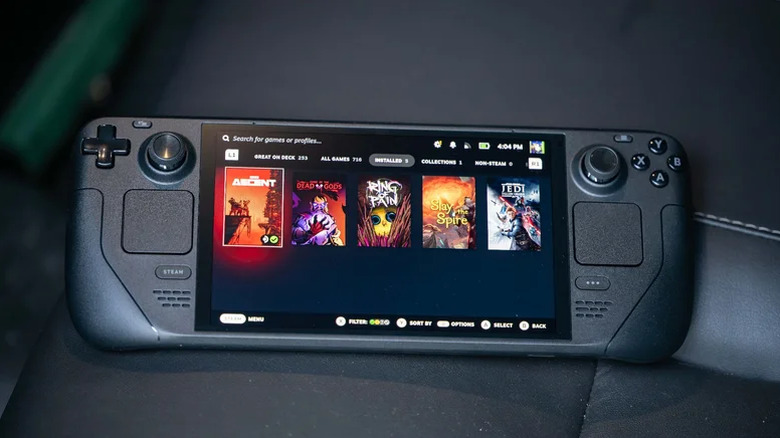
The Steam Deck was released in early 2022 and soon earned its place among the best handheld gaming consoles made. It has since been updated with an OLED panel, better efficiency, and, unfortunately, a higher price tag. The OLED version now starts at $790 for the 512 GB variant and $949 for the 1 TB model. The Steam Deck is powered by a custom AMD APU with a Zen 2-based, four-core, eight-thread CPU that can boost up to 3.5 GHz, alongside an RDNA 2 GPU with eight compute units. You get 16 GB of LPDDR5 RAM and a high-speed microSD card slot in addition to the upgradable NVMe SSD inside.
The biggest advantage the Steam Deck has over the Steam Machine is portability. The 720p-class OLED display (1280 x 800, 90 Hz) might not sound impressive on paper, but this sacrifice is what allows the handheld to run demanding titles at playable frame rates. At native resolution, the Steam Deck managed to output just over 50 fps running "Red Dead Redemption 2" in performance mode and close to 45 fps on low settings in "Cyberpunk 2077" in a gaming benchmark carried out by GamersNexus.
Steam Deck owners have pointed out that gaming on a 720p screen on a handheld is actually a decent experience. That said, if you're docking your Steam Deck to play on a larger screen, you'll have a tough choice to make between a higher resolution or a better frame rate unless you're playing indie titles.
The Steam Machine wants to replace your living room console
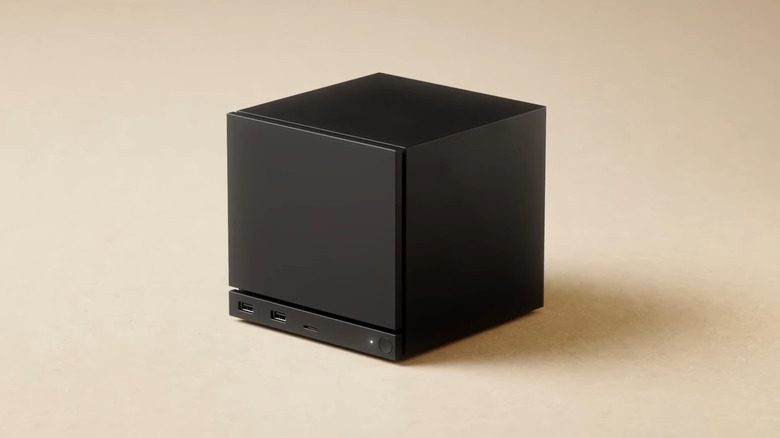
Valve claims the Steam Machine is around six times more powerful than the Steam Deck. This is thanks to the inclusion of a desktop-grade CPU and a discrete GPU. It's powered by a semi-custom AMD CPU with six cores and twelve threads that can hit up to 4.8 GHz. The GPU is RDNA 3-based, featuring 28 compute units and 8 GB of VRAM. This is in addition to the 16 GB of DDR5 memory that the Steam Machine offers. It's set by default to run games at 1080p, and at that resolution, it can run most titles with great frame rates. Valve initially claimed the device could run games at 4K 60 fps with AMD's upscaling technology — real-world benchmarks say that the Steam Machine really isn't equipped to handle that, though.
Unlike the Steam Deck, you need a TV or a monitor and a controller to get started with the Steam Machine. Connectivity options include both DisplayPort and HDMI, with the power supply built into the chassis. You can connect a keyboard and mouse, but Valve really wants you to use the $100 Steam Controller, which has a control layout similar to the Steam Deck's, including two square touchpads. Both devices run SteamOS, which is based on Arch Linux. While this can mean faster load times and improved efficiency compared to Windows, many anti-cheat systems currently don't support SteamOS.