

What Do Those 'Maintain Top Safe Speed' Signs Mean?
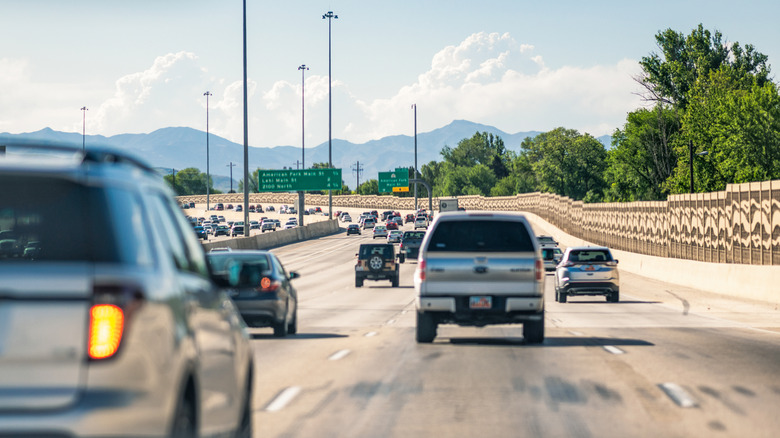
Some speed limit signs are smaller than others, but all are designed to be easy to identify, bearing the simple legend Speed Limit, and the maximum speed permitted. That speed can differ a lot depending on where you're driving, but these signs typically have a uniform design on U.S. roads: A white rectangle with a black border and black text. These signs will be intimately familiar to most drivers, but there's another speed-related sign that's a completely different (though very similar looking) beast: Maintain Top Safe Speed. It's designed only to be used in the most dire emergency situations, which, thankfully, have not arisen on U.S. roads to date.
In a country as enormous and varied as the United States, federal laws are established for those cases where uniformity is important. The establishment of the Manual on Uniform Traffic Control Devices was another step towards that, keeping road signs uniform and recognizable. Because of this, it has to be thorough and complete. That it certainly is – one edition of the manual reaches almost 1,200 pages. It covers everything from the design and shape of the everyday parking sign and the regulations surrounding it, to the Emergency Management Signs. Maintain Top Safe Speed is one of these signs, and was designed to be used to alert drivers to the fact that the area they're passing through is extremely, fatally dangerous, potentially affected by nuclear radiation.
As the MUTCD puts it, "since any speed zoning would be impractical under such emergency conditions, no minimum speed limit can be prescribed by the Maintain Top Safe Speed sign in numerical terms." There were very limited ways to protect the general public driving through a potentially irradiated zone beyond this.
Road signs for the most dangerous circumstances.
Should the world be plunged into such a situation that these signs are necessary to be deployed on U.S. roads, a tactic was devised to ensure that they did not clash with the more conventional speed limit signs that may have been on their route. They could simply be affixed over the top of the existing sign, thereby making it abundantly clear that the perilous circumstances rendered the latter sign irrelevant for the time. Drive safe, but drive fast.
As well as Maintain Top Safe Speed, the Emergency Management Signs also include Emergency Aid Center, Evacuation Route, Area Closed, Shelter Directional, Permit Required, and Traffic Control Point. These are all to help the authorities and the public attempt to navigate a harrowing emergency situation. Maintain Top Safe Speed was introduced in the document in 1961, and though it has never had to be erected as a functional road sign, all of these things, such as that year's expansion of a program to establish fallout shelters in buildings across the country, were the result of a very real possibility that they might.
The context is crucial: In 1961, the Cold War was at an extremely volatile point, with the Soviet Union's testing of the largest nuclear weapon ever detonated, the so-called Tsar Bomba, that year. Nobody at the time really knew if one power or the other would take that most devastating of steps and use a nuclear weapon, nor what the ultimate consequence of such a decision would be for our planet. It was clear, though, that a series of measures had to be established for a potential worst case scenario, and the Maintain Top Safe Speed sign and similar ones were one part of this wider effort.