

The Average Lifespan Of Automobiles On The Road Is Increasing - Here's Why
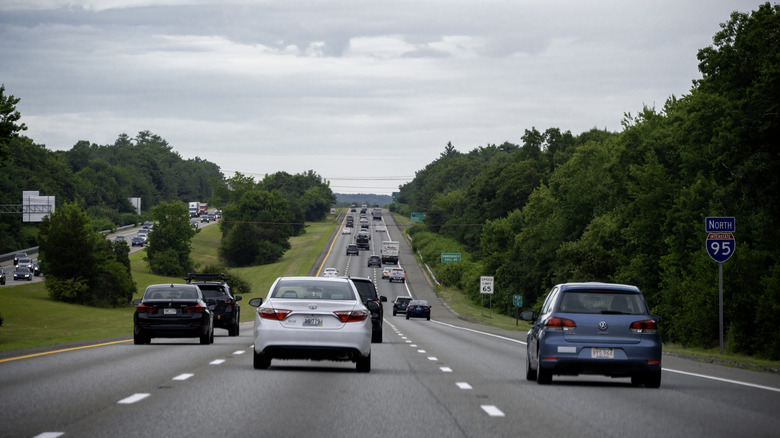
Many motorists simply don't feel the need to "upgrade" and opt for the latest model year whenever it's available. Not doing so, it seems, is becoming increasingly popular among drivers. The United States Department of Transportation has presented data on the average age of cars and trucks in operation in the country since 2000, with data sets that include 2000-2016 and 2022-2025. It shows that there has been a slow but constant increase in the average age of passenger cars on U.S. roads, beginning with 8.9 years in 2000 and climbing all the way up to 14.5 years in 2025. Light trucks also saw an overall trend upwards over the last quarter-century from 8.4 to 11.9 years in age.
This is not just a U.S. trend, either. In August 2025, the U.K's Royal Automobile Club reported that cars across the United Kingdom had reached an all-time-high average age of nine years and ten months, up from just seven years and five months in 2015. The reasons for this on both sides of the pond seemingly include the heavy costs associated with getting a new car, as well as a collective reluctance to embrace evolving technology like EVs. There are still concerns about critical factors like getting the most range out of an EV that spook many drivers, after all. Let's take a closer look at some of these factors, as well as the potential impact that all these aging vehicles can have on the industry.
Costs associated with buying a new car are rising

Fuel prices are one huge issue that motorists face in 2026, and some solutions to ease it, like promoting wider use of E15 fuel, are temporary measures that won't suit every type of engine. More fundamental ways around this issue, such as switching to an EV, are also prohibitive because the cost of buying one will tend to be higher than with a gas-powered counterpart. It's also true that EVs and hybrids are becoming an ever-more important part of the puzzle when it comes to new vehicles, and there's a considerable subset of drivers who don't want to take the plunge with one of these just yet.
The unpredictable nature of government subsidies on EVs and the charging infrastructure to support them is a huge part of this. However, many are simply being priced out of buying a new vehicle in general. In December 2025, The Independent reported that the average price of a new vehicle in the U.S. had risen to $50,000, translating to hefty payments.
Over time, a driver will become extremely familiar with their car and the routes they tend to take it on. They'll develop a routine for the type of maintenance to give it and how often, how each of its features and applications need to be treated, and any warning signs to watch for. It can be very difficult to surrender that for a model that may have issues you're not used to managing. After all, while some motorists relish the chance to have a instrument panel full of new toys to tinker with, others will see them as more of a liability, filled as it is with unfamiliar features that could go wrong. All of this is assuming, of course, that the motorist is able to front the hefty cost of a new vehicle in the first place.
Automakers are providing increased support for a population driving older vehicles

As The Wall Street Journal puts it, "automakers, dealers and repair shops are changing business practices to adapt to a new normal: the 13-year-old car." How is this adaptation taking place? There are several factors to this, and one is ensuring that longer-lasting service can be provided for those vehicles. An important part of this is establishing longer-lasting warranties for the model. This same increased availability, however, also makes it more complicated and time-consuming to administer repairs, because some of the parts that were previously mechanical are now implemented into the system itself.
Though this can make repairs more complex (and potentially more expensive), there's also the big advantage of this electronic system: Patches and updates can be applied that will fix issues and provide new features for what might be a long time to come. This keeps vehicle, owner, and manufacturer in a closer relationship throughout that period. It's also a matter of continuing to support models that are no longer manufactured. For instance, in June 2025, it was reported that Honda would begin manufacturing official replacement parts for one of its beloved classics: the first generation NSX. This concept was expanded in April 2026 in the shape of the Honda Heritage Works, which, Honda reports, heralded "global sales of Honda Heritage Parts and a new Honda Restoration Service in Japan for classic Honda sport-type models."
It's also true that manufacturers are trying to incentivize buyers to invest in newer models by providing features that appeal more to different types of customers. For instance, some may have been turned off from upgrading their vehicle by the increasing prominence of touchscreen technology, and so there have been developments in systems that utilize classic physical buttons as well.