

Why TVs Don't Use AMOLED Screens (But Smartphones Do)
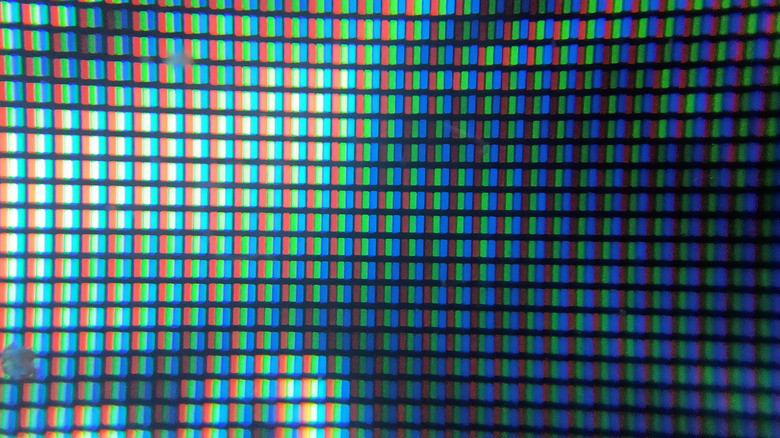
There's no denying that smartphone displays today are simply gorgeous, thanks to their use of AMOLED (Active Matrix Organic Light Emitting Diode). But if they are so great, then why does the TV in your living room stick with OLED instead? You may have heard them use tech like WOLED or QD-OLED, but none of them ever get branded as AMOLED. Now, that's not to say your TV uses an entirely different technology, since it still uses an active matrix — so, it's technically an AMOLED at heart. It just doesn't use the same recipe phones do, and there are a few good reasons for that.
First, it's important to understand what makes AMOLEDs unique. These still are OLEDs, except the way AMOLEDs work is with the active matrix screen tech doing the heavy lifting. Active matrix refers to a grid of thin-film transistors, or TFTs, that sit behind the screen. Their job is to give every single pixel its own switch, which is pulled off by handing it a transistor or two, plus a capacitor to hold the charge. The point is to make the picture look sharper and more responsive.
Driving those self-lit pixels takes a steadier and stronger current than the older transistors used to be able to supply, though. So to help with that, AMOLEDs on phones also rely on a transistor process called LTPS, which is short for low-temperature polycrystalline silicon. Now, while LTPS works just fine on smaller displays, it doesn't scale well to bigger ones due to its complexity. So when you put it all together, the very stuff that makes a phone screen shine is also what keeps it from blowing up to TV size.
Going big breaks the recipe
The thing is that OLED is already delicate enough with all those organic materials crammed inside. They can all be wrecked pretty easily by contamination and moisture. In fact, even one slip during production will render the panel useless. These factors only multiply when the panel is stretched to something like 65 inches, greatly increasing chances for flaws to crop up.
While TVs skip the kind of AMOLED setup on phones, it's not necessarily a bad thing. TVs have wandered down their own evolutionary path, and they lean on different technologies to achieve a crisp, colored picture. Phones still use that LTPS backplane, but the bigger screens have switched over to a different one built on oxide semiconductors.
Phones build color by laying down three separate glowing materials, one for red, one for green, one for blue. Manufacturing like that at TV size is a huge hassle, though. So display makers have started taking different approaches instead. Let's take a look at two of them.
There are workarounds for the problem, though
LG has come up with WOLED, which is white OLED paired with color filters. The OLED layer on these panels only produces white light. Colored filters then change this white to red, green, and blue along the way (by filtering out other colors), effectively removing the need for separate colored pixels for each.
The filtration in question is achieved with the use of colored resins. There's also a fourth white subpixel at play here, which exists to push the brightness higher. The best part about it all is that it's easier to produce, so yields are way better than what you'd get with true RGB.
Then there's Samsung, which has a very different way of achieving RGB compared to LG. The company uses QD-OLED – short for Quantum Dot OLED. This one kicks off with a special blue OLED light source. But instead of using color filters, it uses these quantum dots, which are essentially tiny particles that shift light from one color into another. This allows them to conjure up the reds and greens.
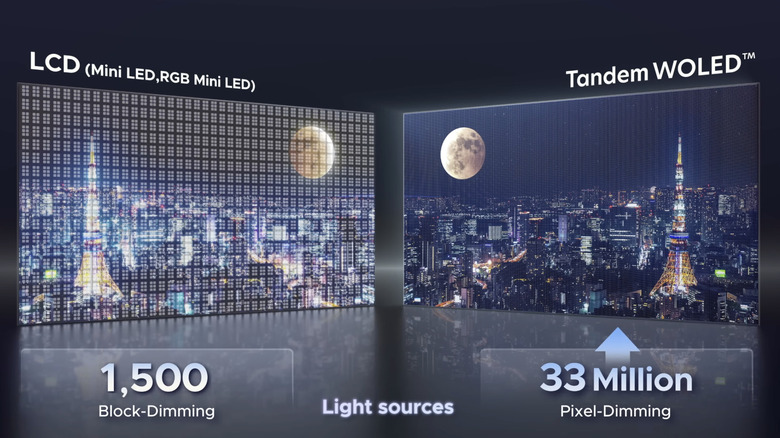
Since color filters are out of the picture here, and because they can hurt brightness, compared to WOLED, QD-OLED is said to reach high brightness levels without losing much contrast. However, LG has quashed any brightness concerns with a newer, stacked Tandem WOLED technology it's now fitting its latest TVs with.