

Should You Avoid Filling Up Your Gas Tank When A Fuel Truck Is At The Station?
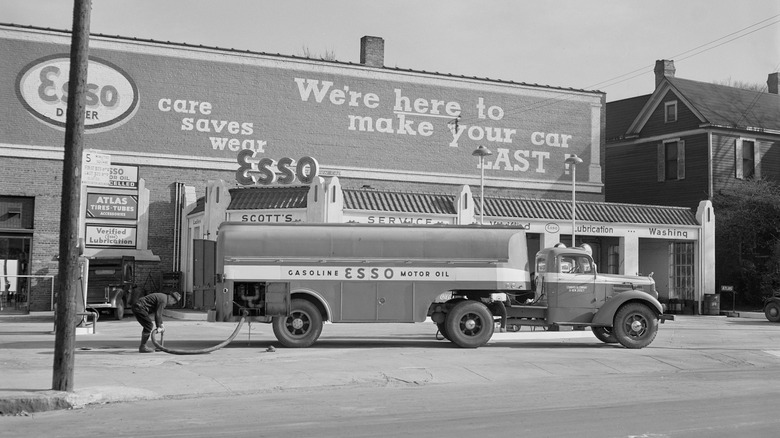
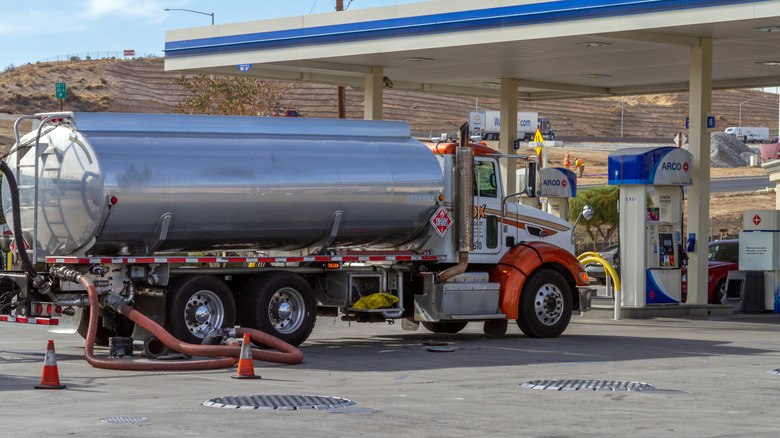
Time and technology go hand in hand as we make our way through this thing called life. For instance, there was a time when getting gas at a station while a fuel truck was onsite refilling the underground tanks was a bad idea, because sediment that had settled at the bottom of the tanker could get into your car's gas tank and muck up the engine. Of course, this was before there were filters at virtually every stage of the pumping process. So back then, that piece of advice was a good rule to follow.
However, technological advancements in fuel refinement and filtration have since turned that old adage into a myth – one of many about fuel — that you really should stop believing. Many experts agree that gas today is filtered so many times that it no longer poses much of a problem. Mike Newton, the general manager of a Ford dealership in Eau Claire, Wisconsin, told WQOW that gas gets filtered at the refinery, then again before it goes into the tanker truck, and a third time as it makes its way through the pumping mechanism at the station. And if all that weren't enough, there's the fuel filter in your car.
What's more, the addition of ethanol back in the mid-1970s — when the U.S. started removing lead from gasoline – improved things considerably. Today, over 98% of gas used in the U.S. contains ethanol. It not only acts as an octane booster that improves car performance, but it also contains cleaning solvents that remove many contaminants.
Time keeps on ticking and technology keeps on improving
In 1973, the Environmental Protection Agency began issuing regulations to phase out lead in gasoline. The following year, ethanol — also known as ethyl alcohol — started to be heavily promoted as a new fuel source. By 1979, several American oil giants, like Amoco Oil Company, Texaco, and Chevron all began marketing commercial alcohol-blended fuels, and by 1986, lead had all but been removed from U.S. gas.
PetroClear makes filters and other accessories used at retail and commercial fuel sites to dispense any number of fuel types. They say that while filters do make a huge difference, like most things, they're not perfect, and sediment can still get from the gas pump into your car. Some states are more stringent than others about which types of filters are used, and most pump manufacturers require stations to use filters. If they don't, the pump's warranty could be voided. Plus, there's a legal remedy: if sediment damages an engine, a station can be held liable and forced to pay for any repairs.
Mike Newton, the aforementioned general manager at Eau Claire Ford, said this is so uncommon now, that he's personally never heard of sediment causing problems. Even though some can still get stirred up when a fuel truck is refilling underground tanks, ultimately, the combination of all the many filters used, along with the addition of ethanol, has mitigated the risk of contamination to the point that there's really no reason not to fill up at the same time. A much bigger problem is the mislabeling of gas pumps, which has left drivers needing thousands of dollars in repairs.