

What Is The 110-20 Rule For Towing & How Does Physics Play A Part In It?

For some drivers, safely towing a trailer or camper can be a pretty routine process, especially if they do it regularly. But if you need to hook up and have never done so, one important rule to be aware of is the 110-20 rule. This states that a vehicle with an 110-inch wheelbase can tow a 20-foot trailer. Though this is an unofficial rule, there is some real physics behind it.
The 110-20 rule is all about leverage. If a trailer moves even a little off its path, the resulting force at the hitch can directly affect the towing vehicle. The longer the trailer, the greater the leverage. If the towing vehicle is too short, a swaying trailer could potentially rotate it or even push it sideways. However, a vehicle with a longer wheelbase provides more stability and can better resist those forces. Every 4 inches of additional wheelbase equals around one extra foot of trailer length that can safely be added.
When a trailer begins to sway, the motion can get much worse with a sudden stop, which is why hitting the brakes is a bad idea. The best move is to slowly decrease speed by easing off the gas pedal, while keeping the steering wheel steady. As the vehicle slows down, the trailer should be able to stabilize and eventually return to its original path. At that point, the towing vehicle can gently brake, but only after the trailer is back where it needs to be.
More helpful guidelines for safe towing
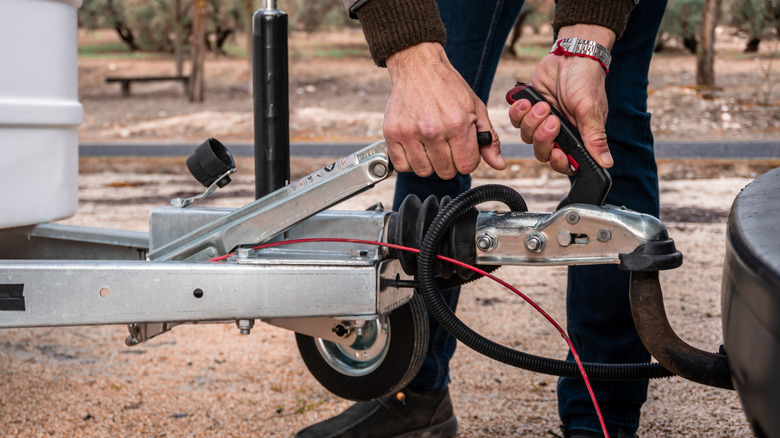
The 110-20 rule provides an ideal towing guideline, but bumpy roads or crosswinds can still cause a trailer to sway. Sometimes a sudden jerk of the steering wheel or a passing semi-truck can be enough to cause a trailer to fishtail out of control. Improper hitching can also affect the trailer, and so can uneven weight distribution. The moment a trailer's stability is affected, the towing vehicle can struggle as a result.
This is why it's important to know the vehicle's towing capacity, or the maximum amount of weight it can safely pull. This number is influenced by how a vehicle is designed, how much weight it is already carrying, and the overall combined weight of the vehicle and trailer as defined by its Gross Combined Weight Rating (GCWR). Manufacturer towing ratings are typically based on controlled testing conditions and often assume very little additional load. Because of this, real-world capacity can be lower once passengers, cargo, and trailer weight are added.
Due to this difference between published ratings and real-world driving, many people follow the 80% rule for towing as a safety precaution. This rule states that a vehicle should not pull a load that weighs more than 80% of its towing capacity. This rule acts as a buffer not only for the added weight from passengers and cargo, but for changing conditions as well.