

Humvee Vs Hummer: What's The Difference?
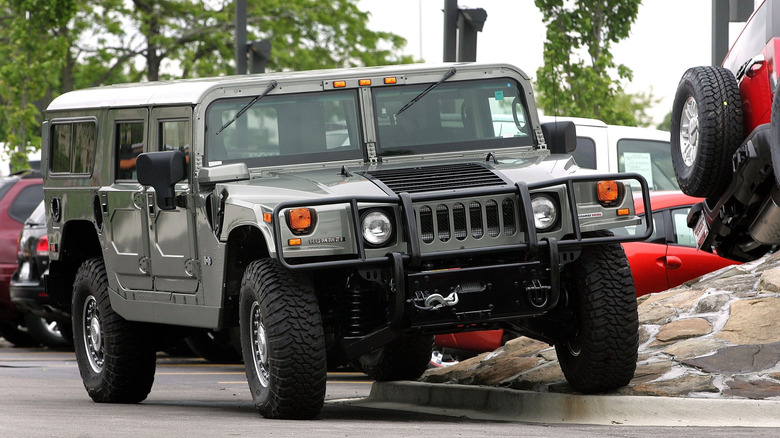
Introduced in 1984 the Humvee first saw combat in 1989, and has since gone on to become one of the most legendary U.S. military vehicles in living history. It was built by AM General and commissioned as a replacement to the long-serving Jeep, promising better all-terrain capability and reliability than its predecessor. The Humvee name comes from its original title, the High Mobility Multipurpose Wheeled Vehicle, or HMMWV.
It was originally intended to be solely a military vehicle, but the media coverage of its early deployments earned it a civilian fanbase too. Among the most notable fans was Arnold Schwarzenegger, who would eventually go on to own multiple examples. This rising popularity led AM General to develop a civilian version of the vehicle, which was called the Hummer.
The first civilian examples of the Hummer rolled off the production line in 1992, and in the beginning, they were a niche vehicle mostly marketed toward off-road enthusiasts and people who wanted to feel like the Terminator on their morning commute. These early examples didn't have trouble finding buyers, despite the fact that some serious compromises came with owning one.
Initially, civilian Hummers featured a 6.2-liter turbodiesel engine, and by the mid-'90s, a 6.5-liter turbodiesel was standard. While these engines were built to be very torquey and very durable, they weren't very fast. In fact, they were so sluggish that an economy hatchback could comfortably out-accelerate a Hummer on the highway.
GM bought the rights to the civilian Hummer
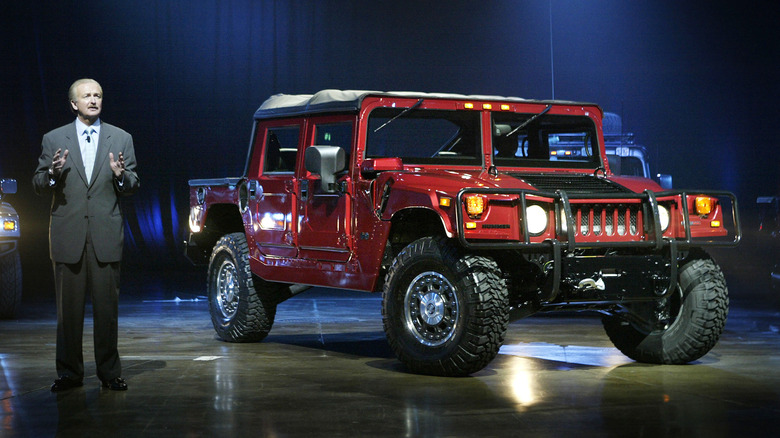
The Hummer's huge size and single-digit fuel economy also made it a very impractical and expensive vehicle to run, but nonetheless, it continued to be popular among a small group of buyers. GM saw an opportunity to capitalize on that popularity, and subsequently bought the rights to the civilian Hummer brand at the turn of the century.
More Hummer vehicles were planned, and so the original Hummer was renamed the Hummer H1. It would later be accompanied in showrooms by the H2 and H3, although neither of the later SUVs was as extreme as the original. Sales continued, but interest in the Hummer brand was starting to decrease. Buyers were less willing to purchase a vehicle that had remained on sale mostly unchanged since the early '90s, particularly since it came with a price tag that comfortably stretched into six-figure territory.
GM launched an Alpha variant of the H1 in 2006 with a more powerful engine, but it wasn't enough to save the oversized SUV. Production of the civilian version of the H1 ended that year, with around 12,000 examples sold over the course of its lifespan. Today, examples of the vehicle remain in high demand with collectors, with the average Hummer H1 selling for more than $70,000.
Both the Hummer H1 and the Humvee have been replaced
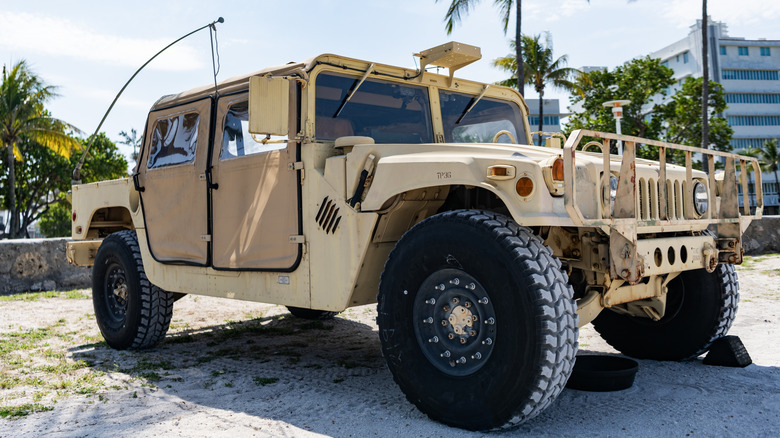
The Hummer brand limped on for a few years after the H1 was discontinued, with sales slowly decreasing over time. GM's financial woes in 2009 saw it attempt to sell Hummer to a Chinese manufacturer, Sichuan Tengzhong Heavy Industrial Machinery, but after that fell through, it axed the brand altogether. Around a decade later, the Hummer brand returned once again as a sub-brand of GMC, although its latest vehicles are very different from the original H1. They're still oversized and impractical, but the latest GMC Hummer SUV and pickup feature all-electric powertrains.
In 2015, the U.S. Department of Defense also announced that the military Humvee would be replaced. Its successor is the Oshkosh Joint Light Tactical Vehicle (JLTV), which is designed to be more reliable, durable, and rapid than the Humvee. Oshkosh also makes the MRAP M-ATV, a vehicle designed to survive large explosions, which was a significant weakness of the Humvee.