

Plastic Vs Rubber Mower Deck Wheels: Is One Actually Better Than The Other?
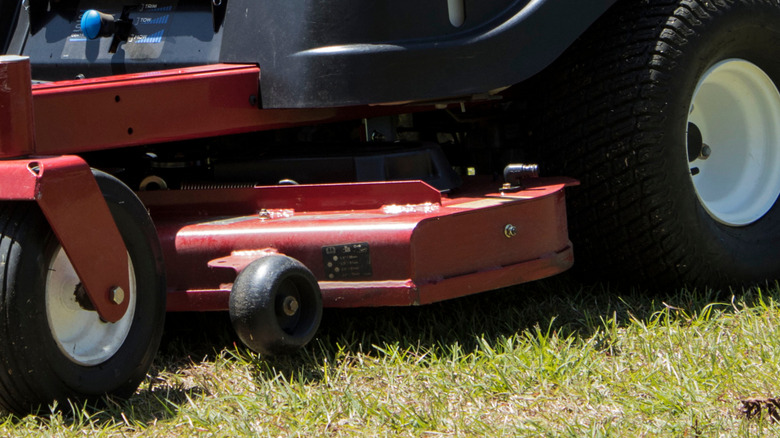
Shopping for a new lawn mower means knowing which models to steer clear of, and knowing what sorts of components you'll need. For instance, mower deck wheels are often made out of plastic or rubber, and one isn't necessarily better than the other. It's more a matter of how each is meant to perform.
Plastic deck wheels are often used in lighter-duty mowing because of their simplicity, and also because they're not as heavy as rubber. This is why you often see them on everyday mowers used by homeowners, as they work well on even terrain. Plastic wheels are also resistant to corrosion and usually don't require much ongoing maintenance.
Rubber deck wheels are used on larger mowers because they're more durable and hold up under heavy load. They can also give better traction and shock absorption, which is important for commercial mowing, where there's a need to handle all kinds of terrain. However, rubber wheels also need more maintenance because of their design, and may need to be replaced more often.
If you do prefer one wheel type over the other, you may be able to swap them out, depending on the mower. But beware that modifying your lawn mower could impact its performance, or possibly even affect the warranty. So before you buy replacement wheels, be sure to check your owner's manual for the proper guidance on how to move forward.
How other mower wheels are designed and built
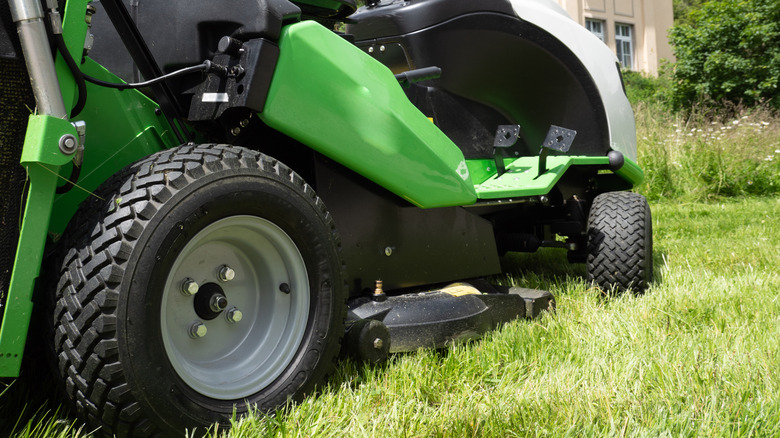
The material used to construct mower deck wheels, whether plastic or rubber, is important because the setup serves a unique purpose. Unlike the mower's other wheels, deck wheels should not touch the ground, only engaging if they're needed. These wheels support the deck and keep it from digging into the ground if the mower dips too low on rough terrain. Because of their design, deck wheels can help decrease potential bounce and tilt on larger mowers as well.
But deck wheels are just one part of the mower's system, and the other four tires are responsible for movement, steering, and traction across the lawn. The front tires are usually smaller than the back, and are used to help guide the mower through turns. These tires typically have ribbed tread patterns that support straight movement. In contrast, the larger back tires provide the mower's primary grip, as well as its driving force. The back tires have deeper tread that allows them to keep traction on rough or slanted terrain.
Both front and rear tires are generally constructed using different designs, including solid, foam-filled, or traditional air-filled. Unlike rubber tires that can go flat, some riding mowers have tires made of reinforced rubber like bias-ply or radial types. Much like deck wheels, the mower's other wheels are determined by the manufacturer based on the mower itself, as well as its application.