

This OG Music Service Is One Of The Only Ad-Free Options Under $10 A Month
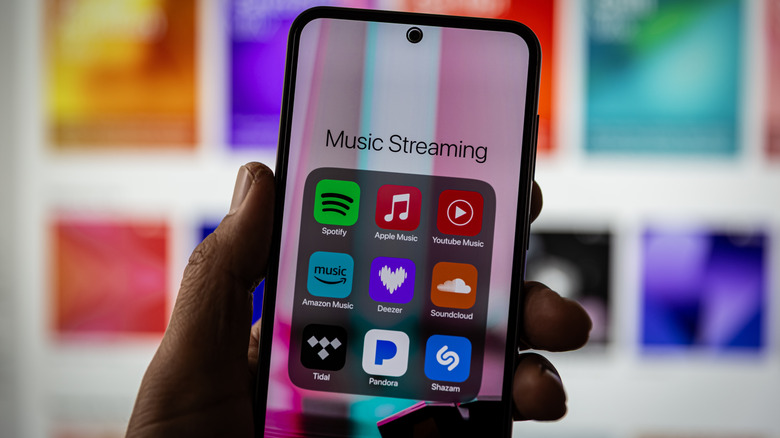
When you first think of music streaming services, Pandora probably doesn't come to mind before other platforms, even though it was once a staple. But it's definitely not one to forget about, especially if you're keen to find a more affordable alternative to Spotify Premium. In case you need a refresher, or this is your first time hearing about it, Pandora is a music, podcast, and comedy streaming platform primarily based around customizable online radio stations.
You can use Pandora for free — or, if you want to unlock more functionality, you can subscribe to a paid tier. The cheapest paid tier, Pandora Plus, is $4.99 per month, making it a much more affordable option than the majority of other music streaming services. This tier gives you access to custom radio stations uninterrupted by ads, alongside unlimited skips and limited offline listening.
There is a small catch, though, and it's an integral part of how Pandora Plus works. Since it revolves around personal radio stations and custom listening experiences, it doesn't really prioritize searching for and picking out individual songs on demand — at least not without listening to an ad first. So, if you frequently find yourself reaching for your phone to hear one specific song, you might decide to opt for Pandora Premium for $10.99 instead. But if you don't mind letting Pandora's algorithm work its magic and listening to the occasional ad, then Pandora Plus could suit you just fine.
How does Pandora compare to other streaming platforms?
Exactly how Pandora compares to its competitors like Apple Music, Spotify, or Tidal, depends on which tier of Pandora you're using. For example, Pandora and Spotify's respective free tiers aren't all that different from one another, as they both set restrictions around your ability to select and play a specific song, and they both include ads. Similarly, Pandora Premium is roughly on par with other streaming services' premium tiers in terms of functionality, offering ad-free access to its entire library, unlimited skips, offline listening, and playlists.
The real differences between Pandora and other streaming platforms arise with the mid-tier Pandora Plus, because of its focus on stations instead of purely listener-directed listening. With this tier, you'll spend more time listening to algorithmically informed, never-ending playlists, rather than specific albums, artists, or songs. However, it's not solely Pandora driving the music. You get plenty of say over what you're listening to, since you can skip as many songs as you want, and there are several different stations to choose from. Plus, you influence the stations based on your tastes, and by giving any given track a thumbs up or thumbs down. You can also download stations to listen to offline.
Pandora Plus effectively creates a kind of bridge between free and premium subscriptions, which differs from how other platforms work. For that reason, it might not serve as a one-to-one replacement if you're hoping to ditch your Spotify or Amazon Music subscription. That doesn't mean that it couldn't work as an alternative, particularly if you regularly find yourself flicking between Spotify mixes or artist radio stations on Tidal.
Pandora's stations rely on the Music Genome Project

Pandora stations work a little differently from autogenerated mixes or playlists on some other streaming services, and that's because it uses something called the Music Genome Project. According to Pandora's official website, the Music Genome Project is the "most comprehensive analysis of music ever undertaken," and it's a bespoke musical database that has been compiled for more than 20 years. It keeps track of a massive amount of different details about every song logged on the service. That project is what provides the backbone of your listening experience when you tune in via Pandora's stations.
When working on the Music Genome Project, Pandora's researchers log information into the database on a song-by-song basis, rating each track based on hundreds of different parameters. This information is then used to create networks and relationships between different songs to find similarities. That's a much more granular approach than just finding different artists that may be similar to one another, which makes the database much more detailed — and arguably, more accurate.
When you give a song a thumbs up or down on a station, it tells Pandora what you do or don't like about it, such as its key, rhythm, or instrumentation. That makes it far more likely to find another song that sounds similar to the one you liked than if it were basing its algorithm on a rough idea that two artists generally belong to the same genres, or that their music came out around the same time.