

5 Unusual Machines That Wear The Harley-Davidson Badge
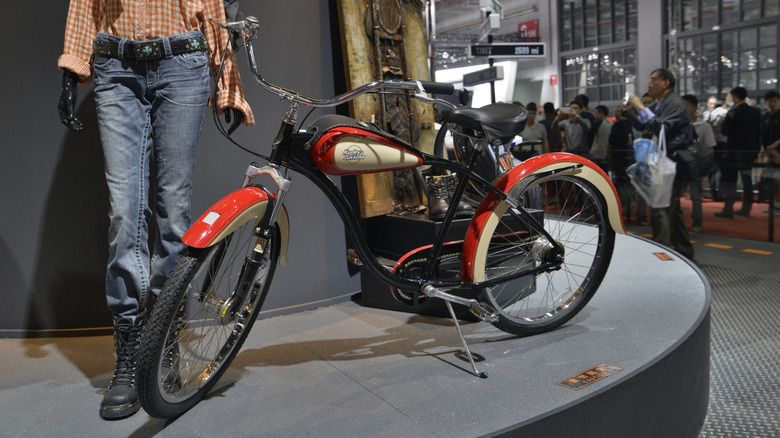
Do you love Harley-Davidson motorcycles? Then you'll love Harley-Davidson lawn chairs, turquoise earrings, cornhole boards, and teddy bears! Yes, those are all real products available on the official Harley-Davidson online store. The point is, Harley-Davidson is more than just a motorbike company. It's a cultural brand.
The Harley-Davidson logo is a ubiquitous cornerstone of American culture. It's not just about motorcycles, or even the motorcyclist's lifestyle, but about what it represents: freedom, rebellion, America, and the ability to travel anywhere in the country with nothing but two wheels and gas money. And yeah, sure, it's also about brand recognition, corporate synergy, and selling products, but that's not as glamorous.
In any case, Harley-Davidson is now so well-known that any product can carry the iconic H-D symbol, whether it's appropriate or not. Over the years, some truly bizarre items have been emblazoned with the Harley-Davidson shield. For this article, we're not looking at everyday merch like t-shirts, jewelry, or novelty playing card decks, but exclusively at machines and gadgets that have mechanical or electronic components. You may be a trivia master with knowledge of all the little-known facts about Harley-Davidson, but do you know these items? Here are five unusual products that wear the Harley-Davidson badge.
Golf carts
When you think about the average motorcycle enthusiast, you think of someone who doesn't follow the rules. They don't go to corporate meetings, they don't wear business suits and ties, they don't shave regularly. Maybe they don't shower regularly either, but that's not important right now.
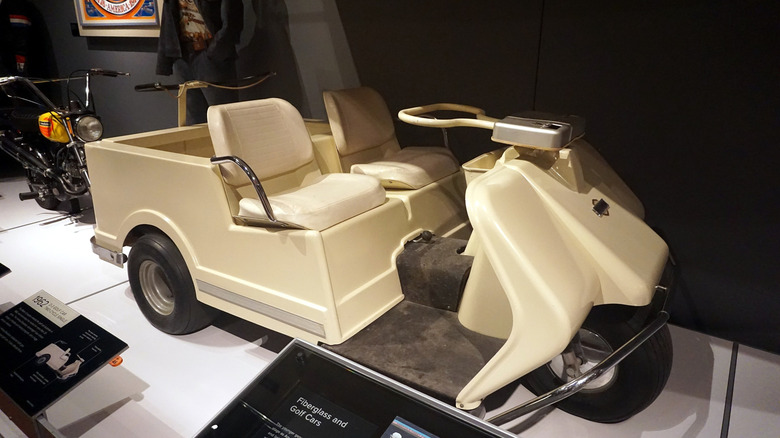
Oh, and they definitely don't play golf. Golf is for squares and politicians, not rebels who don't fit into conformist boxes. Nevertheless, Harley-Davidson started manufacturing golf carts back in 1963, and they continued to do so through 1969. The first H-D golf carts featured three wheels, and had vague ghosts of H-D design, though they were unmistakably golf carts first and foremost. Between 1963 and 1969, the design would evolve to include models with a fourth wheel and fully electric motors.
In 1969, Harley-Davidson was bought up by AMF (American Machine and Foundry), which continued making golf carts, though without the Harley-Davidson branding. Today, a genuine Harley-Davidson golf cart from the 1960s is a bona fide collector's item. It might not have the same pizzazz as a typical Harley-Davidson vehicle, but it is valuable, and an often-overlooked part of the company's history.
Snowmobiles
Riding a motorcycle during the winter months in particularly cold locations is ill-advised and potentially dangerous. Jeans, leather jackets, and gloves might protect you from wind and road rash, but they're not great at staving off the ice on the road. With that in mind, many riders either migrate south for the winter or put their bikes away in exchange for regular old cars.
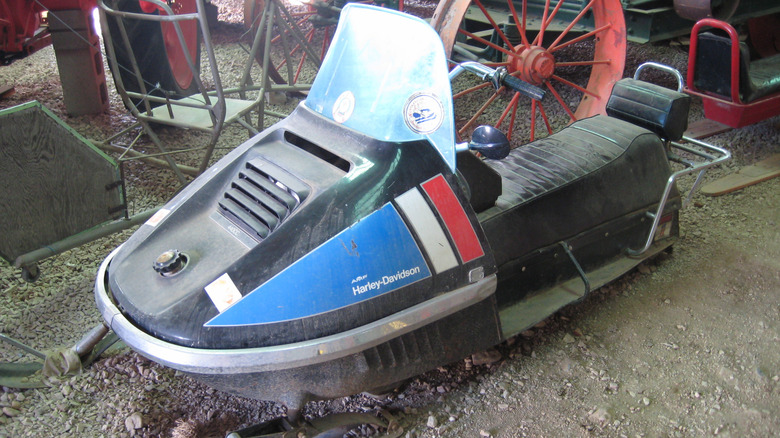
But Harley-Davidson believed there was a way to keep riders on Harleys even amidst a winter wonderland. Their solution was to create Harley-Davidson snowmobiles, the first of which hit the market in 1971. It was early in the AMF/Harley partnership, so it made sense for the "2.0" version of the company to experiment with new vehicles beyond traditional motorcycles. Thus, Harley-Davidson snowmobiles.
The Harley-Davidson snowmobile featured H-D's signature single-stroke engine and Harley-Davidson branding, but it was otherwise very similar to the existing Ski-Daddler snowmobiles manufactured by AMF before it bought Harley-Davidson. Alas, the Ski-Daddler wasn't an impressive or popular snowmobile, and the H-D branding was seen as something of a last-ditch effort to save the lineup. It didn't work, and the company stopped making snowmobiles altogether in 1975. This allowed Harley-Davidson to go back to what it does best: making motorcycles. Nowadays, only die-hard collectors know that Harley-Davidson branded snowmobiles even exist, let alone own one.
Bicycles
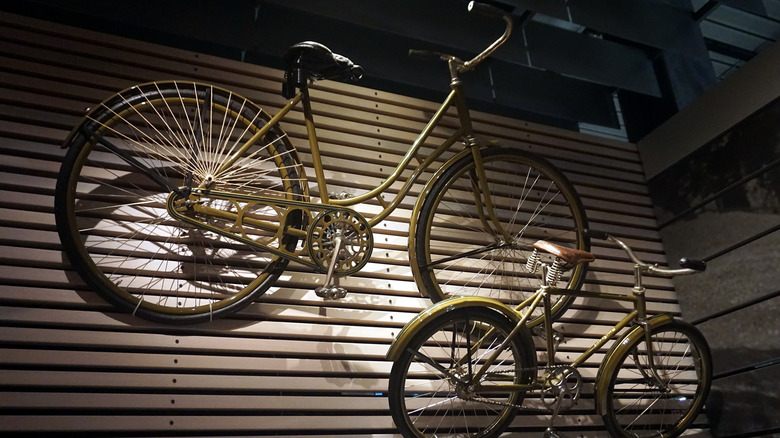
If you're a Harley-Davidson fan, you probably know that the company's first products, made in the early 1900s, were converted bicycles that ran on what would barely qualify as a rubber band engine today. It was a humble beginning, but everybody's got to start somewhere, right?
You might not know that those early experiments were not Harley-Davidson's last excursion with traditional bicycles. In 1916, the brand teamed up with the Davis Sewing Machine Company to produce bicycles. After the end of World War I and during the following recession, Harley-Davidson refocused its efforts squarely on motorcycles and officially pulled out of the bicycle business in 1921. Meanwhile, Davis Sewing Machine Company continued illegally manufacturing Harley-Davidson-branded bicycles, until it was forced to stop in 1923 by Arthur Davidson himself.
About one hundred years later, Harley-Davidson returned to the world of bicycles, but with a twist. If there's a halfway point between bikes and motorbikes, it's the e-bike. In 2020, the company launched the Serial 1 e-bike, which is named after the original Serial #1 motorcycle and proudly advertised as being "powered by Harley-Davidson." The Serial 1 is a bicycle with a small engine for getting up tricky hills and other difficult terrain. The company was quickly spun off into its own entity, and in 2023 was purchased by LEV Manufacturing, leaving Harley-Davidson once again without a line of old-school bicycles. Hopefully, it won't wait another century before giving it another go.
Electronic dartboards
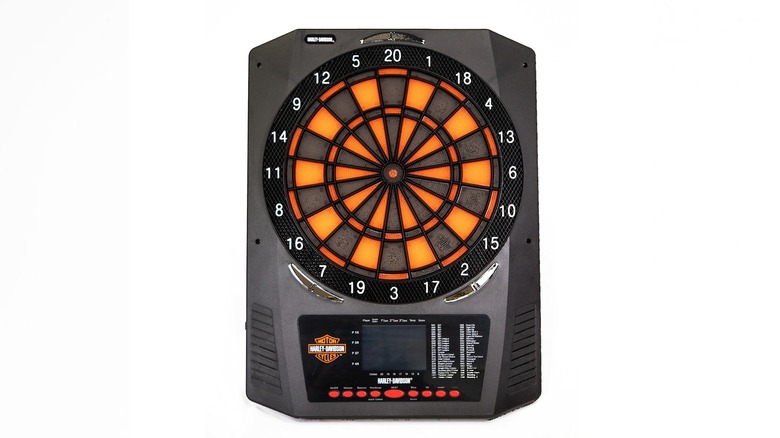
We're now entering the realm of the weird. This Harley-Davidson machine isn't even a vehicle, motorized or otherwise. Instead, it's an electronic dartboard. In fact, there are multiple dartboards available from the Harley-Davidson online store, in both the electronic and non-electronic varieties.
This exists as a result of the commercialization of the Harley-Davidson brand. Back in the old days, bikers were rugged outlaws who lived on the fringes of society. They were considered dangerous, and many a "bikersploitation" movie was made to capitalize on the phenomenon (be sure to check out "The Born Losers," which introduced the character of Billy Jack, one of the greatest heroes in cinema history). In an effort to rehabilitate its image into something more marketable to families, Harley-Davidson sanded down the rough edges of the biker mystique with commercial endeavors like theme restaurants and even a museum in Milwaukee.
As a result, biker-themed merch is now much more common than it was in the outlaw heyday of the past. For proof, look no further than the Harley-Davidson dartboard, perfect for a local dive bar or a wealthy stockbroker's basement pub. It's a little odd to have such frivolous items emblazoned with the Harley-Davidson badge, but at least it's biker-themed. Bikers go to bars, bars have dartboards, thus we have a Harley-Davidson dartboard.
USB charging adaptors
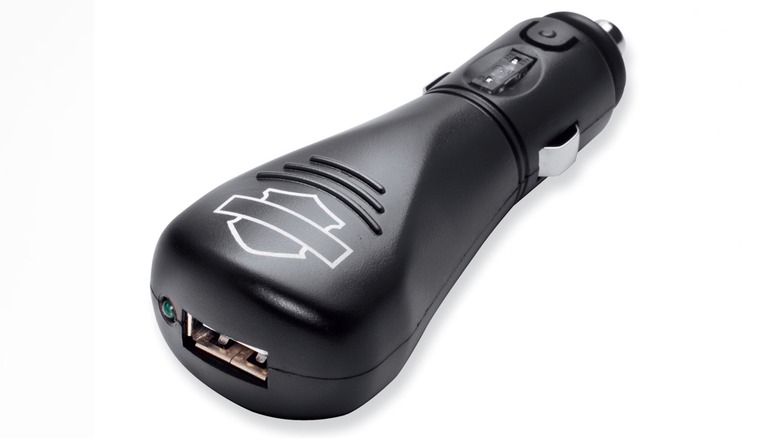
For proof positive that Harley-Davidson will put its logo on anything, check out this USB charging adaptor. At some point, the more items a company slaps its logo onto, the less meaning that logo has. Sure, a 12 volt USB charger works on a motorcycle, but it's hardly a motorcycle-specific accessory. It'll work on any 12-volt port like you'd find in most cars, but it somehow seems sacrilegious to have any kind of Harley-Davidson product in a four-wheeled vehicle.
There's nothing wrong with putting a recognizable name on anything and everything for branding purposes, but if you cross the line, it all becomes too much. Putting a Harley-Davidson logo on a USB charger represents that line perfectly.
Information on this USB charging adaptor is scarce, probably because it's just a 12V port to USB port adaptor. It seems to have an LED light to make sure the gadget is working, but that's it. You could buy two adaptors like this for $10; Pricing this one at $25 must mean that H-D logo was extremely expensive to print.