

Why Most Smart TVs Don't Use DisplayPort (Even Though It Beats HDMI)
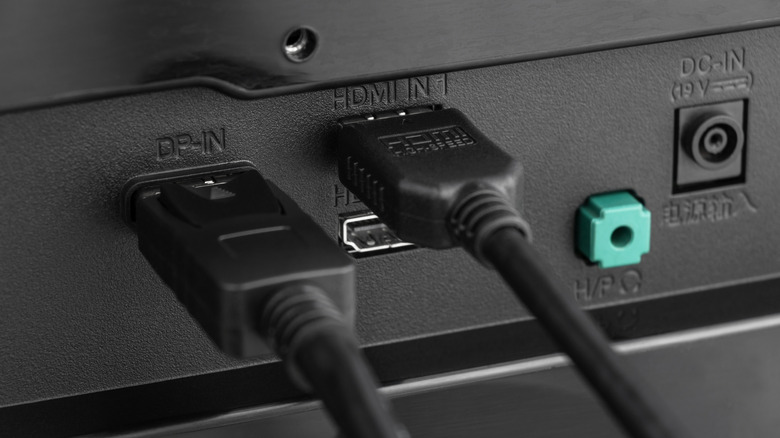
A typical smart TV usually has several HDMI ports for display input, while computer monitors are bound to have at least one DisplayPort connector, in addition to an HDMI port. Both digital interfaces may have started with significant feature distinctions and exclusions at the outset, but two decades after their inception, these competing interfaces have essentially attained feature parity. This is especially true for the HDMI 2.1b ports found in most modern smart televisions, which can display 4K content at 120Hz, support variable refresh rates (VRR), and accept HDR standards like Dolby Vision and HDR10+.
However, DisplayPort had a three-year head-start and began supporting 4K120 video with version 1.3 in 2014. It continues to have an advantage on paper, with DisplayPort 2.1a supporting a maximum bandwidth of 80Gbps, significantly greater than HDMI 2.1b's 48Gbps cap. That means that HDMI can't match DisplayPort's ability to render 8K content at 60Hz with uncompressed colors. DisplayPort also supports both AMD FreeSync and Nvidia G-Sync standards, uncompressed spatial audio formats, display daisy chaining, as well as outputting over USB cables via Alt Mode.
But if DisplayPort is clearly better than HDMI, why is it so rare on smart TVs? The answer is simply because HDMI is so deeply entrenched in televisions and associated devices. Any performance edge DisplayPort has over HDMI likely isn't significant enough to make up for the cost and complexity of incorporating a new digital interface.
HDMI has the first mover advantage and institutional inertia
HDMI's stranglehold on the television space rests on its long-standing presence and pedigree. The seven founding companies (including Sony, Panasonic, Toshiba, and Hitachi) banded together to create a modern digital interface in the early aughts, when the TV industry was moving on from bulky analog CRTs to digital flat-screen televisions. The HDMI interface's specifications are maintained by the HDMI Forum, which consists of over 80 stakeholders ranging from hardware manufacturers like LG, Samsung, and Sony to distribution giants like Netflix. The forum also includes around 2000 companies registered as HDMI adopters that pay thousands of dollars in licensing fees and additional royalties for each hardware device sold bearing the HDMI port and branding.
By the time DisplayPort arrived in 2006, the entire industry was already all-in on HDMI. Not even the lack of per-unit royalties, the relatively nominal one-time membership fee, or the absence of costly compliance or certification testing was enough to tempt television makers to adopt DisplayPort. This was despite the interface outperforming HDMI and being cheaper to integrate.
Given that almost everything you would connect to a TV, including Blu-Ray Players, video game consoles, set-top boxes, and streaming dongles, has adopted HDMI, it's almost impossible to justify the expensive and complicated process of integrating an additional digital interface that is usually only found on desktop computers. On top of that, while DisplayPort itself is royalty-free, manufacturers will still have to pay fees for digital content protection licenses and patents held by the VIA Licensing Alliance.
TV makers don't have compelling reasons to integrate DisplayPort
We have already established how DisplayPort does 8K60Hz in all its uncompressed glory, but HDMI 2.1 can also match the resolution and refresh rate, albeit with display stream compression. Having said that, 8K TV demand and penetration are so woefully low that major brands like Sony, LG, TCL, and Hisense have exited the market. Even Sony, which initially marketed 8K output for the PlayStation 5, eventually removed the branding from marketing materials.
There's no practical reason for TV makers to adopt DisplayPort over HDMI for a niche 8K60Hz application with virtually non-existent user demand. By the time 8K TVs show up in households, HDMI 2.2 will probably have penetrated the market. HDMI 2.2 was standardized in June 2025, and its 96Gbps throughput bests DisplayPort 2.1b.
Even at 48Gbps, HDMI is good enough to play console games at 4K120Hz with full VRR support on your smart TV, with major console players already integrating the experience seamlessly. Unless you explicitly plan on hooking up your monster gaming rig to your TV to play competitive games at insane refresh rates like 360Hz and beyond, there really isn't enough of a use case for DisplayPort compatibility on a TV. Meanwhile, the HDMI interface offers far more TV and home theater-oriented features like the HDMI CEC protocol that improve the living room experience.