

Why Did America Cap The Speed Limit At 55 In The '70s?
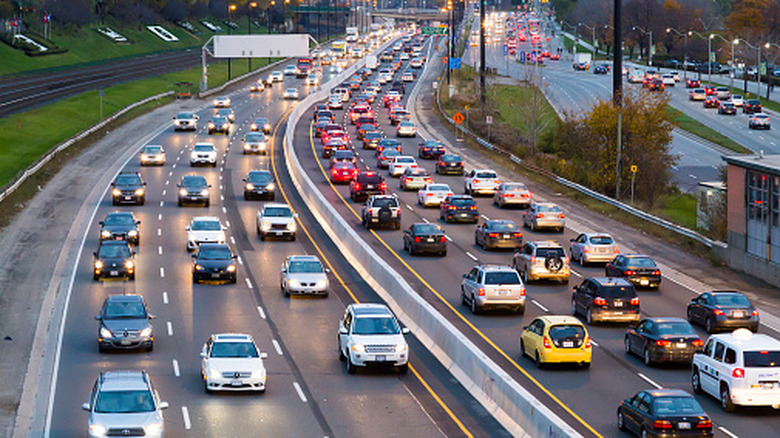
Gen X and prior demographics may remember when all the speed limits were hard capped to 55 mph. It was back in the 1970s and lasted through to the mid-1990s; no road in the United States had a speed limit over 55. It had numerous interesting repercussions lasting up until today, and we're not just talking about the popular Sammy Hagar song still being routinely blasted in karaoke bars.
One might assume that the national speed limit was put in place due to safety regulations or some arbitrary bureaucracy like the Chicken Tax, but the reality is because of the ongoing global crisis at the time. Back in 1973, Arab members of the Organization of Petroleum Exporting Countries (OPEC) placed an embargo on oil exports to the United States during the Arab-Israeli War, ushering in the Oil Crisis. This caused oil and fuel prices to dramatically surge overnight, effectively ending the Muscle Era and beginning the Malaise Era in automotive history.
Subsequently, then-president Richard Nixon agreed to nationalize a 55 mph speed limit for all states in 1974, a law which remained nationalized all the way up to 1995, when speed limits were officially returned to their host states. However, during the 1980s, interstate traffic went back up to 65 mph, thanks to vehicles getting more efficient overall.
The birth and death of the 55 mph speed limit
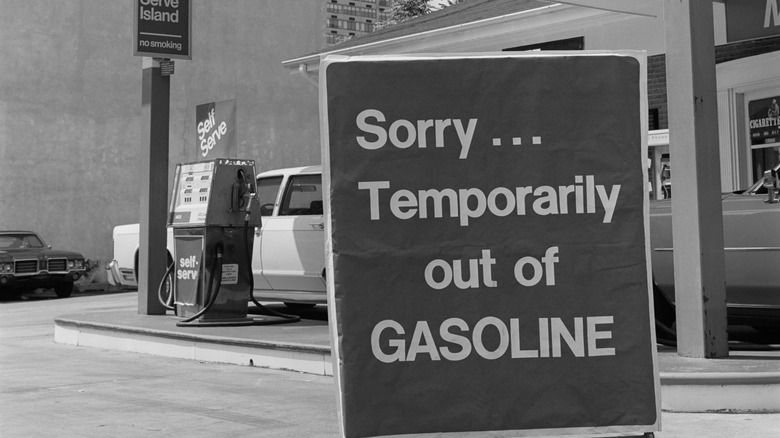
The 55-mph speed limit was imposed in 1974 as part of a nationwide effort to curtail the effects of the Oil Crisis. The law itself, called the Emergency Highway Energy Conservation Act, was the first time any speed limit was set by an entity other than the host state. prior to this, states set their own speed limits, ranging from 40 to 80 mph. The law marked just one example of a whole host of consequences of the oil embargo, with the U.S. and European economies going into recessions overall.
According to the speech given by Nixon during the act's announcement, the speed limit was projected to save upwards of 200,000 barrels of fuel per day. It also committed the use of highway funds to "to support the cost of carpool demonstration projects." Coupled with the Department of Transportation optimization of highways for carpoolers, the intent was to reduce traffic congestion. The law also prohibited the Department of Transportation from approving new projects or funding existing ones within states that didn't comply with the new speed limit.
The Emergency Highway Energy Conservation Act remained in force until April 1987, when Congress passed the Surface Transportation and Uniform Relocation Assistance Act. This permitted states to raise the speed limit to 65 mph for interstate highways, though the 55-mph law remained on the books until November 28, 1995, and the passing of the National Highway Designation Act. This law is what governs how highway speed limits are set to this day — on a state-by-state basis, with the limits themselves continuing to fluctuate.
Long-term consequences
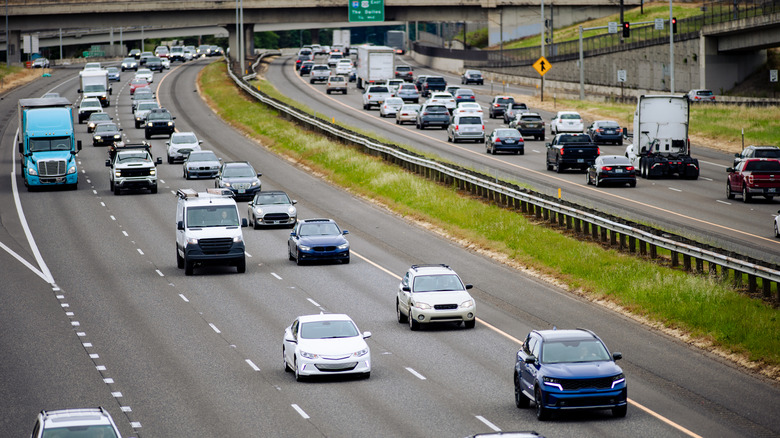
There were two oil crises that created what we know as the Malaise Era: The 1973 and 1979 Oil Crises, respectively. These drove car companies to produce lighter, more fuel-efficient vehicles which were optimized for low-speed driving. Even speedometers were hard-capped to 85 mph. However, this also meant that accidents weren't as fast as they used to be, either. In fact, in 1973, the number of road fatalities totaled to 54,052; and in 1974, that number dropped to 45,196. The correlation was obvious, and proponents of the 55-mph law cited the reduced fatalities as a key factor in maintaining the law into the 1990s.
According to the National Institute of Health (NIH), since the law was repealed in 1995 up to 2005, there was an increase in traffic fatalities by 3.2 percent. Its quoted estimate claims that in that decade, approximately 12,545 deaths and 36,583 injuries (with a 95% confidence interval) occurred as a direct result of the speed limits increasing. These numbers are likely lower today, thanks in part to modern safety innovations such as new signage, pavement types, equipment like collapsible barricades and water barrels at key junctions, plus red light and speed cameras.
Nevertheless, there's no substitute for lowering the kinetic energy of an impact, and nothing does that better than driving slower. To this end, the NIH proposes a lowering of speed limits once again to offset fossil fuel demand and reduce motor vehicle crashes. Ultimately, though, that decision rests in state courts, for better or worse.