

5 Sports Cars With The Best Fuel Economy In 2026
Spirited driving and saving fuel isn't a combination that usually goes together, but if you want a sports car that won't cost a fortune at the fuel pump when you're not flooring it, there are more options on the market than you might think. The most efficient new sports cars sport EPA ratings that wouldn't look out of place on the spec sheet of the average family sedan or small SUV. Yet, they'll all be far more fun whether you're canyon carving on the weekends or just heading out on the daily commute.
Although cars with manual transmissions only make up a tiny fraction of the new car market, there's still one car on the market that offers class-leading efficiency with a stick shift too. If you're looking to keep your spending at the fuel pump in check but don't want to compromise on driving fun, these wallet-friendly sports cars are the best bets in 2026.
BMW Z4
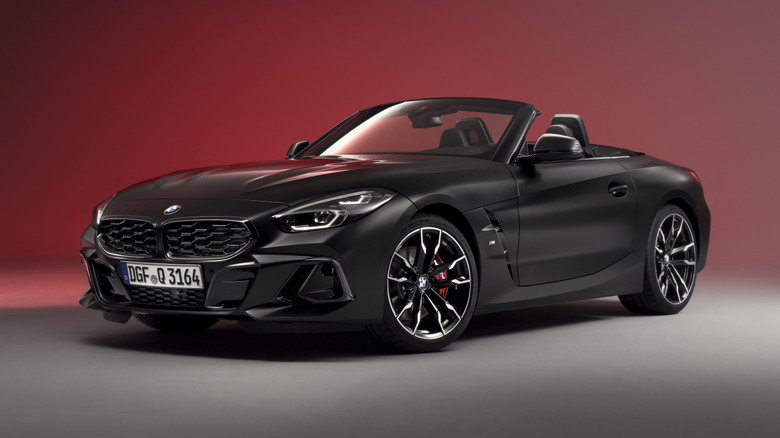
The most efficient version of BMW's sporty convertible is the Z4 sDrive30i, which achieves 28 mpg combined according to the EPA. Even the more potent Z4 M40i isn't far behind, hitting 25 mpg combined. The catch is that BMW requires drivers to buy premium gasoline, but many of the other cars here come with the same requirement. With a full tank, the sDrive30i can drive 384 miles before it runs dry, according to official estimates.
It's not often that a car turns out to be more efficient in the real world than its efficiency numbers suggest, but our reviewer managed to eke 30 mpg out of the Z4 M40i when they tested it in Eco Pro mode. Of course, the appeal of a car like this isn't to drive it around as frugally as possible, but even in its other driving modes, the Z4 remained impressively efficient for a sports car.
That's not to say that most drivers will be necessarily thinking about efficiency figures when they drive the car. Whether it was cruising on a long road trip or testing the car's ability to go sideways in the snow, our reviewer found the Z4 thoroughly enjoyable to be behind the wheel of. It might be one of the priciest and least practical options here, but the driving experience more than makes up for it.
Toyota GR Supra
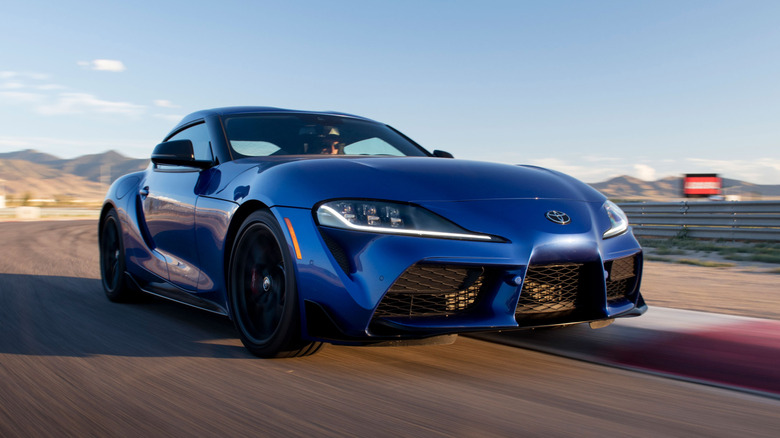
Toyota has offered the GR Supra in both 2.0-liter and 3.0-liter form throughout much of its production run, with the smaller engine being the more efficient of the two by a small margin. Owners with a 2.0-liter Supra can expect to see 27 mpg combined according to the EPA, while the 3.0-liter should return 25 mpg. Anyone who opts for the smaller engine will miss out on the exhaust note of the range-topping car, but we thought the power of the entry-level option was still more than ample to have fun.
Buyers looking for a brand new Supra no longer have a choice between the two powertrains, since the 3.0-liter is the only engine option on offer as the car's production run draws to a close. The range-topping variant is the MkV Final Edition, which starts from roughly $70,000, while the entry-level Supra is now the 3.0. It costs just under $60,000 before you tick any options.
After 2026, the Supra will be discontinued, much to the chagrin of many enthusiasts. It's not a direct decision made by Toyota, but rather it comes as a knock-on effect of BMW's decision to cancel the closely-related Z4. Both cars are currently made in the same facility, and with the Z4 on the chopping block, the Supra had to follow.
Mazda Miata
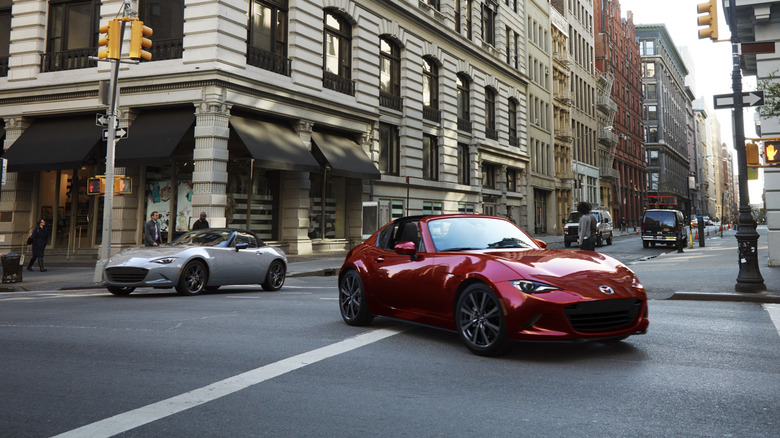
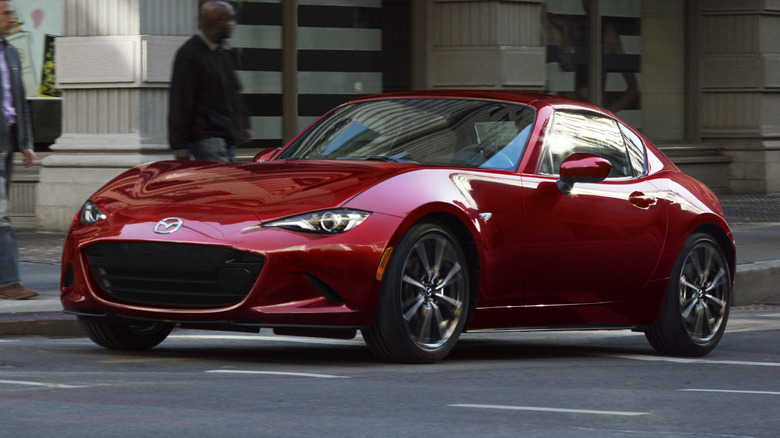
While several of 2026's most efficient sports cars won't be around for much longer, others aren't going anywhere. The next generation Mazda MX-5 Miata is already in development, and in the meantime, the current generation remains one of the most fun cars in its price bracket. It's affordably priced and it won't break the bank to keep running either. In part, that's due to its strong efficiency figures, with both automatic and manual versions of the car averaging 29 mpg combined according to the EPA.
Miatas also have a reputation for being cheap to maintain and repair, with RepairPal estimating a $349 annual cost on average. That's less than its estimate for maintaining and repairing a Toyota Camry. On paper then, the Miata is a great affordable sports car, but that doesn't matter all that much if it isn't fun to drive.
Thankfully, as any Miata owner will likely be more than happy to tell you, it is indeed great fun on the road. We found the manual transmission in the latest generation to be a particular highlight, but even an automatic Miata will still be far more engaging than most other cars on the road.
Ford Mustang EcoBoost
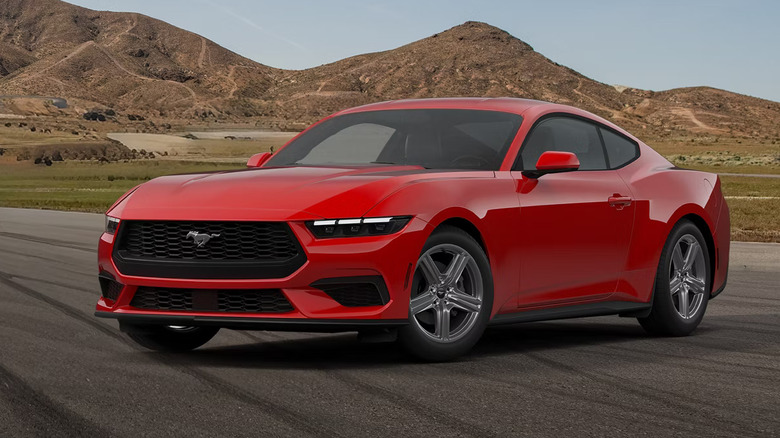
Purists are never going to be thrilled about the idea of a Mustang with four cylinders, but look past the cylinder count and you'll find a car with the performance to match many V8 classics. Ford has managed to create a car that feels similar enough to a traditional muscle car, albeit without the added grunt of the 5.0-liter V8 engine that higher trims receive. Though, it doesn't drink fuel like a traditional gas guzzler.
EPA figures put the Mustang Ecoboost's combined rating at 26 mpg, although our reviewer's testing found that number to be slightly optimistic. In the real world, the four-cylinder Mustang returned just over 20 mpg, making it less efficient than most other four-cylinder cars, but still more efficient than its V8-powered lineup sibling. The good news is that, unlike the previously listed cars, it requires regular gasoline, not premium.
Fuel only forms part of the equation when it comes to weighing up the appeal of the EcoBoost versus the traditional V8 Mustang. Price is also a big differentiator between the two, with the base EcoBoost starting from $34,635 (including a $1,995 destination fee) while the GT costs $48,555. Regardless of the four-cylinder naysayers, those combined savings will be enough to convince many buyers that the EcoBoost is the better compromise.
Honda Prelude
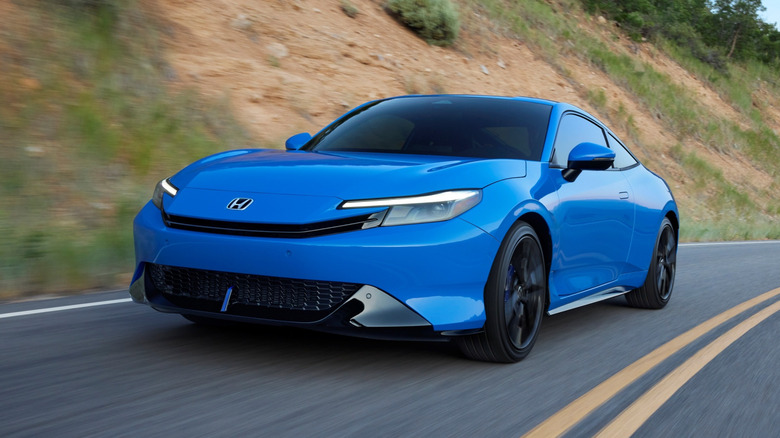
There's plenty of debate over whether Honda's new Prelude is a proper sports car or a nostalgia-baiting pastiche, and whether its considerable asking price is justified. There's no clear answer to either question, but what is clear is that the Prelude is one of the most efficient sporty cars on the market.
Depending on what you define as a sports car, it might even be the most efficient new sports car in 2026. According to the EPA, the Prelude will achieve 44 mpg combined and up to 46 mpg in the city, and there's no requirement to fill it with premium gas either. The agency estimates that owners will spend $4,250 less on fuel over five years of ownership compared to the average new car, assuming an annual mileage of 15,000 miles.
This efficiency comes courtesy of Honda's hybrid powertrain, which is shared with the Civic. With 200 horsepower on tap, it's down on power compared to virtually every other sports car on the market. Although, you wouldn't know by its asking price: at a starting price of $43,195 (including a $1,195 destination fee), it's only a couple of thousand dollars less than a 400 horsepower Nissan Z. Honda's similarly sporty Civic Si starts over $10,000 cheaper. Although it's significantly less efficient, even with the added fuel costs, the Si should still work out as a cheaper purchase overall.