

The Worst Cars For Fuel Economy All Have Something In Common
There are two types of car buyers. One wants a point-A-to-point-B machine — reliable, efficient, and perfectly adequate. The other kind is the enthusiast, someone who thinks of a car as both transportation and a source of pleasure and excitement. These buyers chase luxury, performance, and the kind of driving experience that can't be measured in miles per gallon. It should come as no surprise, then, that enthusiast vehicles consistently top the list of the worst cars for fuel economy.
Take a look at every new car on sale ranked by EPA fuel efficiency figures, and a clear pattern emerges among the worst offenders. There is no efficiency-focused hybrid assistance or tiny three-cylinder turbo engines here — these vehicles are built for power and capability. This is also why every single vehicle mentioned in our luxury cars with the worst MPG article is an enthusiast's luxury performance car. What they share is displacement, ambition, and a total indifference to the pump.
The Lamborghini Revuelto pairs a 6.5-liter V12 with three electric motors, and still only manages 12 mpg. The Ferrari Purosangue takes that same 6.5-liter V12 formula and drops it into an SUV body, also arriving at 12 combined mpg. The Rolls-Royce Ghost brings a 6.75-liter twin-turbo V12 to the party and delivers 14 mpg combined. The common thread? They take a supercar, an SUV, and a luxury sedan and turn them up to 11 with a 12-cylinder engine, with no regard for fuel efficiency whatsoever.
Product philosophy over efficiency
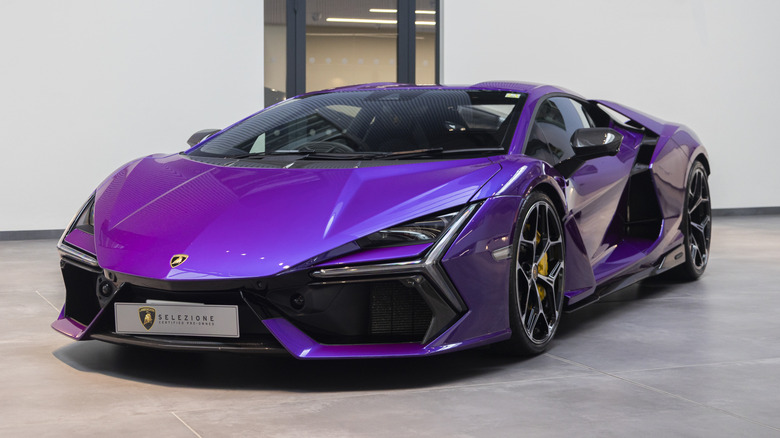
The Lamborghini Revuelto is a hybrid, but it's still rated at 12 mpg. That alone tells you everything you need to know about how a hybrid badge doesn't automatically translate to efficiency. It's reminiscent of Jeremy Clarkson's Top Gear review of the McLaren P1, where he noted that McLaren took hybrid technology – "which is designed to reduce the impact of the internal combustion engine" — and used it to increase the impact instead. "That's like weaponising a wind farm," he said.
The Revuelto operates on the exact same philosophy. Three electric motors, a 6.5-liter V12, and 1,015 horsepower — the electricity isn't there to save fuel, it's there to make the combustion engine hit harder. But then again, the kind of person writing a check for a Lamborghini V12 was never cross-shopping it against a Prius. The Ferrari Purosangue is an SUV, and it takes a similar approach in a totally different market segment. The Puro represents Ferrari's take on what a dynamic SUV ought to be, so much so that Ferrari refuses to call it an SUV, but rather an FUV (Ferrari Utility Vehicle).
The Rolls-Royce Ghost's 6.75-liter twin-turbo V12 manages just 14 mpg, and that is because the V12 was chosen because it was smooth and effortless, not necessarily because of the power or anything else. These three represent the ultra-luxury car market perfectly. Cars that operate in this segment are over-the-top cars, cars that are bought by people with totally different priorities. They break boundaries, they don't follow mainstream trends, and they sacrifice common adequacy of mass market cars for performance, capability, and luxury.
Different rules of the high-end car market
Buying a luxury product is rarely the rational choice. It is viewed in a totally different way compared to a more mainstream product. In the car market, this is truer than in most. If we take a look at a regular BMW 3-Series and a BMW M3, we can see this distinction even without having to go to the ultra-high end market. The base-spec BMW 330i starts at $48,000, the BMW M3 starts at $79,300. The M3 gets bigger wheels, a rougher ride, worse fuel economy, noisier tires, and less sound deadening.
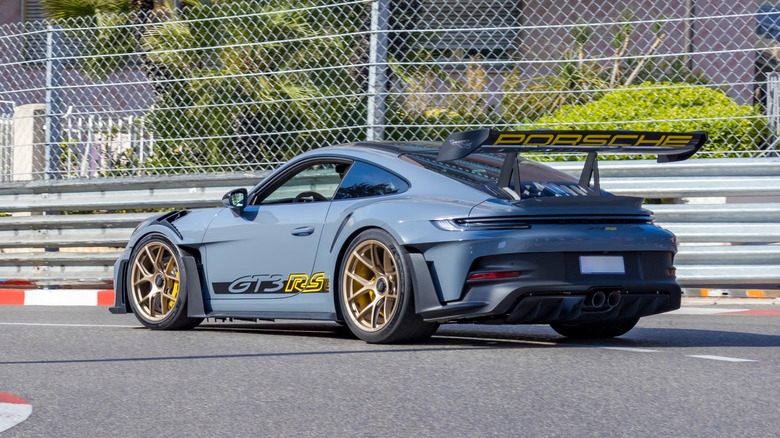
For someone who does not care about the M3 badge, you could make an argument that, since these are luxury cars, the base 3-Series does luxury better than the M3. The $135,000 base 911 compared to a 911 GT3 RS that starts at almost double that amount is similar. The GT3 RS is much louder, has two fewer seats, it doesn't have normal door pulls, has less trunk space, and it's all about performance.
This is because the people who buy the M3 and the GT3 RS want that. They want the rough ride and the noise, they want the capability. They aren't shopping for luxury the way most people understand it — they're shopping for a feeling, the excitement. That is what separates the enthusiast from the mass-market buyer: The things they value most are often objectively worse by conventional measures, yet more desirable for it.