

How Do Temporary Traffic Lights Work?
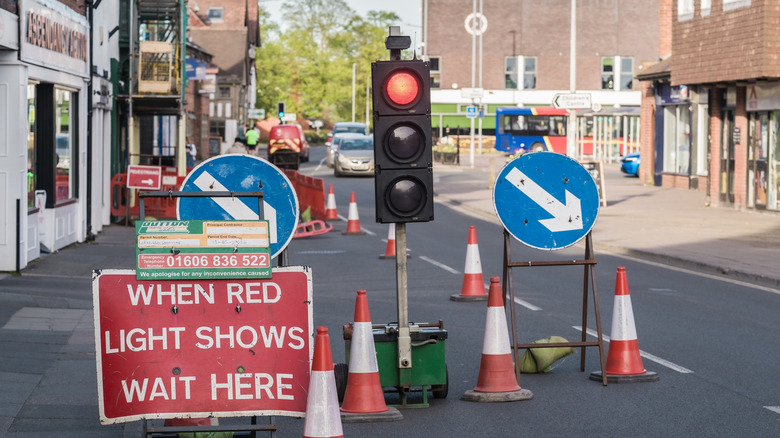
Road construction work is often a messy business, even more so when it's around crucial routes. But unless there's a detour sending cars down an entirely different path, traffic can't just stop, meaning it has to be managed. Since regular signals are often unavailable in these cases — especially when they themselves are under maintenance — the job is relegated to temporary traffic lights instead. At their core, these are self-contained signal heads that crews drop in on site, each with its own power source and a programmable controller.
While they throw the same red, amber, and green signals at drivers as regular lights, the guts are quite different. Every portable unit contains a programmable control unit that does the thinking, handling things like timing, sequencing, and any data coming in from sensors. Crews configure it on site for that specific job, rather than it being tied into a wider city-wide management network the way many permanent signals are. Power is also handled differently — depending on the setup, it can come from a battery trailer, a solar panel, a fuel-powered generator, a mains hookup, or some hybrid combination of those. Permanent signals, by contrast, are typically plugged straight into the local electrical grid.
Manual mode, automatic mode, and synced setups
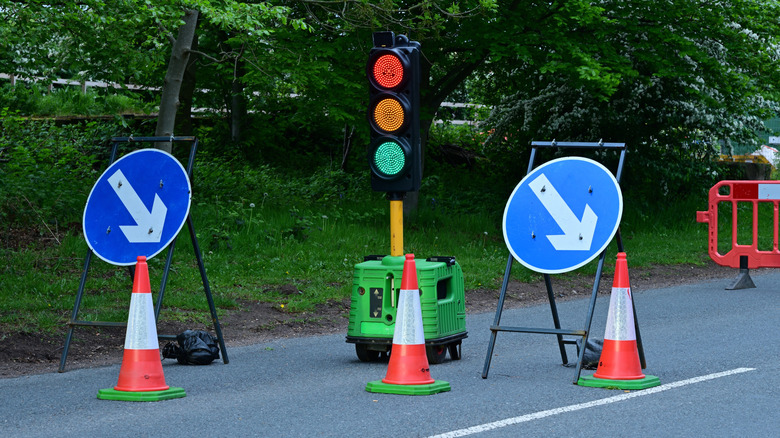
Crews can run the signals in one of two modes. In manual mode, an operator stands at a safe spot and toggles the lights using a remote. This works well when traffic is patchy because a person on the scene can read the situation better than a sensor ever could. But for most other times, the automatic mode is used. Sensors on the unit watch for vehicles at the stop line in a manner that's not too different from how car-sensitive traffic lights detect your car at a regular intersection. The detection method varies depending on the model — infrared is common, but some setups use radar, microwave, or camera-based detection. Once a vehicle is spotted and all's clear, the controller flips the signal to green. It then waits for everyone to pass through before cycling back to red and giving the other side a turn.
Roadwork sites rarely need just one traffic light, though. And when there's more than a single unit — say in a two-way or four-way setup — they have to sync wirelessly to coordinate between themselves. The control unit inside helps do that, since it's also capable of chatting with other signals through a serial bus. The whole thing works very similarly to 'Green Wave' setups that planners run on urban traffic lights, where cars following the speed limit catch consecutive greens through a stretch of intersections.
Out in the wild, and where they came from
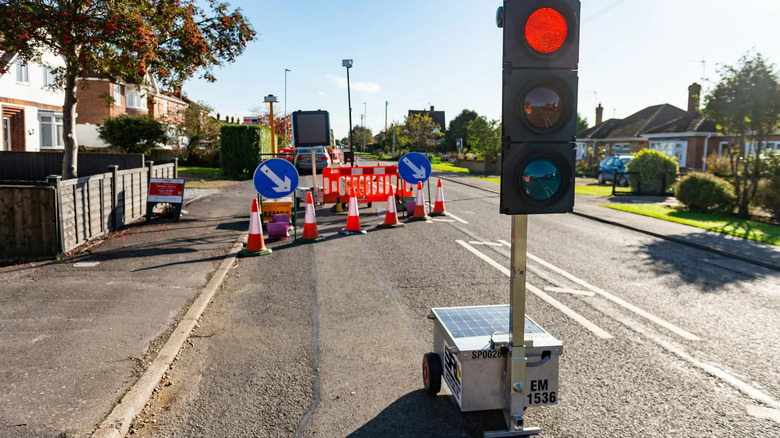
Looks-wise, temporary traffic lights are pretty much identical to the ones at a normal intersection up top, with the familiar red, amber, and green LEDs. The setup underneath varies though. Some are mounted on a stand or pole that crews bolt down on site, while others sit on trailers with wheels and folding frames so they can be towed away once the job is over. There's a whole spread of temporary systems out there — compact portable units, larger trailer-mounted rigs, single-lane alternating setups for narrow stretches of road where only one direction can flow at a time, and full temporary intersection systems that mimic a four-way junction with multiple synced signals.
Either way, the whole point is to skip the need for permanent traffic infrastructure. Most projects they're used for are short-term, like emergency repairs, utility work on water or gas lines, or sections of road where the regular signals are getting serviced. They also come in handy at parades, marathons, and large public gatherings, since the usual traffic patterns get scrambled for a few hours.
Today, this kind of automated setup is the norm. But many decades ago, traffic at messy worksites was usually managed by officers who had to physically rotate signals by hand at every junction. It was a tedious process, not too different from how traffic lights worked before computers were invented. It was dangerous too, since these officers often had to stand right next to moving vehicles. And that's exactly why temporary traffic lights had to take over.