

What Does 'Call The Ball' Mean For Navy Pilots Landing On Aircraft Carriers?
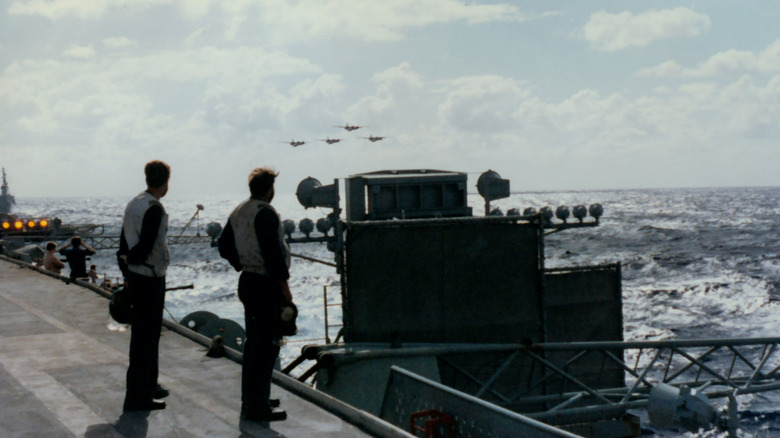
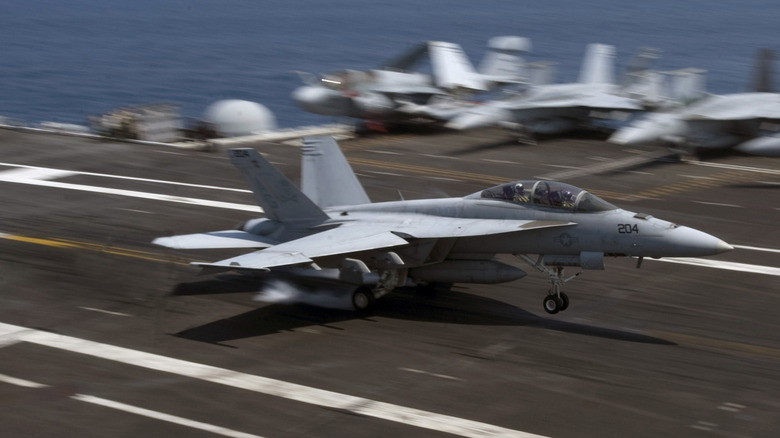
Navy pilots make landing at sea look routine and easy. However, step back a moment to consider how planes land on aircraft carriers, and you soon realize that "looking routine" is just an illusion — after all, the fact that it's essentially thought of as a controlled crash says a lot.
One of the systems designed to help keep this so-called crash landing under control is an optical landing system that consists of lights, mirrors, and lenses. These lights let pilots know they're on the correct glide path. And, in an increasingly high-tech U.S. Navy, it's rather comforting to note that this piece of technology was first proposed in the 1950s by a British test pilot, Commander Nicholas Goodhart, who developed the concept with nothing more than a secretary's mirror, a torch, and some lipstick.
A scaled-up version of the system — presumably, sans lipstick — was installed on a British aircraft carrier, the HMS Illustrious, in 1953. The system used a concave mirror reflecting bright light towards an approaching aircraft. The pilot would compare the position of the reflected light against a row of fixed reference lights; when they lined up correctly, the pilot knew they were on the correct glide path.
Today's pilots track the motion of a bright amber light known as the meatball. On approach, the Landing Signal Operator will ask the pilot to "call the ball"; by acknowledging, the pilot confirms they see the IFLOLS. This light is part of the Improved Fresnel Lens Optical Landing System (IFLOLS) installed on modern carriers, including the world's most advanced aircraft carrier. While it's a more advanced system, the underlying principle is identical to Goodhart's invention.
The importance of calling the ball
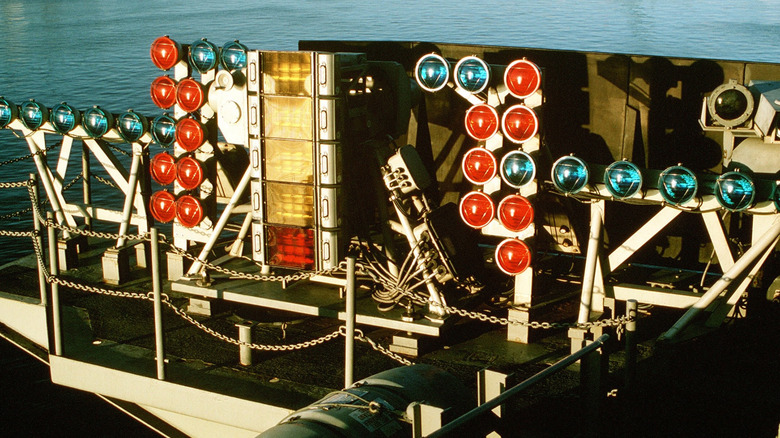
If one fact can be used to demonstrate just how game-changing this system was, it's that, by 1955, just two years after the Royal Navy had tested the prototype, the system was installed on every single U.S. Navy aircraft carrier. For pilots, the system offered one huge advantage: immediacy. Rather than relying on deck crew signals to indicate how the approach was going, the system gave them real-time information they could react to instantly. While much-improved Fresnel lenses have replaced the original mirrors, naval aviators from the 1950s onwards will still recognize the system.
While the "meatball" is the cue for the pilots to aim at, the system's datum lights are also critical. For a pilot, the trick is to keep the bright amber light centered on the fixed row of green datum lights either side of the meatball. If the ball is centered, then the aircraft is on the correct glide slope of about 3.5 degrees. To keep the lights lined up correctly, the pilot makes fine adjustments from about three-quarters of a mile out — where it appears as a 7.5-inch ball — during daylight landings. Pilots can start preparing for landing from double that distance during night landings, as the ball is easier to spot in low light.
Fun fact: The "meatball" was not named after the dinnertime favorite. Instead, it earned its nickname for its resemblance to Japan's Hinomaru flag (the red circle on a white background), which was often referred to as the meatball during World War II.
How the system works
Despite the concept's simplicity, the technology behind the system is fascinating. Let's begin by examining the light at the center of the story. The modern ball isn't generated from a single beam of light; rather, it uses a stack of 12 light cells and some incredibly clever optical manipulation.
The light from each cell travels through a series of reflectors, filters, and magnifying lenses to create that single ball-shaped image. This is the amber light that's visible from nearly a mile away in daylight. But, of course, nothing is ever straightforward in naval aviation, and we need to remember that all this is happening on the deck of a ship that could be pitching or rolling. To account for this, the 12 cells are housed in Stabilized Optic Tables (SOT). These use the ship's gyro system to keep the lights steady relative to the ship's movement.
Crucially, however, the meatball is stabilized to the horizon and not the ship. This means that from a pilot's perspective, the optical beam maintains a constant glide slope even when the carrier is in heavy seas. While the system still features on new ships like the USS John F. Kennedy, whose sea trials began in January 2026, the U.S. Navy's Joint Precision Approach and Landing System may eventually replace the current optical system. For a system invented with a mirror, flashlight, lipstick, and a bit of ingenuity, though, the optical system and its meatball haven't done too badly.