

5 Weapons & Vehicles The US Military Operates With XBOX Controllers
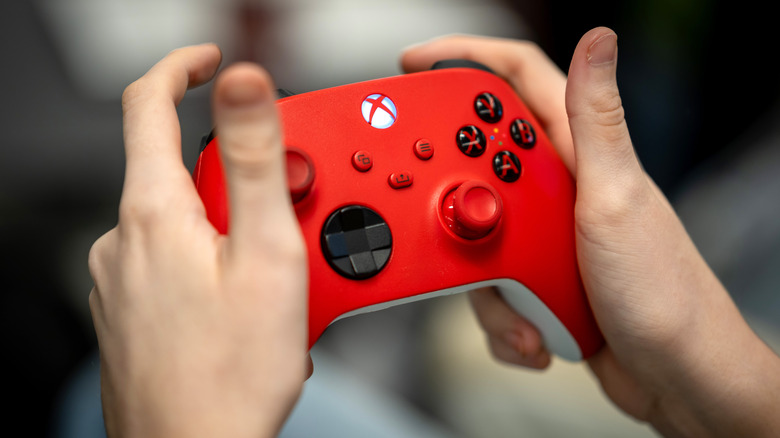
There is a long history shared between the US military and the video game industry. First-person shooter games have always been highly popular, making them excellent recruitment material. The military even made its own game franchise, pouring millions into the America's Army series. Young, impressionable boys dazzled by the power fantasy of digital war happily head off to bootcamp as a result, even if war and "Call of Duty" couldn't be more different; It worked with "Top Gun," so why not a game that puts you in a soldier's boots? But it's not just recruitment. The military uses gaming for training, so it should come as no surprise that they've deployed literal game controllers on the battlefield.
Quite a few pieces of military hardware use Xbox controllers, or controllers inspired by them. It is disturbing to imagine lives being taken by the same device used for living room entertainment, but it is what it is. We found five military vehicles and weapon systems that are operated with a console controller — sometimes a literal Xbox one.
Submarine photonics masts
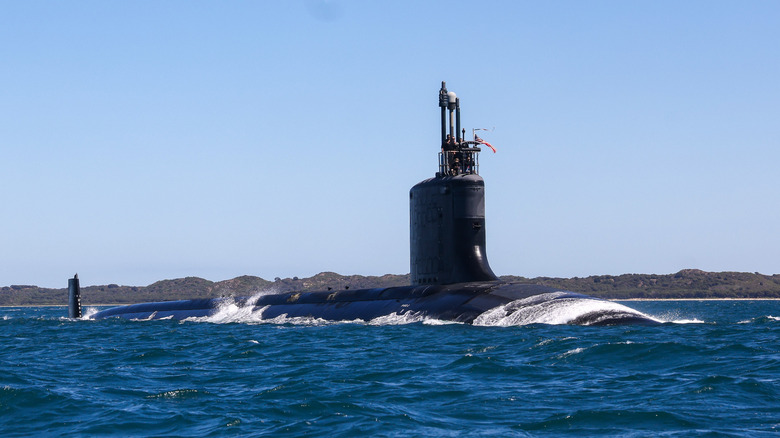
A photonics mast is effectively a modern periscope. Rather than going analog, with prisms and mirrors to glimpse what's going on above water, a photonics mast is all digital. It bundles in other functions, too, like antennas and rangefinders. Anyway, a photonics mast will regrettably deprive us of that classic movie depiction of periscopes. You know the one: A frenetic, sweaty sailor in a dark, red-lit command center with their forehead pressed into the viewfinder, swiveling around wildly, searching for enemy ships. Nowadays, the operator can sit back, relax, and control the whole thing with their thumbs.
In this case, they're using an honest-to-god Xbox 360 controller, or at least they used to back in 2017, when this was starting to become the norm on Virginia-class submarines. It seems this wasn't the original design, however. Prior to Xbox controllers, operators had to grin and bear it with an expensive, unintuitive stick controller, and their honest feedback drove the Navy to integrate the cheaper, more familiar control scheme. We imagine people get a bit of whiplash walking onto a submarine that costs billions of dollars and seeing something consumers can buy for the price of a nice lunch.
It's unclear if the Navy continues to use controllers now, 9 years since that news broke. It's possible they've graduated to the FMCU (Freedom of Movement Control Unit), a console-esque controller designed for military purposes. All we can hope is that, whatever solution they choose, it doesn't get stick drift.
NMESIS, M-SHORAD, and RABDO
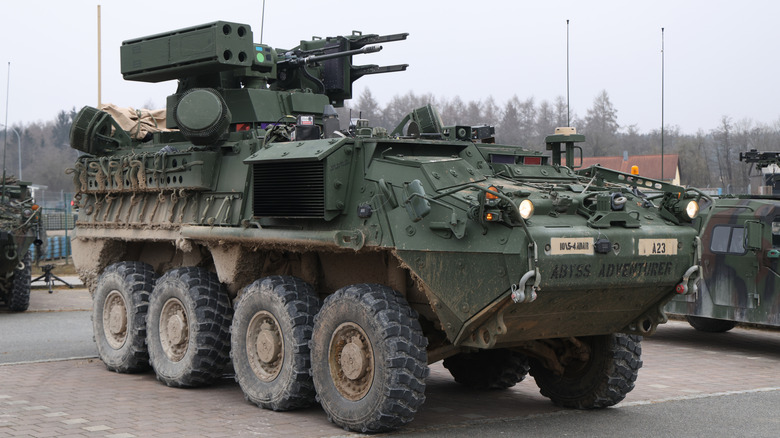
A photonics mast is a pretty harmless use of a video game controller. Where it starts to get more uncomfortable is seeing it in weapons systems. According to Task & Purpose, NMESIS (Navy/Marine Expeditionary Ship Interdiction System) and M-SHORAD (Maneuver Short Range Air Defense) are two systems that use the Xbox-reminiscent FMCU. The details are unclear, but we imagine soldiers holding an FMCU controller aim with a thumbstick and press a button to open fire. M-SHORAD is in active military use in Europe, too.
Fortunately, there are situations where these FMCU controllers are used for less lethal means. Take the Air Force's RABDO MRAP truck (RABDO is a military program, short for Recovery of Airbase Denied By Ordnance, and MRAP stands for Mine-Resistant Ambush Protected), a machine capable of blowing up mines with laser guns. Yes, you read that right. Seated somewhere in the cabin, there's probably a soldier with an FMCU controller minesweeping in the most cyberpunk way imaginable.
There's plenty of evidence of an FMCU controller in the hands of soldiers across military branches. Marines are in testing for a HELEX laser system that seemingly uses the FMCU, and the Army uses it for drones. Using game controllers for real-life military purposes seems to be on the rise globally, too. Just look at Ukraine's drone industry and mastery of drone warfare in its defense against Russia. We imagine the only thing that will change this trend is fully AI-controlled war machines that make a controller pointless.
LOCUST Laser System
Lasers are becoming an important part of warfare, especially now that drones are completely flipping the battlefield. One such system is LOCUST, a weapon system that deletes drones out of the sky with dozens of kilowatts of energy. Importantly, it's a versatile system. It works on Army trucks and Navy ships. This is not some in-development technology that hasn't yet proven itself for battlefield duty, by the way. While limited in some aspects, live-fire events have shown it to be incredibly effective at sending drones spinning and burning down from the sky. And guess what? It appears to use an Xbox controller, too.
Admittedly, the evidence for this is based solely off of a "60 Minutes" interview with a controlled demonstration. Perhaps LOCUST uses something else, like the FMCU, when in the field. Further, the demonstration shows how advanced AI systems do a lot of the work here, and the LOCUST relies on manual input primarily to sight and OK targets. Nonetheless, it proves that these high-tech weapon systems that cost millions or billions of dollars still need a humble Xbox controller, at least sometimes, to help them do their job.
EOD robots
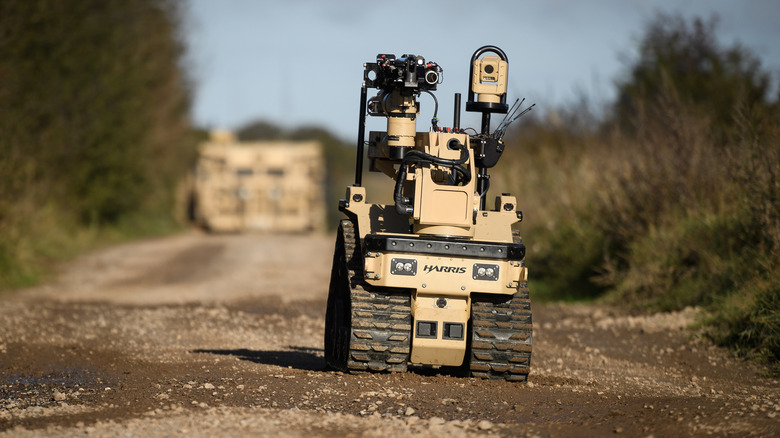
Working EOD (Explosive Ordinance Disposal) is a perilous job. Look no further than the portrayal of the job in "The Hurt Locker," in which soldiers undertake the gut-wrenching task of locating and disabling IEDs. It's always better to send out the robot if possible. And in some cases, those robots are controlled with — you guessed it — Xbox controllers.
A picture from Defense Visual Information Distribution Service shows a soldier using one to maneuver a Pacbot 310 in Afghanistan in 2011. We've seen soldiers do the same with other EOD robots, such as the Andros FX. It's possible law enforcement officers may be using Xbox controllers for their own bots, too.
Having said that, the Xbox controller may not be the default anymore. The Andros FX EOD robot has been shown in some cases to use a controller-screen combination that looks like the military's version of the Wii U. Naturally, a complex robot with a multijoint articulating arm might be somewhat limited by two thumbsticks and a few buttons.
Merops drone interceptors
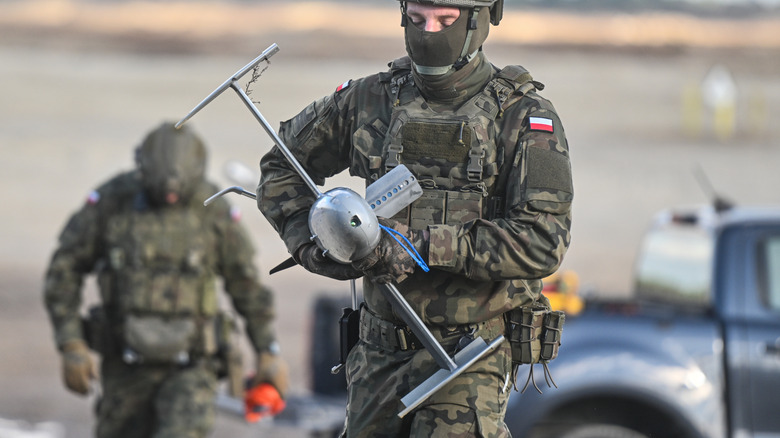
Consumer drones have used game-like controllers for a long time, though they're clearly more inspired by RC remote controllers than Xbox controllers. In the military, however, there are situations where drones used in active warfare quite literally rely on game controllers. Business Insider (via AOL) reports how America's Merops Interceptor drone system uses Xbox controllers. Not the FMCU or an Xbox-like controller, but a genuine Xbox controller intended for video games. When one of those drones can cost $15,000 a pop, a controller you can grab for around $60 is not a bad deal.
Cost is only part of the equation. Ukrainian drone operators sometimes attribute their success (in part) to a background in video games (via Reuters), demonstrating that a video game controller can actually be perfectly suited to these sorts of applications. A video on The Wall Street Journal YouTube channel even shows Ukrainian drone operators training with video games before deploying that knowledge on the front lines, presumably building on their previous experience playing video games on the same controller they use now.