

Does Resting Your Hand On The Shifter Wear Out A Manual Transmission?
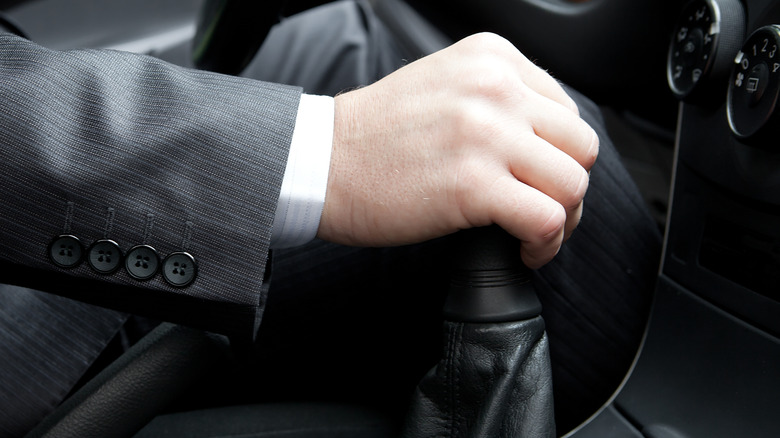
Resting your hand on a manual transmission's shift lever can definitely wear out certain parts of that transmission. And even though very few cars offer a manual transmission, there are still quite a few drivers who depend on a stick shift to get them around. So if you have been resting your hand on the shifter while you drive, please stop — we will now explain why this is bad for your car.
The shift lever on a manual transmission is connected to a complex mechanism full of moving parts that changes gears whenever you move that lever from one position to another — after disengaging the clutch, of course. The continuous pressure of your hand resting on the shift lever can greatly increase wear on the various parts of the transmission, which should only be subjected to momentary pressure when you shift up or down. These parts include items like selector forks and rotating collars of dog clutches, which have nothing to do with eating utensils or anything canine-related. But by resting your hand on that shift lever, you could end up causing severe wear to the dog clutch collar or even breaking one of the selector forks in the transmission.
Instead of resting your hand on the lever, keep both hands on the steering wheel and reach for the shift knob only when you shift. Change gears, then put your hand back on the wheel. Your transmission will thank you by lasting longer.
There's another very good reason why you shouldn't rest your hand on a manual shifter

Another very good reason not to rest your hand on the manual shifter has everything to do with safety. Having both hands on the steering wheel means you are ready to deal with any issues that may arise as you drive to your destination. Having two hands on the wheel at all times means that you are fully prepared to take action in the event of an emergency, whether that involves steering around an obstacle or just bringing your car to a quick and secure stop. Just keep in mind that in terms of your hand placement on the wheel, '9 and 3' is the new '10 and 2' steering wheel rule.
To recap, there are two great reasons to keep both of your hands firmly on the steering wheel of your manual transmission-equipped vehicle. One is to prevent excessive wear and tear on various components of your transmission, which could ultimately result in an expensive repair job. Another concern is maintaining the highest levels of safety while driving, which could make the difference between avoiding an accident and having one, with the possibility of injuries or worse for those inside your vehicle, as well as for pedestrians, cyclists, and other motorists. And if this topic has piqued your interest in acquiring a new car with a manual transmission, here's a list of the most affordable manual cars you can buy new in 2026.