

'9 And 3' Is The New '10 And 2' Steering Wheel Rule - And Here's Why

Years ago, we were taught to drive with our hands at the "10 and 2" positions on the steering wheel. This correlated to where the numbers on the face of a clock are located. That meant our left hand was placed at the 10 o'clock position while the right hand latched onto the wheel at the 2 o'clock slot. Steering wheels have come in all shapes and sizes but were generally much larger back in the era before the central hub was packed with an airbag, which wasn't federally mandated until 1998.
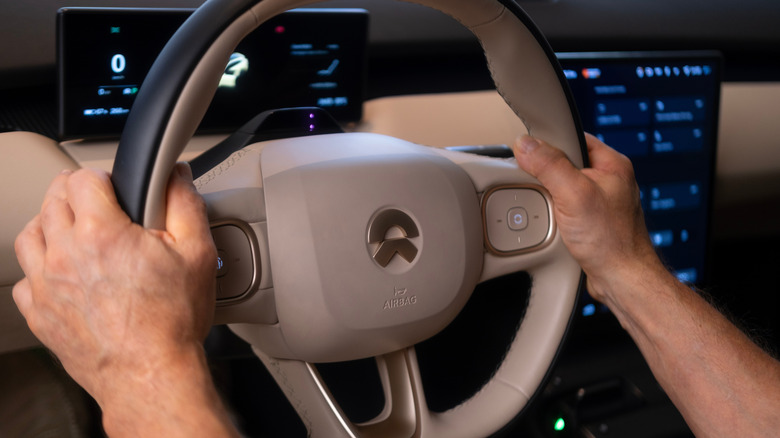
According to the National Highway Traffic Safety Administration, both hands should still be used to grip the wheel, but not at the customary ten o'clock and two o'clock positions we're familiar with. Instead, you should now grab the wheel, gently yet firmly with your fingers (never the palms) on the outside of the steering wheel (never inside the rim), thumbs pointed up at the now standard 9 o'clock and 3 o'clock positions.
Folks who continue to follow that old-school rule of the road are not only showing their age but are also (technically) doing it wrong. To be fair, though, it's hard to unlearn something that driver's ed instructors continually drilled into our heads. Be that as it may, what we were taught has since become outdated, thanks to modern technology and constantly evolving safety features that have now forced people to change where they place their hands on the steering wheel.
It's all in the hands
In 1956, the steering wheel found in a Chevrolet Bel Air or a Ford Fairlane was 20 inches in diameter. There was no power steering back then, so it required enormous strength and the leverage provided by the big wheel especially when it was stopped. Power steering has gone through many iterations over the decades. It was first introduced in a 1926 Pierce-Arrow but took until the 1950s for Chrysler's version (aka "Hydraguide") to become the model for modern power-assisted steering (PAS).
Still, it took until the mid-1970s before most new cars sold in the U.S. came standard with the feature. Yet, steering wheels remained large, and their diameter was, in fact, very important to the overall ability to drive the car. Smaller wheels allowed for quicker reaction times, but larger ones reduced the overall effort needed to crank the wheel in whatever direction the car needed to go.
Given all the technology packed into today's power steering, such as Electric Power Steering (EPS), the average diameter has shrunk dramatically to between 14 and 15 inches. Therefore, recommendations for hand positions have become more flexible in an effort to increase driver control and, of course, drive the vehicle safely. In fact, according to California's Department of Motor Vehicles, when controlling the vehicle using the "Hand-to-Hand Steering (Push/Pull)," you can place your hands at either the 9 and 3 o'clock or 8 and 4 o'clock positions, even when making a turn. However, you should never cross your hands over the middle of the steering wheel.