

Why The A-10 Warthog Still Hasn't Been Replaced Yet
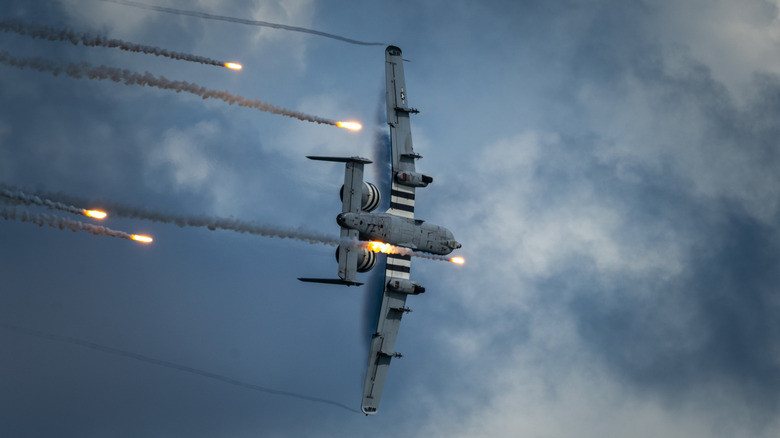
There's a reason the US Air Force can't quit the A-10 Thunderbolt II, and while you might think it's simply because the jet is beloved, the real answer is a little less obvious. It comes down to cost. A single Warthog costs the service "only" around $6,000 per flight hour to keep airborne. This is an aging jet, one the Air Force has actually been trying to retire for the better part of a decade. But it simply hasn't been able to. The main reason is that its proposed replacement, the F-35A Lightning II, doesn't come close in operating cost. It's nearly six times pricier to put in the air at around $35,000 per hour by the same accounting method.
It's one of the reasons why, in late April 2026, Secretary of the Air Force Troy Meink confirmed the service won't retire the Warthog until 2030. This is essentially a reversal of the original plan to wrap up A-10 operations by 2026. So now, until 2030, three squadrons will keep flying. Likely also influencing the decision was how useful the Warthog proved during Operation Epic Fury, the US campaign against Iran. The A-10s did everything from going after Iranian fast-attack boats in the Strait of Hormuz to flying close air support over Iraq and Syria. And on April 3, they even pushed into Iranian airspace to help rescue the downed crew of an F-15E Strike Eagle. Of course, all of this played a major role in the decision, especially since it came mere weeks into these operations. But there's even more math at play.
The numbers only get uglier per target
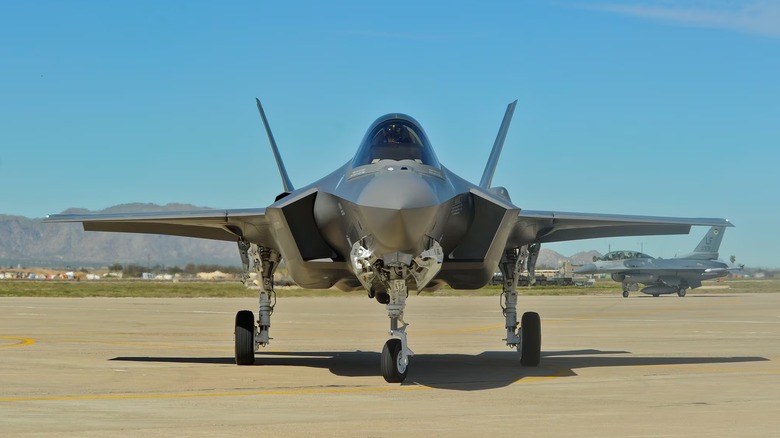
The thing is, the difference in per-hour flight cost is only half the story. The costs compound further when you do the math per sortie. The Project on Government Oversight obtained a redacted Air Force flyoff report that compared the A-10 and F-35 to figure out which is the better close-air support aircraft. The report stated that the F-35 simply needed more sorties than the A-10 to hit the same number of targets. So not only are you paying roughly six times the hourly rate, but you're also paying it for more trips.
A lot of that comes down to what each jet can carry. A fully loaded A-10 hauls 16 GBU-39 small-diameter bombs. Meanwhile, the F-35, when it's flying stealth and keeping everything tucked in its internal bay, gets eight. Then there's the cannon. The Warthog's GAU-8/A holds around 1,174 rounds of 30mm ammo. The F-35A's GAU-22 magazine, by comparison, maxes out near 182. For close-in gun work, the difference isn't even a debate.
Then there's readiness. According to official data from fiscal year 2024, the F-35A's mission-capable rate sits at just 51.5%, noticeably behind the aging A-10's 67%. That means on any given day, nearly half the F-35 fleet might not be in any shape to fly the mission at all.
Replacing it isn't a simple swap
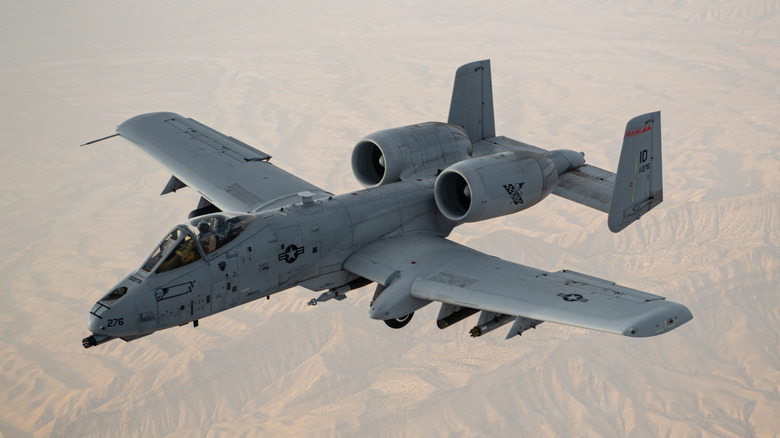
What makes the Warthog so cheap to run also makes it hard to replace. It first entered service in 1976, and production wrapped up in 1984 after 715 airframes rolled off the line at a Fairchild Republic factory in Hagerstown, Maryland. Today, roughly 162 are still flying. The design is straightforward. Twin TF34 turbofan engines sit high on the rear fuselage, where small-arms fire has a harder time reaching them. A titanium tub wraps around the pilot. And then there's the seven-barrel 30mm GAU-8/A Avenger Gatling gun that fires roughly 3,900 rounds per minute. It's perhaps the most iconic bit of the jet, and it's what produces the famous "brrrt" sound.
That said, while the jet is cheap to fly, the upgrades it's racked up over the years haven't been. It's also in finite supply, as no new A-10s have been built in over four decades, and the infrastructure around the jet has been winding down. For instance, heavy maintenance at Hill Air Force Base in Utah ended earlier this year, and the final class of A-10 pilots graduated in early April from Davis-Monthan. So in the end, the answer to what aircraft could replace the A-10 after 2030 still officially seems to be the F-35. But the numbers show why that's proving so difficult.