

What OEM Tires Does The Toyota Camry Typically Come With?
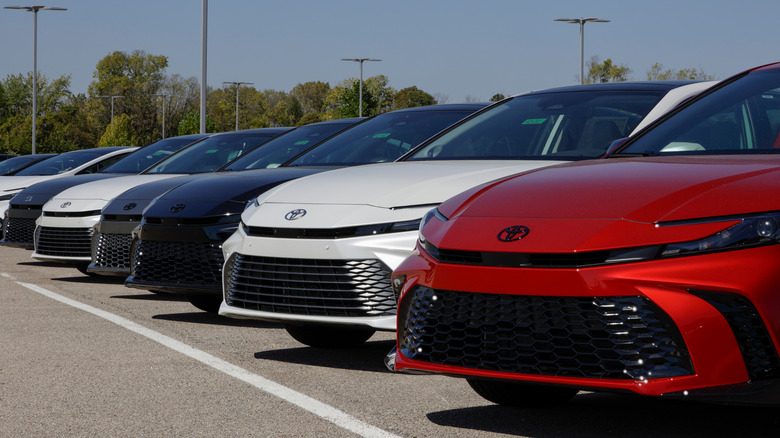
Even with the continued popularity of pickup trucks and the rising dominance of crossover SUVs, the venerable Toyota Camry sedan continues to be one of the best-selling vehicles in the United States, typically topping the sales charts when it comes to non-pickup and non-SUV models. The current version of the Camry, which moved to a standard hybrid powertrain as part of its 2025 model year redesign, is in many ways better than it's ever been, delivering stellar fuel economy, a spacious interior, and what should be Toyota's excellent reliability, all for — by modern standards at least — a very affordable price.
Unlike previous generations of the Camry, which offered buyers a choice between four-cylinder, six-cylinder, and hybrid powertrains, every new Camry now comes with the same 2.5-liter hybrid-assisted four-cylinder engine. However, there are still some significant differences between trim levels as shown in the OEM wheel and tire specs. Depending on the specific year and trim, the Camry comes equipped with tires from brands like Michelin, Firestone, and Bridgestone. But it's not just the brands of tires that can differ on the Camry. There are also substantial differences in both wheel and tire sizes that make for noticeable differences in fuel economy ratings between the various trims.
Same car, different tire options
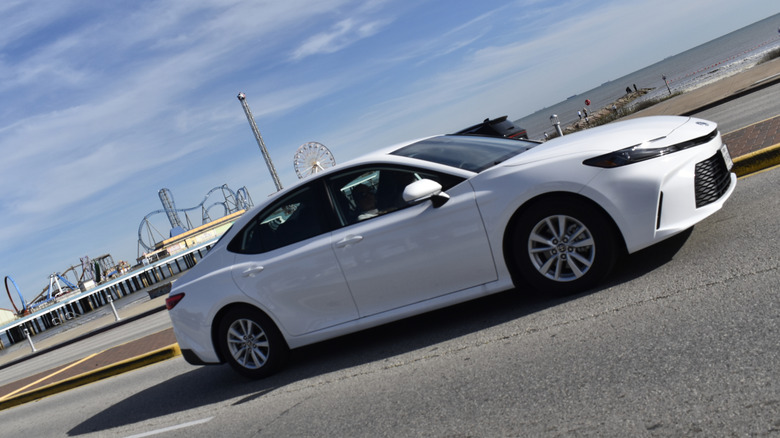
If you look at the EPA fuel economy ratings for the 2026 Toyota Camry lineup, you'll notice that there are substantial differences in the MPG numbers across the various trims, despite the cars all being powered by the same 2.5-liter hybrid engine. Part of this is due to the availability of all-wheel drive, which slightly decreases fuel efficiency compared to the front-drive models. The trim level itself also plays a big factor, with the Camry's higher-priced SE, XLE, and XSE trims all having lower MPG ratings than the base LE model.
The Camry LE comes with 16-inch alloy wheels and 205-65-R16 tires – usually the Firestone FT140. That is a pretty modest diameter for a contemporary midsize sedan. While the wheels and tires on the Camry LE may look small compared to other cars, however, the size isn't just about cutting costs. Larger tires typically mean worse fuel economy, and the front-drive LE model with smaller tires does indeed get the highest fuel economy ratings of any Camry with a rating of 52 MPG in the city and 49 MPG on the highway.
The higher trims of the Camry come with larger and heavier 18- or 19-inch wheels. These are usually wrapped in lower-profile Bridgestone Turanza EL440 tires, lowering fuel economy ratings by as much as 5 MPG. With the same FWD powertrain, the higher trim Camry models are rated at 47 MPG in the city and 45 MPG on the highway – which is noticeably lower than the LE model.
Is it worth it to swap tires for a better MPG?
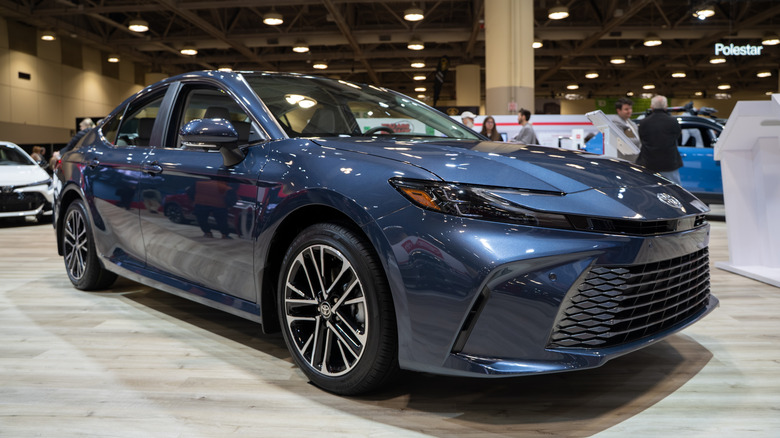
The good news is that you aren't necessarily locked into keeping the same tire size or model that your car has. Several Camry owners have swapped out their heavy stock tires for smaller, lighter combinations and have experienced positive results. For example, one driver on Reddit shared that they saved as much as 10 pounds of unsprung weight on each corner of the car. Along with the weight savings, owners have also reported improvements in ride quality after switching to a smaller diameter wheel and a tire with a thicker sidewall.
Whether or not the look of the larger wheels and tires is worth the trade-off in fuel economy will depend on the driver. Yes, the LE model might have the best MPG ratings with its small 16-inch wheels and tires, but it's still the base model of the lineup with a basic cloth interior and a more subdued exterior treatment. There are also other amenities, like ventilated seats, that you can only get on the higher-trim models.
These additions are surely a reason that owners buy a higher-grade car and then downsize to smaller 16- or 17-inch wheels so they can have the best of both worlds. Regardless, the Toyota Camry with its standard electrification remains one of the most sensible new car purchases out there — no matter which wheels and tires it's equipped with.