

How The James Webb Space Telescope Works Using Less Power Than Your Microwave
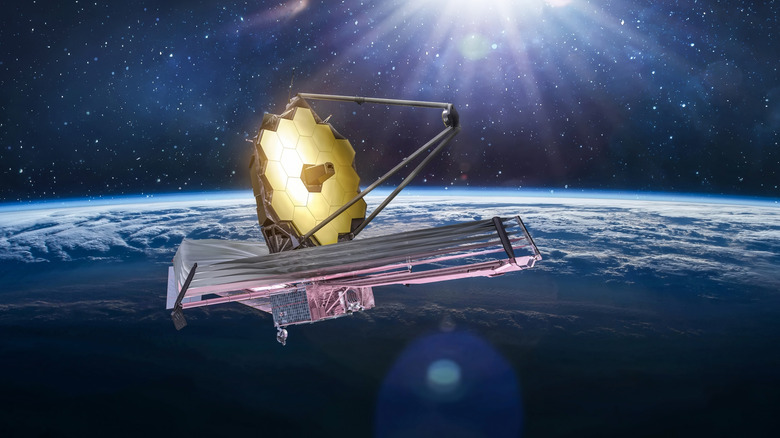
The James Webb Space Telescope (JWST) is the most advanced space telescope ever constructed and one of the coolest pieces of tech we've ever sent to space. And even though its technology may be difficult to grasp, the power it uses is very relatable. In fact, it can operate on about one kilowatt of power — than a microwave. This is possible due to how the telescope's onboard systems use power.
The JWST is designed to avoid doing "active" work whenever it can, especially when it comes to the cooling system. The Webb uses a giant sunshield to block heat from the Sun, Earth, and the Moon, in a process that's known as "passive" cooling. So as the sunshield does its job, it doesn't need nearly as much power as a traditional cooling system would require. In fact, the deployment process itself required far more activity than the telescope's normal day-to-day operations. Once it's open, the sunshield functions in a steady, low-power state.
The JWST's communications systems, propulsion controls, science instruments, thermal management, and onboard computers also don't need much energy. This allows them all to run simultaneously, as the telescope itself collects data during operation.
From liftoff force to deep space stability

The telescope that confirmed the existence of a runaway black hole might use very little power to function now, but the same isn't true for the energy it took to get it into space. The Webb was launched on an Ariane 5 heavy-lift rocket that uses solid rocket boosters and a cryogenic core stage to generate the force required for liftoff. Each booster produces about 1,100 metric tons (over 2 million pounds) of thrust. This accounted for the majority of the Ariane 5's total liftoff thrust.
After the launch, the Webb was deployed from the Ariane 5 through a precise series of mechanical steps. These steps involved the JWST's transition from a compact launch configuration into a fully operational observatory. Once it was in position, the telescope's sunshield and other components unfolded and locked into place. This allowed the observatory to begin operating as designed, eventually showing us what the dawn of a new solar system looks like.
Even though the Webb's power consumption is minimal, it's designed to function in the extreme conditions of deep space and built to operate in temperatures below -370 degrees Fahrenheit. Its systems are highly specialized and the structures are engineered for both endurance and stability. The JWST is able to autonomously carry out its mission over long periods, while also sending important data back to Earth along the way.