

5 Common Mistakes People Make On Their Driver's Test

Your driving test can be a daunting hurdle. Whether you're coming of age as a teenager or starting a little older, the stress of passing can be stifling. From personal experience, the test as a teenager was far easier than my move to England, where I had to requalify as a driver. Even with over half a lifetime of driving experience, that license took two attempts!
The trouble that many drivers have when trying to pass their test is a feeling that every little thing has to be done perfectly. The examiner will be looking over your every move, and some small mistakes can eliminate you right away, no matter how well you'd driven up to that point.
On the other hand, a wealth of little issues can also add up to failure. These often come from a lack of practice or stubborn bad habits that have worked their way into your driving fundamentals. These five common issues are the main troubles that plague drivers during their driving test.
Improper lane changes

Changing lanes is a necessary part of driving, but many parts of this maneuver go wrong if you are underprepared or nervous on the day of your test. Even if you do it all right, it's still possible to appear as if you bungled the maneuver. A big issue you'll find with changing lanes is that your head must move to check for oncoming vehicles. If you don't exaggerate this movement, your test administrator may not notice it and dock points, assuming you only checked your mirrors.
Some Reddit users suggest that anyone who wears earrings or has long hair should play into these features and wear dangly jewelry or put hair into a ponytail or some other hanging style. This creates additional moving elements on your head whenever you turn it to help exaggerate the fact that you are indeed looking around.
Changing lanes is a fairly simple process, but with so many steps in rapid succession, newer drivers may miss something. Checking your mirrors before hitting the turn signal starts the process. This is one of the easiest things to gloss over, but it's crucially important, even when you think you're driving all alone. Then check your mirrors and turn your head to evaluate blind spots before ultimately initiating the maneuver. It's also important to keep in mind that it is never permissible to change lanes in an intersection.
Speed issues

Speeding is obviously going to leave a black mark on your testing scorecard. If you drive too fast, the test administrator will clearly notice, and this can easily result in a failing grade. In Washington state, for instance, surpassing the posted speed by 5 mph will result in failure, even if you're just keeping up with the flow of traffic.
Similar hard caps on speed can be found in other states, too. Even though most drivers speed, it's important to remember where you are. When taking a driving test, you're in a run-out-the-clock scenario. There's no need to do anything other than exactly what the tester instructs. Move slowly, don't make any unnecessary decisions or movements, and get to the end of the test as quickly and smoothly as you can because, generally speaking, once you pass this barrier, you'll never have to do it again.
However, it's also critically important to avoid driving too far under the speed limit. Driving too slowly is also hazardous. It's a good idea to stay just under the posted speed limit, but keep an eye on the road signs so you don't unexpectedly and unknowingly drop even further below the limit or blow straight past it as you enter a new area. Driving too slowly is often cause for a minor point deduction on your test, but if you continuously drive well below the speed limit, it may be grounds for a failure. Driving too slowly can indicate that you're perhaps not confident enough to get behind the wheel on your own.
The rolling stop
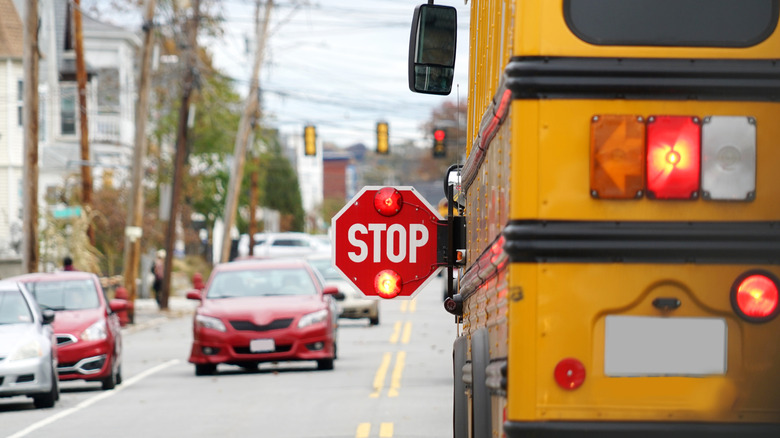
Rolling stops are another bad habit common among fully licensed drivers, even though the practice is illegal in all 50 states. During a routine drive, it can feel unnecessary to come to a complete stop before a stop sign or a right turn at a red light. But the rules are crystal clear on this point. Another important thing to keep in mind is the school bus stop sign. You must stop behind a school bus for the entire time its stop sign is extended.
Also, by initiating a rolling stop, you may be inadvertently (or intentionally) jumping the line at intersections. This is another problem that can fail a driving test. Right of way is on a first-come, first-served basis; if you are the first car to arrive at the intersection, you are the first car to pass.
New drivers should practice to avoid this bad habit. With good habits and discipline, you won't scramble to do the right thing on the day of your test. It's good practice to count to three at each stop you must make. This gives you ample time to demonstrate that you have indeed fully halted the car's movement.
Jerky hand movements and letting go of the wheel

Anecdotally, it doesn't appear to be strictly necessary to keep both hands on the steering wheel during a driving test, although others report the opposite. Either way, hand position comes with a significant caveat. There are many times when performing a road maneuver requires both hands, regardless of the regulations on your steering grip. Driving tests are no time to be casual — they demand your full attention and best effort.
Even if you prefer to drive with one hand on the wheel, it's a good idea to nearly glue your palms to the wheel to ensure that you have complete control over the vehicle at all times. The only real exception is for drivers in cars with a manual transmission, which demand an additional hand movement away from the steering wheel.
Hand placement and related movement issues can also include things like forgetting to hit the turn signal. Placing your hands at 10-and-2 or 9-and-3 sets them in prime position to manage indicators, wipers, lights, and other fixtures. By doing this, there's no big gesture required to hit the turn signal, making it far easier to accomplish (and harder to forget, something that even experienced drivers do). Failing to adopt a firm and confident grip on the wheel in this manner can also result in jerky hand movements that translate into potentially unsafe car movements. Your examiner will notice this, and with enough instances of jerky turns or corrections, may ultimately fail you.
Letting your nerves get the best of you
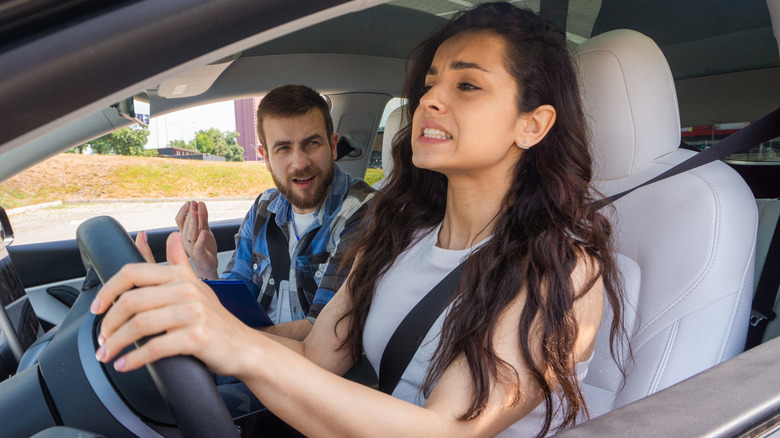
Finally, one of the most common problems for training drivers is nerves. It's only natural to feel a little performance anxiety ahead of an important task. But if you let your nerves get the best of you, it can cause numerous small mistakes that add up on the day of your test. Even an extremely good driver can succumb to a plethora of small mistakes that interfere with decision-making and critical motor skills.
The best way to avoid this issue is to remember that your examiner isn't your enemy. They aren't looking to ding you for every little mistake, hoping to fail you and knock your confidence. At the same time, these professionals are seeking to keep unsafe drivers off the road while advising them on how to pass the next attempt.
If you do fail, you can ask them for tips or advice, and they'll usually be happy to oblige — they're human, too! They know that drivers of all skill levels make mistakes, and they're not sitting beside you to punish those errors. Take a deep breath before you start and remember all the driving you've done up to this point. Most drivers taking their test will have only signed up if they know they can handle the task. Think of the test like any other driving you've done in the past. If you've developed good driving habits throughout your training period, the test should be a breeze.