

The US Air Force Just Paused Its Entire T-38 Fleet - Here's Why
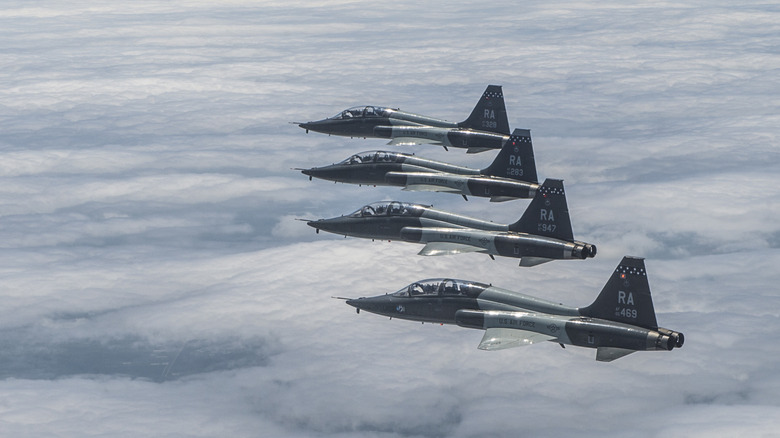
The usual next step following an aircraft mishap is to pull that unit aside for inspection. Very rarely does it result in the entire fleet getting grounded. That only happens when the Air Force suspects a problem on one airframe might be present on every other one.
However, that's exactly what's happened with the T-38 Talon, the USAF's primary trainer aircraft for fighter and bomber pilots. On May 12, one of these jets went down during a routine training mission in rural Alabama. Specifically, it was assigned to the 14th Flying Training Wing at Columbus Air Force Base in Mississippi. Both pilots ejected and survived, though one of them, a Japanese aviator trainee with the Japan Air Self-Defense Force, suffered a broken leg.
Weirdly, around the same time as this incident, a second T-38C was reportedly broadcasting 7700 on its transponder – the code pilots use to signal a general in-flight emergency. While the Air Force hasn't confirmed whether the two aircraft were flying together, two separate incidents on the same day raise eyebrows.
As a result, a week later on May 19, the Air Force put the brakes on every single T-38 Talon in its fleet with a fleetwide operational pause. An Air Force press release noted that the pause "allows an ongoing Safety Board to locate and assess evidence" from the wreckage. As of writing, nobody knows how long the grounding will last. But as these aircraft clear inspections, they should individually trickle back into service. In the meantime, crews will have to stick with simulators to keep their hours up.
Why the T-38 is crucial
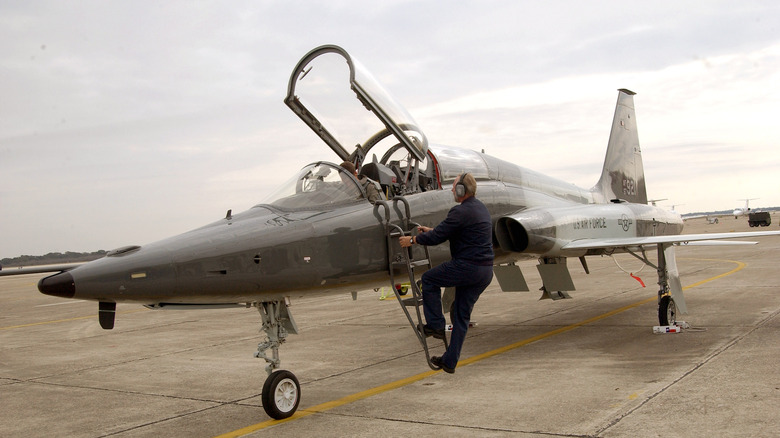
The T-38 Talon has been giving student pilots their first taste of supersonic flight since 1961, meaning it's actually older than most of the people flying it. Northrop built more than 1,100 of them , and over 450 are still serving the USAF today. Even though it's not designed to engage with enemies, it's still crucial to the service since it's the only advanced jet trainer in the Air Force's inventory. Anyone destined for an F-22 Raptor, one of the most expensive jets ever built, or even the B-2 Spirit flies one of these first.
The latest variant of the jet is from 2001 and is called the T-38C. Even though it has a glass cockpit and updated engine components to increase available takeoff thrust, the underlying airframe is the same as the original. Inside, two General Electric J85 turbojets push the plane past Mach 1. The jet can also climb above 55,000 feet, so student aviators can learn the ropes.
Replacements are underway
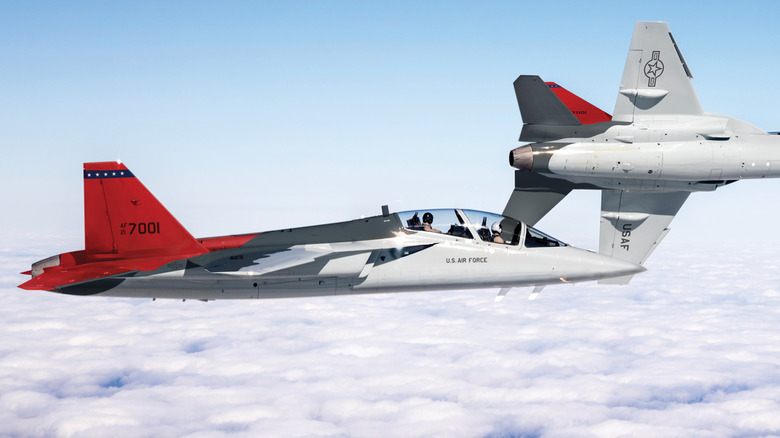
Despite its workhorse status, this is still a pretty old jet. The Air Force is obviously aware of that and is already working on replacing it. The earliest retirements are set to kick off in 2027, with a full fleet phase-out targeted for the 2030s. As a replacement, the Boeing and Saab T-7A Red Hawk is supposed to take over by 2028 even though production of those jets only recently got greenlit in April 2026.
It's fair to say, the T-38 is being used to its limits, and that's exactly why the jet keeps showing up in incident reports like these. Its J85 engine alone is a huge headache to maintain. By 2020, the Air Force's internal depot system was struggling so badly with overhaul backlogs that pilot training output was actually at risk. At the time, Lt. Gen. Brian Robinson, Air Education and Training Command boss told the Air Force Times, "It's an old engine...There's a lot of moving parts" The Air Force then awarded a $237 million contract to a company called StandardAero to fix things. Today, until the T-7A Red Hawk arrives in numbers, the Talon is stuck doing the heavy lifting.