

5 Of The Best Materials To Use For Your Workbench Top (And Why)
We may receive a commission on purchases made from links.
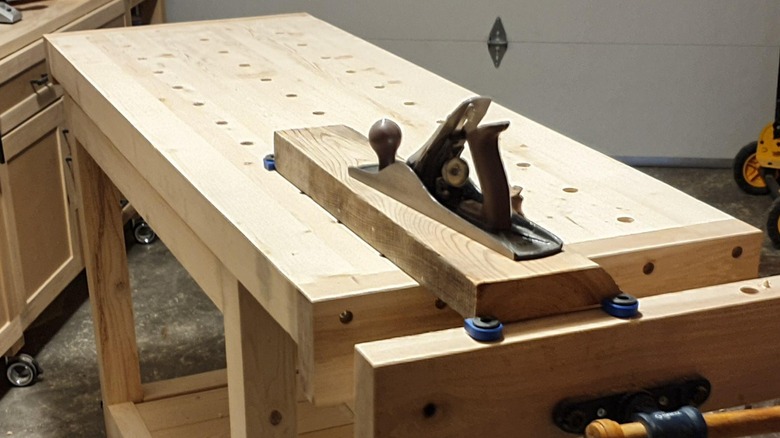
It's easy enough to run to Home Depot and buy a workbench or table to complete your home garage DIY setup, but there are a lot of benefits to making your own workbench from scratch. You can customize the size to fit your space, add in custom features like vises and dog holes, and save money by making it out of affordable lumber rather than paying for an expensive prebuilt unit. For those who are new to furniture building, it can also be an excellent way to practice skills and techniques on a piece that is made to take abuse, and therefore doesn't have to look perfect. Most people will make the bones of their workbench out of construction-grade lumber, such as kiln-dried 2x4s and 4x4s, or reclaimed wood. Others might choose to use a metal structure out of materials like steel pipe.
But no matter what you decide to use for the frame, you're going to need a tabletop. There are a lot of different options out there, and all of them have their pros and cons. Some might be better suited to woodworking, while others might be more ideal for mechanics. Some will be soft and cheap, while others will be harder and more impact-resistant. Those who are thinking about building their own workbench might want to take a look at some of the best materials available for the top, consider the strengths and weaknesses of each, and then decide for themselves which material is best suited to their individual needs.
MDF and Masonite
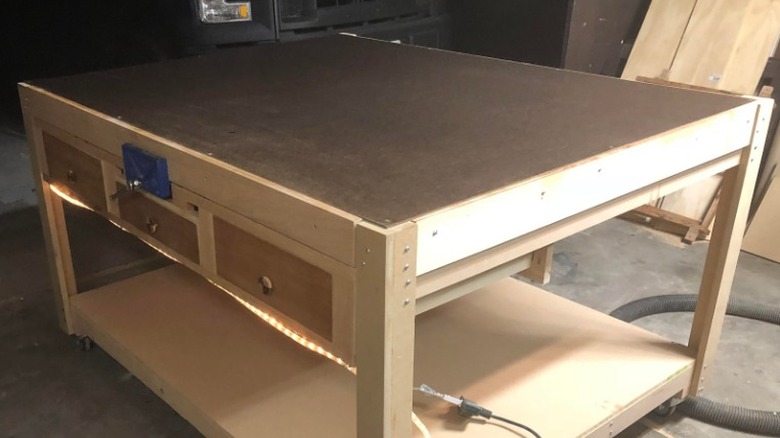
There is an old shop trick that involves using one to two layers of medium-density fiberboard (MDF) and then placing a thin sheet of Masonite hardboard on top. MDF isn't generally considered a very high-quality material. It's made from the leftover fibrous scraps that occur as a byproduct in wood mills. These scraps are mixed with adhesives and then shaped into a sheet good similar to plywood. It can crumble when overworked and can dent easily. MDF is cheap, dense, and rigid, which makes it an excellent structural base for a workbench top, but you probably wouldn't want it to be the actual surface.
That's where the Masonite hardboard comes in. Masonite is a type of hardboard, also known as high-density fiberboard. It's similar in composition to MDF, but it's compressed to a higher density, making it stronger, more impact-resistant, and less absorbent. This serves as a protective layer over the MDF, giving you a smooth and resilient surface that is moderately stain-resistant (though it certainly isn't completely oil or waterproof).
This isn't the prettiest solution, but there are several advantages. The first is that it's affordable. You can get 4'x8' sheets of ¾-inch MDF for $49.98, and a sheet of hardboard for $14.25 at Home Depot. The second is that sheet goods are fairly simple to work with. Simply mark your measurements and cut them with a circular saw. Some stores, like Home Depot, even have cutting centers that will do it for you. The third is that the Masonite can serve as a "sacrificial" top layer. If it's only attached with screws and not glue, you can abuse it to your heart's content, and then simply take it off and replace it with a fresh sheet when it's ruined.
Plywood
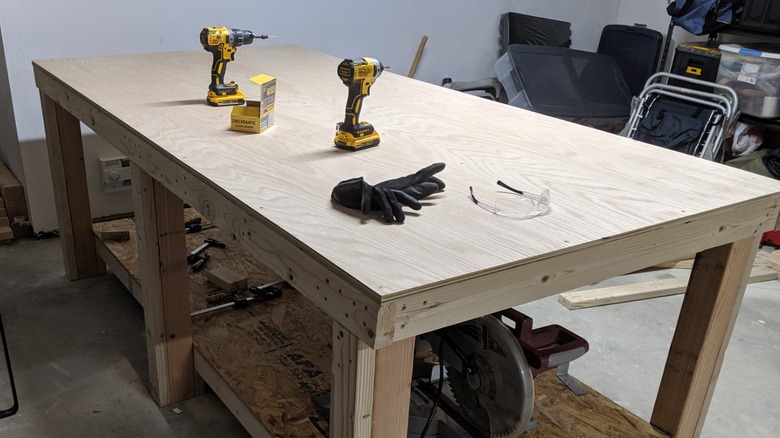
Another sheet good that you might consider if you want something that's still affordable but a little more aesthetically pleasing is plywood. These core-filled sheets are highly durable, easy to customize, and work great for power tool workstations, assembly tables, and outfeed tables. They are much less ideal for mechanics' work, however, as they are highly absorbent.
There are several different kinds of plywood that come in different grades, ply counts, thicknesses, ratings, and veneers. You can use nearly any kind of plywood to make a workbench top if you have some bigger scraps lying around, but you'll want to make sure that it's thick and dense enough to make a solid surface, whether that involves using something like 1-inch plywood or simply stacking thinner boards until you get your desired thickness. Radiata pine sanded plywood is going to be one of the more affordable options. A 23/32-inch 4'x8' sheet runs $49.88 at Home Depot. While the pine itself is a softer wood, the cores are glued together with PF resin, making them exceptionally flat and sturdy. That said, those willing to spend a bit more to get a sheet of hardwood plywood can get something that looks a lot nicer, sands smoother, and offers a bit more surface resilience. Baltic birch, maple, and oak plywood are all readily available for around $90 per ¾-inch 4'x8' sheet.
If you really want to make a plywood benchtop look clean, then you might also want to get some edge banding. It's usually cut to fit standard plywood sizes and can be found in the same hardwoods used in the sheets. You simply cut them to length and iron them onto the edges of the plywood to give it the appearance of a solid wood board.
Butcher block
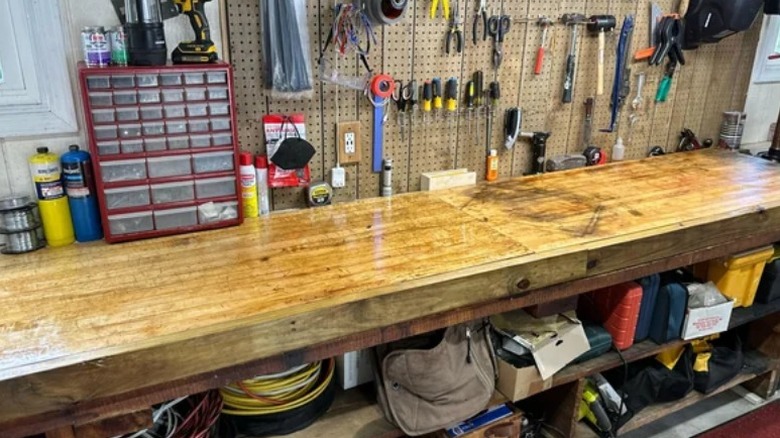
One hack that has become increasingly popular online is the use of premade butcher block countertops. Take a look at some of the prefab units sold by major workbench brands like Husky, Ryobi, Kobalt, and Craftsman, and you'll find that many of them use a similar design for their surfaces. But the same stores that sell these workbenches for $200+ also sell actual butcher block countertops that are generally thicker and denser, and can be found in much larger sizes at lower prices.
Home Depot, for instance, sells a Hampton Bay Engineered Birch Butcher Block Countertop that is 25 inches deep and available in 50-inch, 74-inch, and 98-inch widths for $119.00-$189.00. This is clearly more expensive than MDF or plywood, but there are a lot of reasons why butcher block serves as a more premium choice. These countertops are probably one of the highest quality hardwood options you can get outside of expensive solid boards. You can find them in different hardwoods, such as walnut, saman, and acacia, which are harder to find in other formats. They can be cut like a sheet of plywood to fit your bench's dimensions, and placing them in a simple frame of construction-grade lumber is still probably going to be far cheaper than buying a prefabricated unit with a thinner and lower-quality top.
Butcher block has excellent impact resistance, but is fairly absorbent. This makes it great for fine woodworking tasks as well as other forms of hand and power tool work, but it's once again less than ideal for any work that involves oil, paint, or chemicals.
Sheet metal
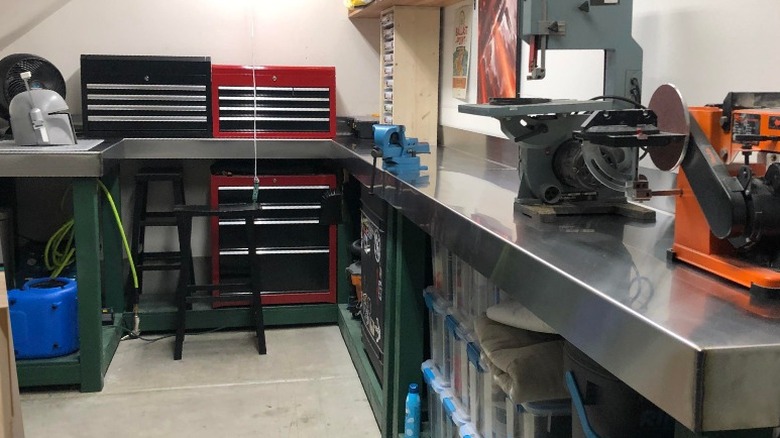
Now let's look at some non-wooden benchtop ideas. Those who are comfortable with metalworking might consider making one out of sheet steel. As you might imagine, steel is extremely durable, impact-resistant, impervious to motor oil and chemical solvents, and isn't easily burned. If the steel itself is too thin to serve as a solid surface, you can easily place it on top of an MDF core.
We already know that you can get a sheet of MDF for about $50, but sourcing the steel is a little trickier. Big box stores don't usually carry steel sheets in the kind of sizes that you'd want for a workbench. That's more of a specialty item. There is a 2'x4' sheet of 24-gauge at Lowe's for $49.98 and a similar-sized 16-gauge option at Home Depot for $129.98 that could work for a smaller bench, or you could use two for a larger one if you're okay with a seam in the middle. Alternatively, you could check local specialty outlets or shop online through a retailer like MetalsDepot to get a sheet that is customized to your size needs. 14-gauge or 16-gauge is ideal, as that's thick enough that the steel will resist denting, but thicker gauges cost more. You can choose to use a thinner sheet for the oil and chemical resistance if you're willing to accept that you might get a few dents over time.
There are a couple of ways you can attach it. A sheet fitted to the top can be fixed with mechanical fasteners, and forum contributors have suggested that contact cement or epoxy adhesives would work. Alternatively, you can buy a larger sheet, cut squares out of the corners, and then bend the metal to wrap around the MDF.
High-Density Polyethylene (HDPE)
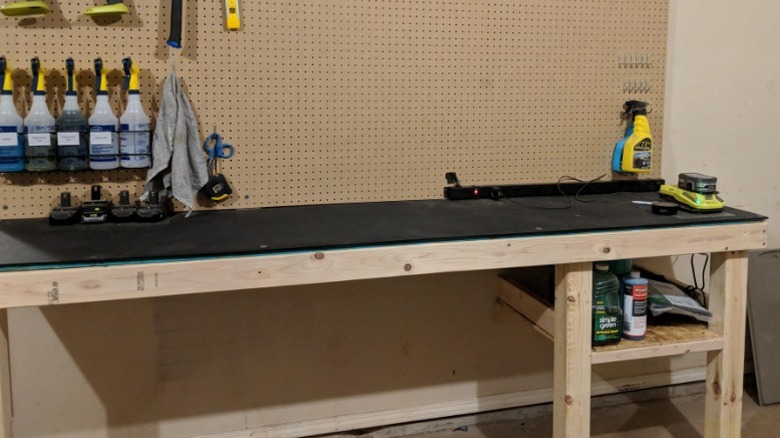
Another option you might consider is plastic, particularly if you need a station for working with finishes, paint, epoxy, or other adhesives. High-density polyethylene (HDPE) is a type of non-porous thermoplastic that's known for its high tensile strength, density, and impact resistance. It also has a bit more heat resistance than most plastics. It's the same stuff used in plastic cutting boards, so you know that it's fairly gouge-resistant and easy to clean.
It's often sold as a sheet good, though it can be surprisingly expensive. Home Depot offers ½-inch sheets in 2'x4' for $123.86 and 4'x8' for $523.96. This makes it a tough sell for a larger workbench, but you might find that it's a reasonable expense for a smaller paint and glue station. You can also store the HDPE sheet separately and then simply place it on top of your current workbench when you want the added protective layer.
The sheets can be cut with regular woodworking tools, but it isn't very forgiving, so you'll need to be precise. It also isn't particularly rigid, so this is another material that is best paired with an MDF or plywood base. If HDPE is too expensive, a cheaper alternative to consider for this kind of workstation is melamine. This is a laminated particle board that provides similar chemical resistance and easy cleanup at a much lower price. Unfortunately, it's not nearly as impact-resistant and scratches easily, so you might find yourself resealing or replacing it regularly.
Our methodology
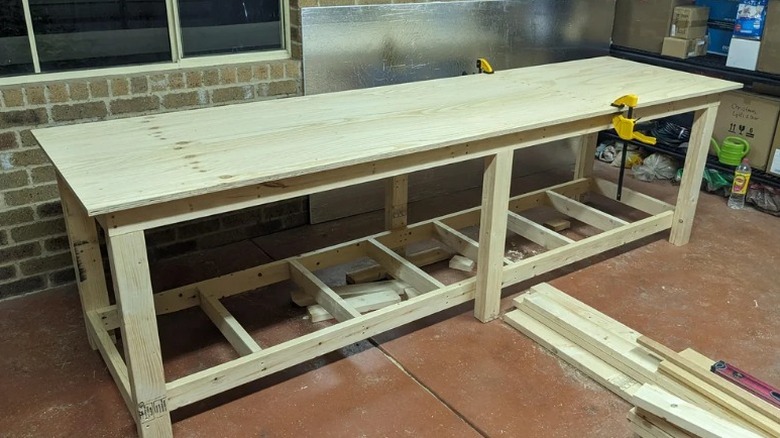
The ideal workbench top can vary depending on the type of work it's intended for and the budget that its builder has to work with. Some might want something cheap that they can beat up and replace easily, while others might prefer something of quality that is built to last. In making this list, our aim was to provide a range of different options that could appeal to a broad spectrum of craftspeople.
To that end, we looked at many of the different kinds of homemade workbenches that had been shared on instructional websites, forums, and social media. We then researched the composition of the materials that were used to verify their properties, making sure to share both their more useful attributes and their shortcomings so that we could showcase the kind of work that they're best suited to.
Finally, we sourced the materials so that we could share costs and availability with our readers. This makes it easier for readers to find these materials and get a better idea of how much each one would add to their project.