

3D Printing Made This Researcher's 40-Year-Old Concept A Reality
As 3D printing becomes more accessible and printers get increasingly budget-friendly, academic researchers are coming up with a plethora of useful new creations. They're also going back over older ideas to see if the new technology enables any previously impractical ideas to be brought into use. The latter is exactly what researchers at MIT's Computer Science and Artificial Intelligence Laboratory (CSAIL) did, and they ended up building a new three-sided zipper based on a professor's four decade old design.
The professor in question is William Freeman, who came up with the idea of a three-sided zipper back in 1985. He suggested that the zipper could allow materials to be transformed from being soft into being rigid, since it would take advantage of the natural structural rigidity of a triangle. Then, when the material no longer needed to be rigid, it could be unzipped and would return to its flexible form, making it easier to pack and transport.
Freeman's original design used belts with wooden teeth to create the zipper and a slider to zip and unzip the belts. He entered it into a design competition and didn't win, but he patented the design nonetheless. Around 40 years passed and the team of MIT researchers decided to take another look at the idea. This time around, 3D printing technology allowed the researchers to create custom plastic zippers for a variety of different situations, including everything from camping to wearables.
3D zippers can be useful in many ways
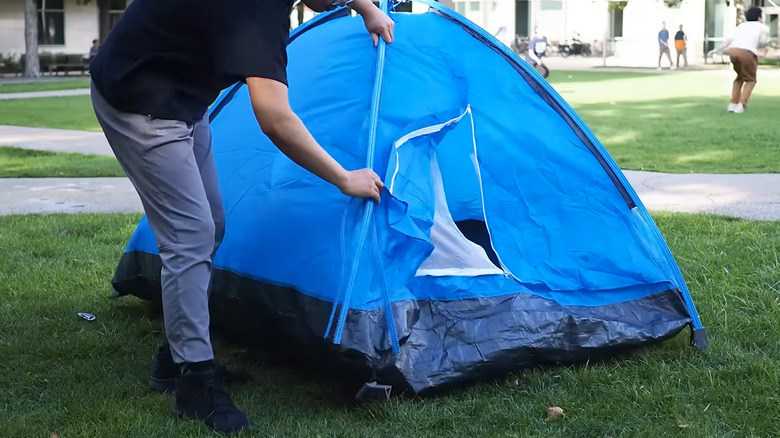
The team demonstrated just how useful 3D zippers could be by creating a series of prototypes, each of which used them in a slightly different way. One prototype was a collapsable tent, which used 3D zippers instead of traditional tent poles.
The unique design was significantly faster to put up than a traditional tent, since each arm could be zipped together in seconds rather than minutes. In total, the researchers found that it took them a minute and 20 seconds to assemble their new tent, compared to 6 minutes for a traditional tent. As well as being a useful innovation for camping and backpacking, the researchers also noted that larger zipped structures could potentially be used for rescue missions or disaster relief.
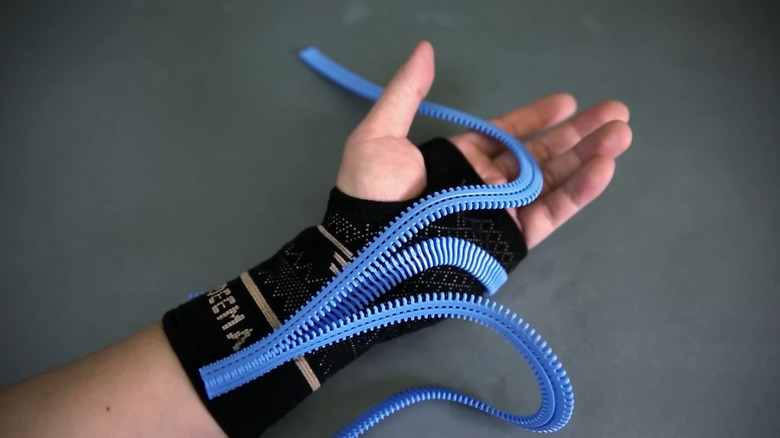
Another of the team's 3D zipper prototypes was a robot that used a motor to zip and unzip parts of its legs. The zipper mechanism allowed it to quickly increase the height of each leg to clear obstacles, then decrease its height again for better stability on flatter ground. The zipper design also proved useful for a wrist cast, where it could be zipped to provide impact protection but quickly unzipped when the wearer needed more mobility.
The team saw different results with different plastics
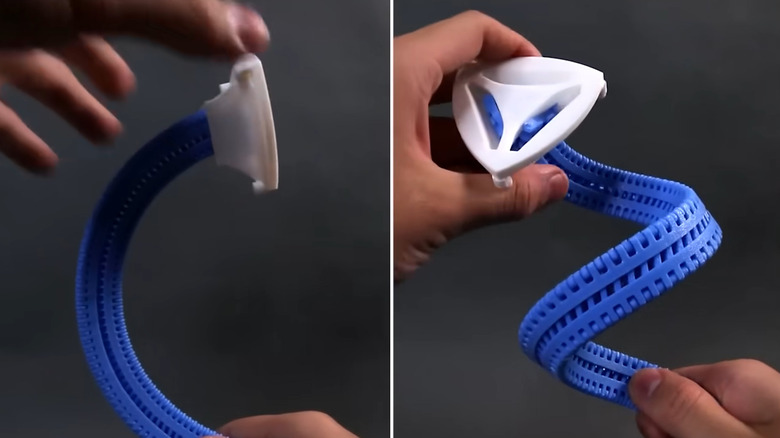
It's well worth watching the video below to see each prototype in action and check out the team's other ideas, which include a moving art installation where a zipper creates a twisting vine. Of course, the real-world usefulness of all these designs would be limited if they weren't durable enough to be repeatedly zipped and unzipped.
As it turned out, the zippers proved to be more than durable enough to withstand long-term use. The researchers found that using common consumer-grade 3D printing filaments was sufficient to produce long-lasting zippers, but that PLA filament was more durable than TPU filament. On the other hand, using TPU resulted in more flexible zippers. After testing their zipper designs until they broke, the team found that their zippers could be expected to last around 18,000 cycles over their lifetime.
While the initial study found plenty of uses for the new design, the team noted that plenty of other ideas still had to be tested. They gave the example of using a zipper design to grab rock samples on a spacecraft, and added that other flexible wearables could be developed alongside the wrist cast. If Freeman hadn't patented his original 3D zipper design, it might have been lost to history. But, now the technology to make it a reality has finally been developed, it might prove to be useful in a variety of ways in the future.