

China Claims A New Breakthrough In Alternative Fuels: Could It Solve Global Oil Problems?

If you break down any hydrocarbon fuel, you'll find two basic ingredients — carbon and hydrogen. These are two elements that are abundant on Earth. In fact, hydrogen is the most abundant element in the universe, and we all know that the atmosphere contains plenty of carbon in the form of CO2. This begs a question — in the face of dwindling natural resources and market uncertainties, couldn't we just bang some atoms together to make fuel? While this is an obvious and immense oversimplification, a group of Chinese scientists is working on a technology that does just that.
The scientists from the Shanghai Advanced Research Institute (SARI) have created the long-chain hydrocarbons used in jet fuel by combining waste CO2 with water (each water molecule contains two hydrogen atoms). We take a look at the chemistry of this process later, but put simply, it uses a technique known as "reverse combustion" to convert the CO2 and hydrogen into long hydrocarbon chains. The SARI team's process converts these gases into the hydrocarbons, some of which fall within the molecular weight range that distinguishes jet fuel – namely, C8 to C16, where the number denotes how many carbon atoms are in the chain.
Much of the technology in creating hydrocarbon fuels from their constituent elements isn't new. The Fischer-Tropsch process, for instance, was developed as early as 1920. However, this relies on syngas, which is made from coal, gas, or biomass. And, more recently, the US Navy even got in the act when it tried to make jet fuel out of air and water.
What we know about China's alternative fuel breakthrough
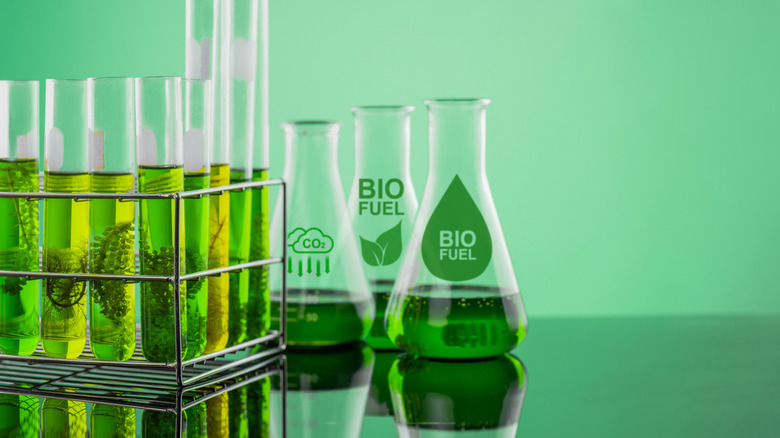
The premise of the process is simplicity itself: take two ingredients, mix them together, and hey presto — jet fuel. However, while the recipe is well understood, the "cooking process" has always faced a major hurdle — converting the constituent elements into hydrocarbons efficiently. That being said, our vehicles aren't strangers to synthetic liquids — there are already plenty of popular synthetic oil brands that we're happy enough to use in our vehicles.
The SARI team's breakthrough came from the catalyst used in the process. Using an iron-based catalyst laced with aluminum and potassium additives, the scientists have created a process that may have overcome these hurdles. We won't get too technical, but the process produces about 454 ml of heavy olefins per gram of catalyst per hour — heavy olefins are a class of long-chain hydrocarbons. Using one particular catalyst "recipe" (FeAlK8 to give it its proper title), the process converted nearly half the incoming CO2 — around 49% — into hydrocarbons.
The catalyst also allowed the process to be completed at a relatively low temperature (626 degrees Fahrenheit) and at pressures of about 290 PSI. For comparison, the average car tire is pressurized to about 32-35 PSI, and the Fischer–Tropsch process that does a similar bit of alchemy uses between 150 and 600 PSI. Finally, the fuel produced remained thermally stable during an 800-hour test. Which is a useful attribute when you're mid-ocean at 39,000 feet. This isn't going to solve the planet's fuel worries yet, but it is a step towards making CO2-to-fuel systems economically competitive.
Could China's synthetic fuel solve global oil problems?

The short answer is no. China's synthetic fuel won't solve global oil problems — at least not yet. While the breakthrough is undoubtedly impressive, it isn't going to make oil tankers obsolete overnight. There is still a substantial gulf (in more ways than one) between creating synthetic fuel in a laboratory and creating enough of it to satisfy even a fraction of global demand. But even before that stage, the fuel must pass strict certification and safety testing; compliance with these standards is necessary if it's to be widely used in commercial aviation.
These are the standards that ensure we thankfully don't hear pilots announcing fuel failures in the middle of a trans-Atlantic flight. There's also the energy factor to consider. While the process uses waste CO2 and water as raw ingredients, turning these into jet fuel uses substantial amounts of electricity. If that energy comes from fossil fuels, then the environmental benefits of the fuel become less apparent. At least in sustainability terms, the process would need to be powered by renewable or green energy sources.
This is an emerging technology that may yet play a role in reducing global dependency on a finite natural resource with an already stressed supply chain. The technology isn't a quick fix to the problem of soaring jet fuel prices, but it could be another step toward breaking our reliance on fuels extracted from the ground.