

Not BMW Or Audi: The Highest-Revving Diesel Engine Comes From This Japanese Automaker
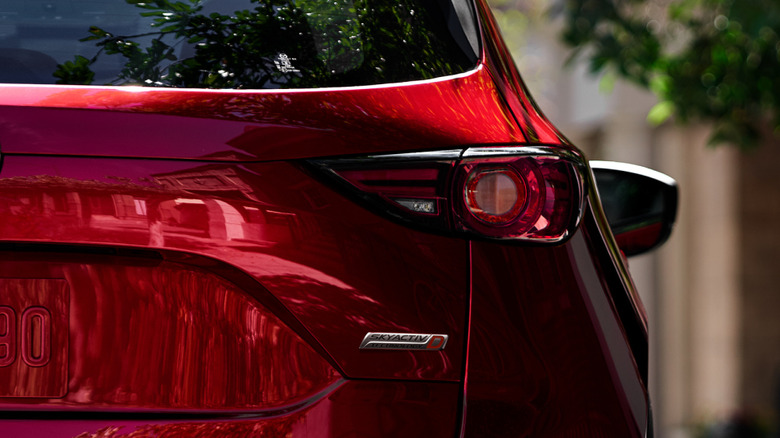
Normally, we associate diesel engines with low revs and high compression ratios, making them ideal for situations where you want more torque horsepower — and yes, there are a lot of differences between the two. Unlike gasoline engines, diesels have no spark plugs. Instead, they rely on compression to ignite the fuel, with the heat from compression spontaneously igniting the otherwise quite stable fuel. One might assume, then, that a diesel with low compression and high revs wouldn't work. Mazda didn't get that memo, however.
That's right — the manufacturer responsible for producing the highest-revving diesel in a passenger car is none other than Mazda, the same company famous for its use of the Wankel rotary. The Japanese marque seems to really like oddball engines, as it opted to develop the 2.2L Skyactiv-D, an engine with motorsports heritage and some truly unusual specs for a diesel. The engine debuted in the Mazda CX-5 in 2012, although it took until 2019 to arrive in the U.S.
What makes this engine so special, though? For one, it's actually the basis for the 2.2-liter diesel racing engine Mazda used beginning in 2013. Mazda marketed the engine as particularly high-revving, sporty, and spirited, and to this end designed it with the lowest possible compression and highest RPM redline ever seen in a production diesel — 14.4:1 compression and 5,500 RPM, to be precise. Let's take a look at the specs.
Anatomy of the 2.2L Skyactiv-D
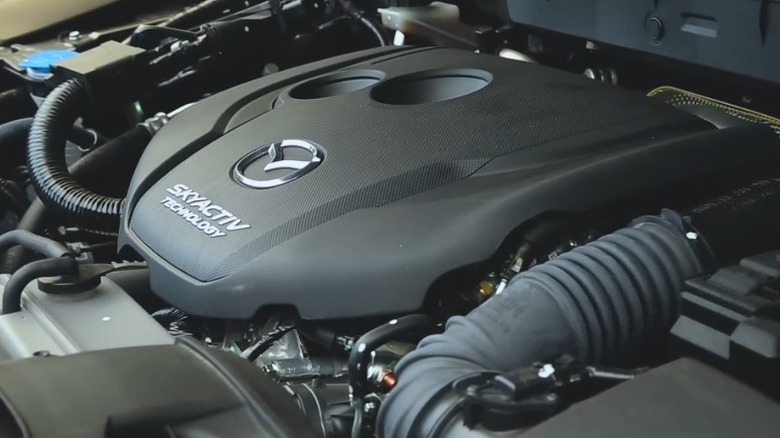
The main highlight of the engine is, of course, how high it revs. The hard data show that the 2.2-liter powerplant makes 168 hp at 4,000 RPM and 290 lb-ft. of torque at 2,000 rpm before hitting that 5,500-rpm redline. It boasts a sequential twin-turbo setup and common-rail direct injection, boosting fuel economy to a quoted 27 mpg city and 30 highway. This is an economy-focused platform, after all, so we shouldn't expect sky-high power numbers; even so, the specs are quite impressive compared to some gasoline engines and are also not too far removed from the legendary Jeep 4.0-liter inline-6.
Apart from its high redline, the Skyactiv-D boasts other technological oddities. Take the "Natural Sound Smoother," as Mazda calls it — a mass damper fitted inside each piston's wrist pin, designed to smooth out the engine's harmonic frequencies and prevent vibrations. That's just one of many additional devices, both hardware and software, that Mazda utilizes to help smooth out the engine. It certainly adds complexity, but it also means the engine is more civil to drive in city traffic.
Mazda also developed its SkyActiv engines specifically to meet strict emissions requirements. To this end, the company outfitted the Skyactiv-D with advanced glow-plugs, lightweight internals, and a low compression ratio to eliminate the need for external after-treatment systems, effectively making a clean diesel engine right out of the box without any complex and expensive emissions-reducing devices.
Is it any good?
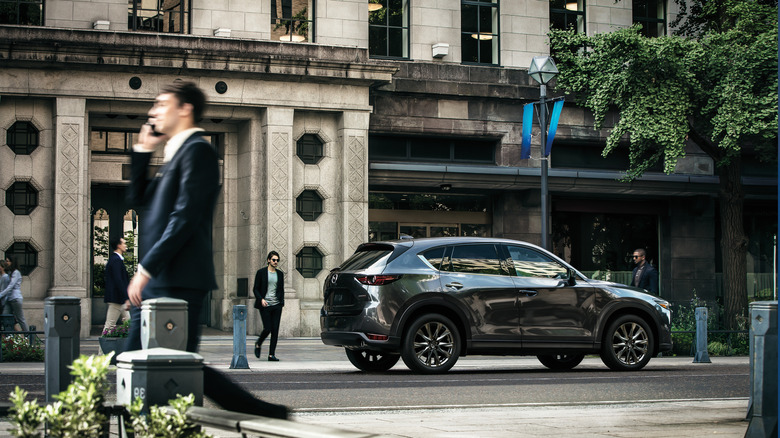
If one were to look at this engine in a vacuum, they might miss the forest for the trees. Yes, it revs high and has remarkably low compression for a diesel, but ultimately, Mazda designed this engine as a regular passenger-car powerplant. Emissions are the main reason this engine exists; Mazda utilizes the low compression ratio to more precisely control the fuel mixture before ignition, therefore allowing more advanced timing and lower NOx emissions.
This focus on emissions did not come at the cost of other aspects of the engine, though. Reviews of the time generally praised the Skyactiv-D's introduction, citing the then-new diesel CX-5 as an excellent combination of smooth civility and respectable towing capacity. It did accelerate slowly, but that's not too surprising when it was never designed for performance to begin with. Non-American outlets also liked the engine, with Car Magazine comparing a 2.2-liter SkyActiv-equipped Mazda 3 favorably against rivals from Volkswagen and Ford.
Ultimately, though, this is something of an oddity that comes across as something of a half-diesel, half-gasoline engine — if such a thing could ever exist. Is it an outstanding engine? That's a matter of debate. But it's certainly different enough that only Mazda could ever commit to making it. It is, after all, the same company that took a 4-rotor engine to Le Mans in the 787B, one of the best rotary-engined cars ever.