

You Really Shouldn't Put Expensive Tech In Airport TSA Bins - Here's Why
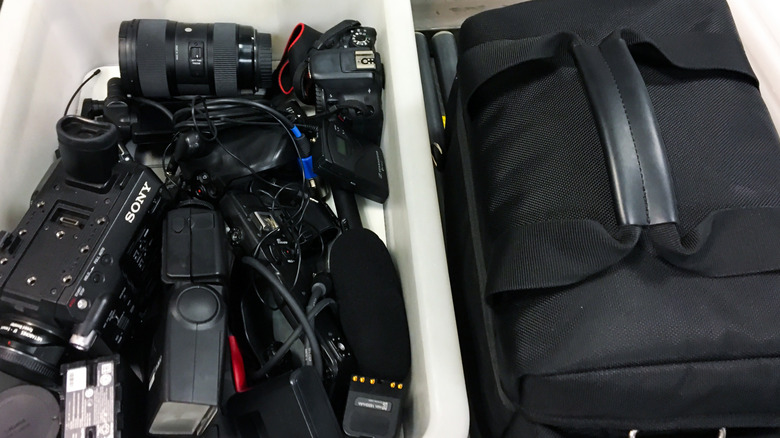
Before you arrive and relax at your holiday destination, going through TSA screening is a stressful rite of passage. Apart from reports about TSA damaging luggage, there have also been claims about items going missing during the scanning process. With the rush of screening lines and thousands of people passing through each day, there are a lot of possible reasons why your things can get lost. For example, you may have removed an item, put it in the bin, and forgottento retrieve it. When this happens, you can simply return to the scanning area and speak to the TSA supervisor to retrieve it. But if it's not there anymore, the next course of action is to file a claim using the TSA Lost and Found Form.
However, it's also possible your belongings have disappeared because someone stole them. In the past, we've talked about how phones get targeted by thieves at TSA checkpoints a lot, especially when left in the bin. But in reality, there's nothing really stopping someone from stealing any expensive tech when it's left unattended for too long. In particular, small valuables that are easy to shove into bags or coat pockets are likely targets. So, if you want to avoid having your headphones, smartwatches, e-readers, tablets, cameras, and other expensive gadgets snatched, it's best to do a few things for added security.
How to avoid expensive tech going missing
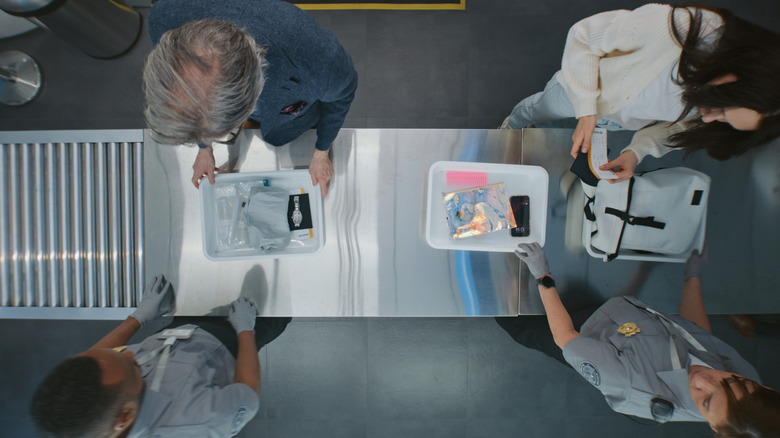
While there's no getting around security screening for your gadgets at TSA checkpoints, there are some things you can do to make it harder for them to go missing. First, you'll want to avoid taking things out of your bag when it isn't necessary. Unless TSA officers or screening instructions say otherwise, keep your expensive gadgets in your zipped or locked carry-on to add a barrier to access. You can also use a pouch to keep loose electronics together, so they don't accidentally fall out during the security procedures.
Second, try to make it a habit to wait until your bin is in the scanner before moving on during the scanning process. When possible, try to keep your bins together, so none of your items are lagging behind where you can't see them. Avoid taking your eyes off your things, especially when it's crowded. Third, you can invest in travel-friendly tech backpacks like the Wenger SwissGear 1900 ScanSmart, which has fold-out laptop pockets made for TSA scanning. If you tend to travel with a lot of valuable electronics, it's also good practice to take photos of your devices. In the event that they don't make it out of the TSA scanning area, you can use these as a reference when speaking to appropriate authorities.
Why you may not always have to remove items in the future
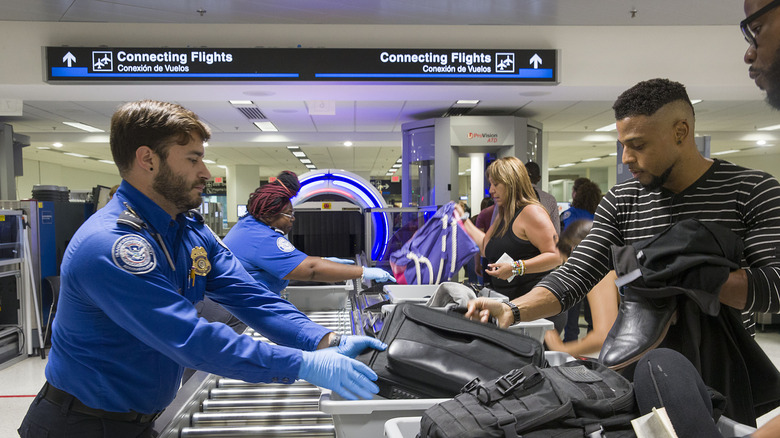
If you are a U.S. citizen, U.S. national, or lawful permanent resident of the U.S., you might be eligible for TSA PreCheck, which lets you use special security lines. With TSA PreCheck, you can generally leave your laptop and other tech inside your carry-on during the expedited screening process, as well as 3-1-1-compliant liquids. However, this can still depend on the officer inspecting you, and there is no guarantee you'll be exempt.
In recent years, the TSA has shared that some airports, like the Southwest Wyoming Regional Airport, have been upgrading their screening processes with Computed Tomography (CT) technology and Advanced Imaging Technology (AIT). Unlike older methods, the TSA says that CT technology can eliminate the need for taking electronics out of your bag. To do this, the scanner generates a 3D image that can be analyzed without having to remove items from inside the bag. The only problem is that you might have to wait a few years, since the nationwide rollout is still ongoing.
According to Global Rescue, some of the key disadvantages of CT scanners are high costs and delays in deployment due to changes in internal processes. In a 2024 statement to Travel + Leisure, a TSA spokesperson shared that "We are anticipating that it may not be until 2040 that we have CT units fully deployed across the nation and have the capability of changing the requirement across the system."