

Is The LG G5 TV Worth The Hefty Price Tag Compared To The C5?
We may receive a commission on purchases made from links.
When you first look at them, the most noticeable difference between LG's G5 and C5 smart TVs is easily their price tags. Depending on the size, the G5 can be up to 25% more expensive than a comparably sized C5. With such a large price gap, it's easy to question whether the upgrade is worth it – and where exactly your money goes if you do invest in a G5.
The two TVs boast a gamut of similar features, alongside similarly glowing reviews and high ratings. What Hi-Fi? rated both TVs a full five stars, while Tom's Guide surprisingly gave the C5 a half-star advantage over the more costly G5. They're also both among Consumer Reports' best-rated LG TVs. You can see a similar trend in user reviews, too, with each TV having an almost-five-star average on the LG website. Based on all of that, it's easy to conclude that you probably don't need to spend the extra hundreds (or thousands) of dollars on the G5, given the similar performance.
However, there is one substantial difference between the C5 and G5 that's worth considering before you commit to the C5: how much brighter the G5 is. Stuff even called it the "best and brightest OLED TV" in a five-star review. That difference can translate to a significant upgrade in image quality and make it worth the price, depending on your room, budget, priorities, and preferences. Besides that, there are also several other differences between the sets, ranging from the number of audio channels to some minor panel traits.
Brightness creates contrasts between the G5 and C5
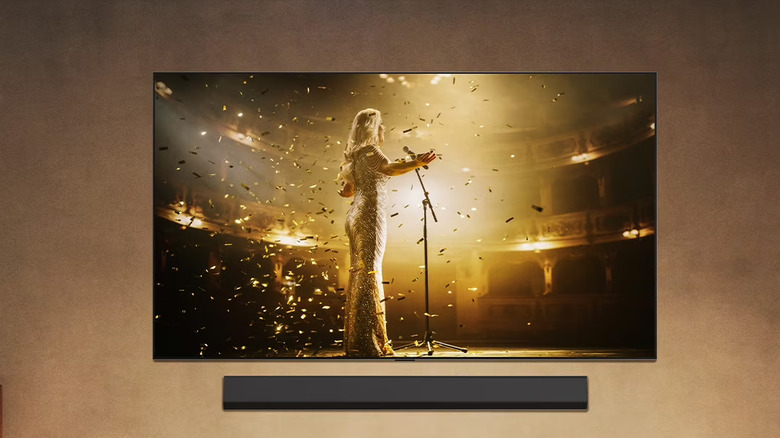
The G5 uses a fourth-generation LG Display OLED panel, which produces a remarkably bright appearance in SDR and HDR modes. As a result, many reviews and tests note just how bright the G5 is. Tom's Guide put this to the test to find out exactly which one is brighter — and by how much — with some striking results. In a 10% window, the G5 put out 2,296 nits in HDR, compared to the C5's 1,196 nits. The G5 has the upper hand in SDR too, although the difference isn't as noticeable with 465 nits versus 335. For some, that difference will make the G5's hefty cost worthwhile.
But what can a brighter screen do, really? It depends, but higher maximum brightness translates to more contrast, in turn improving picture quality by adding depth. So, the G5 can offer a much deeper image than the C5, courtesy of its much higher brightness. The G5's high peaks, paired with features like Perfect Black, Brightness Booster Ultimate, and the fundamental strengths of OLED technology, make for sharp, high-contrast images. This advantage made the LG G5 one of the best TVs you could buy in 2025 and may be worth paying for, especially if you have a bright room, as brighter screens can offer a better experience than dimmer ones in well-lit rooms.
How else are the G5 and C5 different?
At first blush, the two TVs share a lot of similar features. They each offer native 120 Hz refresh rates, pixel dimming, Dolby Vision, and Filmmaker Mode, among a list of other overlapping features. The differences start to become noticeable when you check their processors. The C5 has the a9 AI Processor 4K Gen8, while the G5 has the faster a11 AI Processor 4K Gen2. A similar disparity is notable when you compare the built-in AI upscaler; the C5 has the a9 AI upscaler, while the G5 has LG's a11.
There's also one minor difference when you compare the two TVs' gaming-oriented specifications. Although they both offer variable refresh rates, the G5 maxes out at 165 Hz compared to the C5's 144 Hz. Both, however, support AMD FreeSync, are G-Sync Compatible, and have HGIG support. The two TVs also have different speaker systems, which is something that may differentiate them for some users. The C5 offers a 2.2-channel system, while the G5 has 4.2 channels.
There's one more noticeable difference between the G5 and C5 range: size. Although each range is available in overlapping sizes varying from 55 to 83 inches, there are some exceptions. The C5 is available in 42 and 44 inches, with the largest model coming in at 83 inches. Meanwhile, the G5 bottoms out at 55 inches, but it does run all the way up to a whopping 97 inches, should you have about eight feet of space you want to fill with a TV.