

The US Navy Only Built 3 Of These Attack Submarines - Here's Why
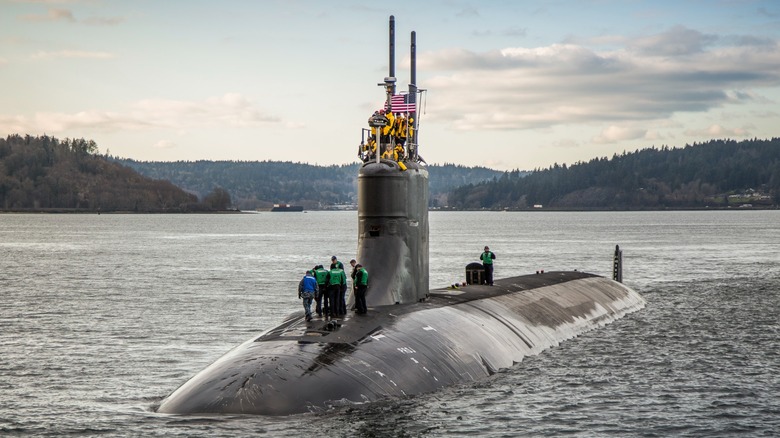
The United States Navy is the most powerful blue-water navy in the world, and it's loaded with impressive warships of all kinds. The Navy's submarine fleet is substantial, consisting entirely of nuclear-powered submarines of various classes, from attack subs to nuclear launch platforms. One of the most impressive classes of fast attack submarines is the Seawolf-class, which was first introduced to the inventory in 1997 with the commissioning of the USS Seawolf (SSN-21).
Initially, the Navy sought to replace its Los Angeles-class boats with 29 new Seawolf-class subs, but that didn't happen. There were several reasons why the Navy only went with three of the planned 29 Seawolf-class submarines, and like so many defense contracts, cost was the overarching factor. The class' design project began in 1983 during the Cold War, but by the time the fleet accepted the first boat in its inventory, the Cold War had long been over. It became impossible to justify the cost per boat, which was substantial, so Congress opted to pull the plug on the remaining planned subs.
In terms of cost, each Seawolf-class boat ran the government around $3.5 billion ($7.65 billion in 2026), making it the most expensive submarine in U.S. history. Despite the limited number of Seawolf-class subs, they remain some of the most advanced nuclear submarines in the world, which is impressive given their age as of writing. With the program's cancellation, the Navy looked at other projects before settling on the smaller, yet more affordable Virginia-class submarines, of which the Navy operates around two dozen as of November 2025.
The Seawolf fast attack submarines are costly but impressive
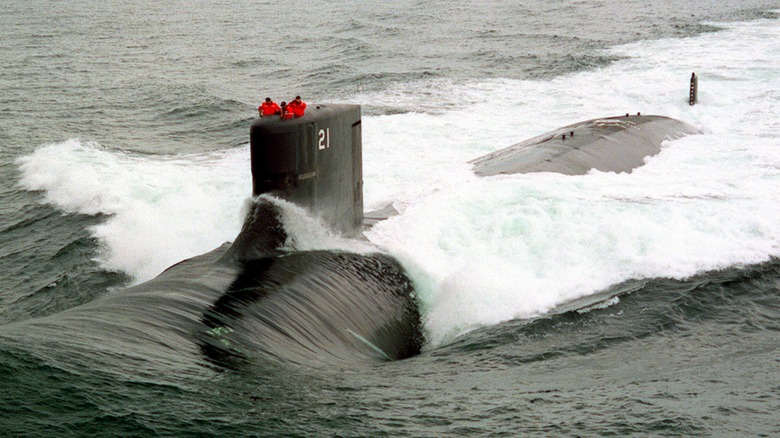
If there ever was a boat that embodies the notion, "Run silent, run deep," which is also the title of a 1958 film, it's the Seawolf-class. They are the fastest military submarines currently in operation, as they're able to reach a top submerged speed of 40 mph. The USS Seawolf and USS Connecticut (SSN-22) displace 9,137 tons of seawater when submerged, but the USS Jimmy Carter (SSN-23) is significantly larger; The boat was extended by 100 feet, measuring a total of 453 feet in length
and It displacing 12,151 tons of seawater when submerged, though all three boats have the same diameter of 40 feet.
What makes the class so beneficial to the Navy is its sound, as in they don't make a lot of it. Their onboard systems operate incredibly quietly, making them difficult to pick up on sonar. For this reason, Seawolf-class submarines are sometimes compared to the F-22 Raptor, as they both are difficult to detect and are packed with weapon systems. The subs can carry up to 50 weapons in a mix of UGM-109 Tomahawk cruise missiles, Mark 48 Torpedoes, and Harpoon anti-ship missiles.
While the fleet continues to operate its three Seawolf-class submarines, the bulk of the fleet consists of newer Virginia-class boats. These too are expensive, costing around $3.2 billion for the latest Block V version, though that's in 2025 dollars. The Navy plans to retire its Seawolf-class subs, beginning with the USS Connecticut, in 2031. The other two will likely follow sometime after that, ending the Seawolf-class submarines' operational time with the Navy.