

Six Ships Ranging From Medieval Times To The 1600s Found In 'Exciting' Discovery
Building a railway tunnel through somewhere as historic as Varberg in Sweden meant the authorities couldn't just send in the contractors straightaway. That's because Swedish law requires archaeological digs first in these sensitive zones, since careless digging could destroy valuable artifacts.
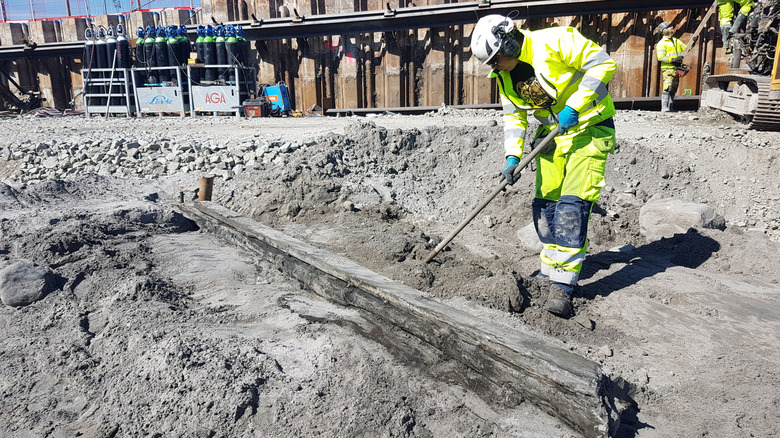
Case in point, a team of archaeologists and marine archaeologists from Arkeologerna, Bohuslän Museum, Visual Archaeology, and Cultural Environment Halland got to it. They started digging in 2019 and ended up finding a whopping six old ships over the next few years, with some dating way back to the Middle Ages.
The dig itself was part of the Varberg Tunnel project, a major undertaking that's taking the main stretch of rail and burying it under Varberg itself, similar to the E39 Ferry Free project in Norway. This is a 3 km (1.86 mi) stretch, which, after moving underground, will give the waterfront back to the locals and smooth out commutes. The area itself was once a harbor with defensive structures, so old vessels showing up there makes sense. The ships were all found buried in mud, and four of them are from the Middle Ages, while another dates back to the 17th century. The sixth is a bit of a mystery, though, since the team couldn't pin down its age.
The crew detailed their findings in a report, as reported by the Swedish Arkeologerna – though the initial version only covers three of the wrecks. Out of these, the second wreck got the most thorough look since it was the best preserved. Wrecks five and six, on the other hand, had to be lifted out of the mud in a hurry due to the tight schedule of the tunnel construction, and they weren't in great shape.
A ship may have been set on fire on purpose
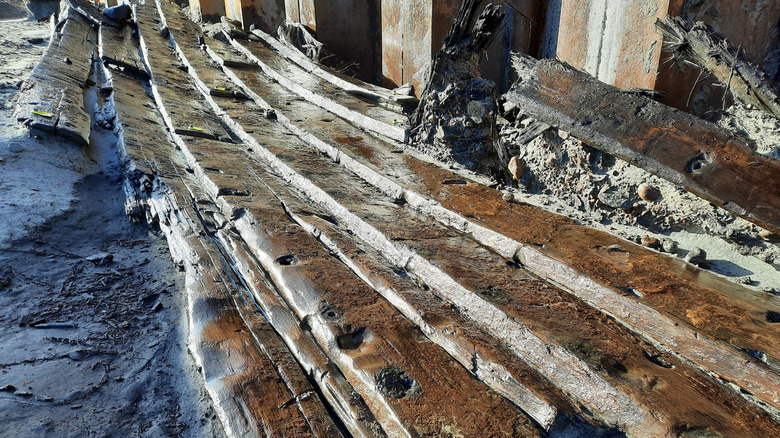
The second wreck was also the most interesting of the bunch, and a significant section of the ship was found in one piece. Overall, two starboard hull sections, a bunch of scattered timbers, and a berghult – a wooden strip bolted to the outside of the hull, mainly there to take a beating when the ship pulls up to a quay – were fished out.
The ship itself dates back to the late 1530s, putting it roughly in the same window as France's deepest shipwreck. It's made out of oak from the Halland and West Sweden timber stock. It's also built clinker-style, meaning the planks overlap at their edges rather than sitting flush. Perhaps the oddest bit about the whole ship is the burn marks on that berghult. The team reckons that the whole thing went up in flames before sinking, if it wasn't intentionally torched.
Then there's fifth wreck, which has plenty in common with the second one. Even though it was built about a century later in the 1600s, it uses the same kind of oak. This one probably worked the waters around Varberg and nearby Ny Varberg, another medieval city in the area, and likely sailed through the Baltic Sea too. Those are the same waters where another historic Navy shipwreck broke through the surface after 400 years under the sea. The final one in the report is Wreck 6, and it's the odd one out. It's a caravel-style vessel, meaning the planks sit edge to edge against the frame instead of wrapping around.
The thing is, with large infrastructure projects popping up along Sweden's West Coast, it's likely that even more preserved shipwrecks will be unearthed in the region. After all, this area has served as a port for centuries.