

Why Automakers Abandoned These Popular Windshields During The 1960s
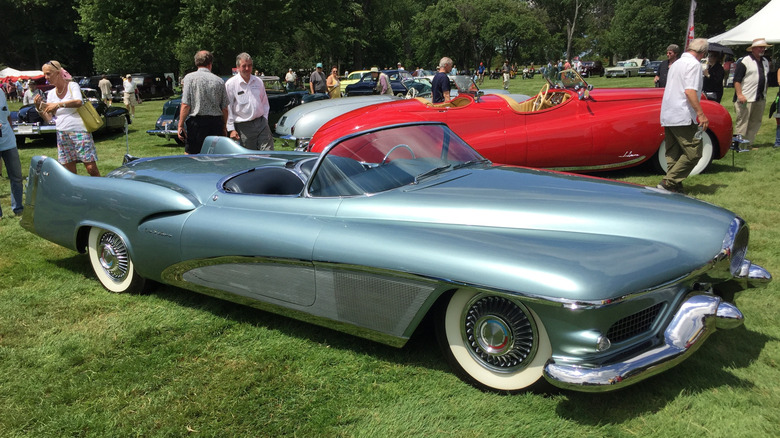
The year was 1951. New York Yankees star Joe DiMaggio announced his retirement from baseball. Universal Automatic Computer (UNIVAC), the first commercial digital computer, entered service at the U.S. Census Bureau. And Harley Earl, the legendary head of automobile design at General Motors, created the concept for the 1951 GM Le Sabre, the vehicle credited with introducing the wraparound windshield. Earl was very familiar with concept car design, as he was the man who created the ahead-of-its-time Buick Y-Job concept in 1938.
Earl's goal with the wraparound windshield was to reduce the driver's blind spots while giving passengers a more panoramic view. He drew inspiration from the bulbous canopies of new-age jet fighters and was only able to implement the idea once technology made it possible. Still, in those early days, bending glass was a laborious and costly effort. It first had to be heated to a perfect state between a solid and a liquid, then carefully draped over a steel form, where gravity naturally curved the glass. The effort was worth it, though: it turned out well enough for GM to start offering it on its 1953 models, and several other automakers soon followed suit.
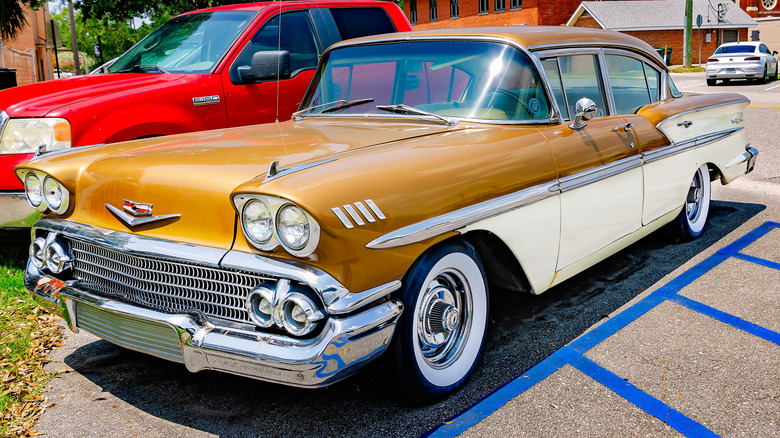
However, by the early 1960s, the wraparound fad had fizzled out, mainly due to problems with the "dog-leg" pillars used to fashion the wraparound effect. Not only did the slanted pillars make it more difficult for people to get in and out of the car, but the curved portions actually distorted the driver's view. What's more, the wide expanse of glass created unbearable heat inside the cabin, while the thinner pillars proved structurally unsafe and offered little protection in an accident.
Panoramic windshields were a fad
Harley Earl had become so renowned by the 1950s that, when he did something, the rest of the industry sat up and took notice. Earl is credited with everything from establishing industry standards still used today to creating the Corvette and putting tailfins on Cadillacs. Such was the case with his wraparound windshield, which fit in perfectly with the trend of automakers mimicking jet plane features and slapping them onto their vehicles.
Chrysler, however, went a different way, opting for a design that echoed that of the 1948-1954 Hudson. The automaker's windshield retained the slant and panoramic view, but didn't have the same safety issues as GM's "dog-leg" pillars. The result, according to an issue of "Motor Life" magazine from 1954 (via Indie Auto), was a windshield that didn't really look much like a traditional wraparound one from the outside, but still offered great visibility with much less distortion. The design was a hit with safety-minded folks, though, even if it still had some optical distortion.
Excessive heat remained a key issue with massive windshields of any sort, mainly because air conditioning hadn't yet become widely adopted. While it had become a common option by the mid-1950s, uptake was slow: even in 1965, fewer than one-quarter of all new automobiles had the costly feature. On top of that, vehicle safety was becoming a growing concern by the late '50s, and the thin, slanted "dog-leg" A-pillar wasn't as strong as old-school versions. Ultimately, the wraparound panoramic windshield proved too problematic (and costly), forcing the industry to ditch the whole concept.