

Sony's AI Robot Took On Human Table Tennis Pros – Here's Who Came Out On Top
To reach an elite level in any sport, athletes need to combine split-second reaction times with a deep knowledge of playing techniques and a high level of physical agility. Take, for example, table tennis, where if a player loses track of the ball for even the smallest amount of time or misjudges its trajectory, they'll lose the point. Table tennis has been used as a way to test the capability of robots for a while now, but in a new study published in the journal Nature, Sony has detailed how it built what it calls the first robotic system that can compete with elite-level table tennis players.
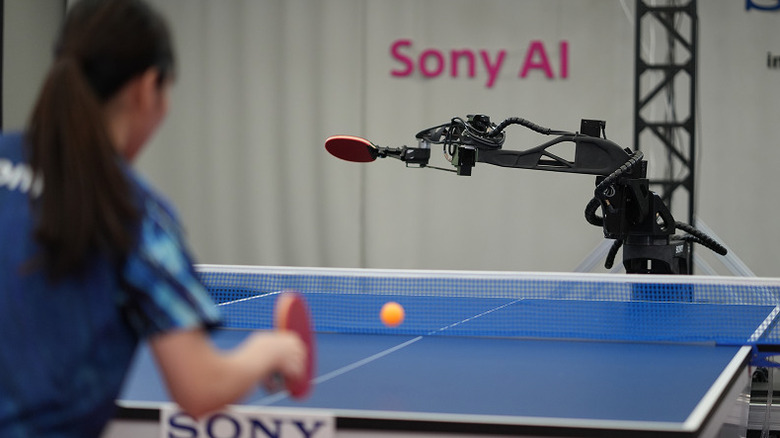
In the study, Sony pitted Ace, its table tennis-playing robot, against five elite-level athletes and two professional athletes. It defined elite athletes as those with more than a decade of playing experience who participated in regional or national table tennis championships in Japan. A step above those players were the professional athletes, who both compete in the Japanese professional table tennis league. In the initial study, the robot managed to win seven out of 13 games it played against elite-level athletes, but it only won one out of seven games against the professionals.
The robot didn't need special treatment
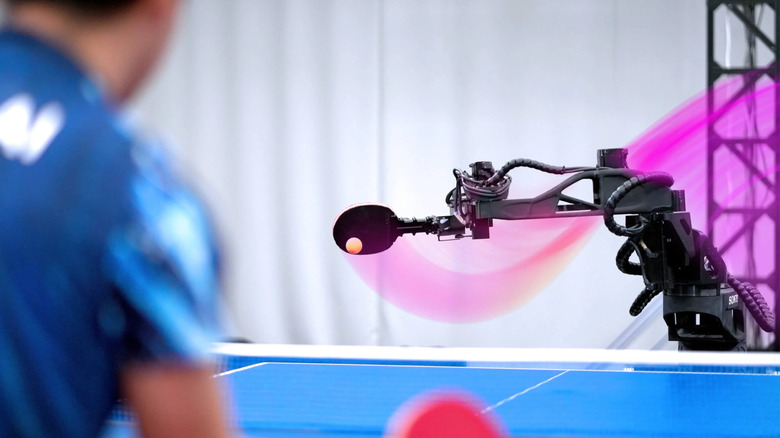
Previous studies involving robot table tennis players have seen the rules of the game tweaked to suit the capabilities of the robot, but Sony's Ace robot played according to standard Japanese competitive table tennis rules. The tournament even featured a pair of professional umpires to officiate each match.
Although it proved to be competitive, researchers found that there were a few key differences between the playing styles of a human competitor and the playing style of the AI bot. Humans scored points against the robot mostly by playing a similar type of shot — high-speed shots with top spin — while the robot scored points using multiple different techniques. Winning shots played by humans also tended to be stronger than their average shot, while the robot's winning shots weren't much different from its average ones.
Despite it potentially being a great way for human players to improve their game, Sony's Ace robot isn't going to be available to buy on Amazon anytime soon. It has been primarily created as a test bed for AI development, and its makers continue to improve it.
Sony has continued to improve its Ace robot
Studies published in academic journals often take months to come out thanks to the strict pre-publication review requirements. Although this article was published in April 2026, the initial tests took place a full year earlier. In the intervening months, Sony says that it has refined its robot, making it even more competitive. It pitted Ace against four new players, two being elite-level and two being professionals, in December 2025. In that tournament, the robot managed to win against three out of four players, losing only to one professional opponent.
Winning table tennis matches might be impressive, but on its own, a table tennis-playing robot is of limited use in the real world. However, Peter Stone, chief scientist at Sony AI, says that the "breakthrough is much bigger than table tennis," because it represents "the first time [...] an AI system can perceive, reason, and act effectively in complex, rapidly changing real-world environments that demand precision and speed." That could help researchers develop more effective AI-powered robots far outside the world of sports.
Sony's Ace robot was limited in mobility to the confines of a table tennis court, but other robotics companies have been making waves in other, less confined sporting disciplines. Earlier in 2026, a humanoid robot completed the Beijing half-marathon, beating the human record time in the process. Not every new AI debut has been so successful, though, with a Russian AI robot recently taking a dive moments after its stage debut.