

A Humanoid Robot Raced In The Beijing Half Marathon And Did More Than Just Win
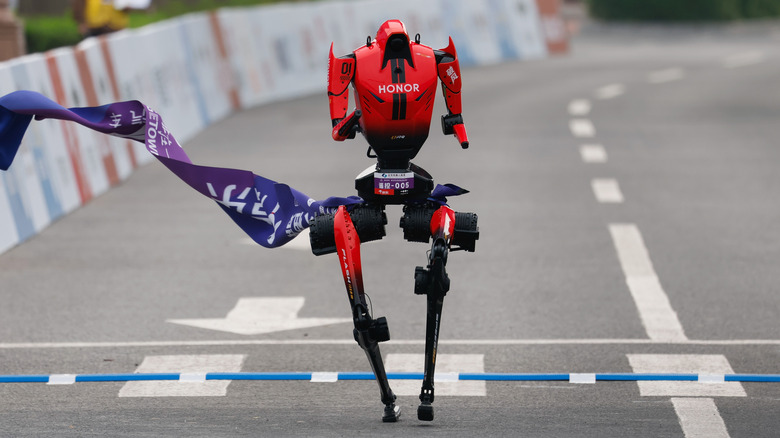
Humanoid robots have become increasingly common, with companies pushing further into the technology — especially in China, where these creations are making notable progress in multiple ways. One of China's humanoid robots survived a solo expedition in -53 degrees Fahrenheit, while another company's robot has made waves in the world of athletics. This robot, from the smartphone company Honor, took part in a half-marathon and left its robot competitors and human rivals in the dust on the way to a record-setting time.
As reported by NBC News, Honor's autonomous humanoid robot, dubbed Lightning, placed first in the 13-mile Beijing E-Town Half-Marathon in China, which features robots and humans running in parallel lanes. In addition to being the first-placed robot finisher (with two other Honor robots comprising the top three), it completed the race in 50 minutes and 26 seconds — significantly quicker than any human has run a half-marathon. For reference, the current world record is 57 minutes and 20 seconds, which Jacob Kiplimo set at the 2026 EDP Lisbon Half Marathon.
On paper, this seems like a major step forward for robotics, and to some degree, it is. At the same time, some are skeptical of Lightning and similar bots, questioning if the level of hype behind them is warranted.
Should we be impressed with Lightning's marathon performance?
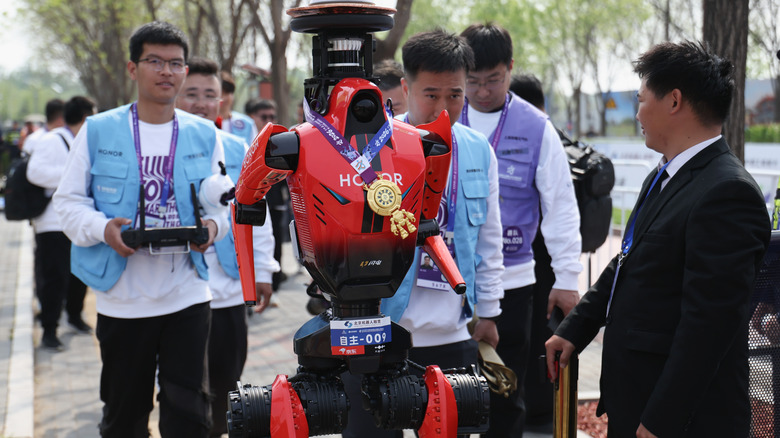
Much of the reason Honor's Lightning robot and its half-marathon run are making headlines comes from its engineering. Lightning and most of the other bots held up much better than in the 2025 race, with most successfully navigating the course without crashing or running into onlookers. However, the operative word there is "some," meaning there are still areas for improvement. As impressive as Lightning may seem, the likes of iRobot co-founder and Massachusetts Institute of Technology professor Rodney Brooks believe that the success of this autonomous robot has been blown out of proportion.
Speaking to Scientific American, Brooks claimed the Lightning run isn't nearly as wondrous as it's made out to be, because the robot doesn't engage in the same level of thinking as a human during a marathon. "There's no ability to interact with the world because it's all pre-mapped," he told the publication, going on to question: "How many support people did [the robots] have? How many vehicles followed them?" While he notes that Lightning performed well on a technological level, it lacks the human competence that makes next-level athletic feats so incredible.
China's humanoid robots can do a lot, and Lightning managing to finish a half-marathon is indeed something to marvel at. With that said, there's still more work to be done, as they are yet to achieve the sort of humanlike autonomy that would make their feats all the more applause-worthy.